
If you are weighing fractional digital team vs marketing retainer, you are probably not looking for “more marketing”. You are looking for momentum, clarity, and a clear line between effort and outcomes.
Table of Contents
Both models can work. The problem is that they solve different problems, and many business owners buy one when they actually need the other. This guide breaks down fractional digital team vs marketing retainer in practical terms so you can choose the right fit for your stage, team, and goals.
Fractional digital team vs marketing retainer: the simplest definition
A traditional marketing retainer usually means you pay a monthly fee for a defined set of marketing services or outputs, often focused on one or more channels.
A fractional digital team at VVRapid can be a single fractional lead who plugs in part-time to provide senior direction, prioritisation, and accountability. That lead can implement directly in some areas and coordinate specialists or your existing team when needed.

So in fractional digital team vs marketing retainer, the key difference is often this:
- Retainer: consistent channel activity and deliverables.
- Fractional: consistent leadership, prioritisation, and a system that ships improvements tied to outcomes.
If you want a service overview, start here: Fractional Digital Team
Why this decision matters (especially for busy owners)
When the wrong model is chosen, you usually see one of these patterns:
- Lots of activity, but your website and funnel do not improve.
- Reports arrive, but decisions still feel like guesswork.
- Everyone is busy, but nothing ships consistently.
- You keep switching strategies because results feel unclear.
This is why fractional digital team vs marketing retainer is not a “which is cheaper” question. It is a “which reduces risk and increases progress” question.
What you actually buy in a marketing retainer
In many retainers, you buy:
- A monthly bucket of hours, or
- A set list of deliverables, or
- A channel-specific service package
That might look like:
- X social posts
- X blog posts
- X ad management tasks
- A monthly report
- Occasional landing page suggestions
A good retainer can be great when:
- You already know your positioning and offers are solid.
- Your website converts reasonably well.
- Tracking is clean enough to judge what is working.
- You want consistent, channel-specific execution.
A retainer becomes frustrating when you need cross-channel prioritisation, website conversion work, technical fixes, and measurement clarity, but the scope is limited to “marketing tasks”.
What you actually buy in a fractional digital team
In fractional digital team vs marketing retainer, fractional work usually centres on ownership and decision-making.
You buy:
- A senior person who drives priorities.
- A monthly operating rhythm that keeps work moving.
- Coordination across moving parts like website, SEO, content, tracking, and conversion.
- A focus on outcomes, not just outputs.
A good fractional lead will:
- Identify what matters most this month.
- Turn that into a short, realistic plan.
- Ship improvements weekly, either directly or via coordination.
- Review performance and adjust the plan.
If you need a defined plan first, VVRapid’s roadmap service is a logical starting point: Digital Strategy Roadmaps
Fractional digital team vs marketing retainer: the 7 real-world differences
1) Strategy ownership
- Retainer: strategy may exist, but is often separate from delivery.
- Fractional: strategy and delivery are linked through one owner.
If you have ever said “we have a strategy but nothing changes,” fractional digital team vs marketing retainer often points toward fractional.
2) Prioritisation
- Retainer: deliverables continue even if priorities shift.
- Fractional: the plan changes when the data and business needs change.
Good growth is usually about choosing fewer things and doing them well.
3) Website and conversion focus
- Retainer: may treat the website as a landing place, not a conversion system.
- Fractional: usually treats the website as a product that gets improved continuously.
If your site needs consistent improvements, fractional digital team vs marketing retainer tends to favour fractional leadership, often alongside dev support.
Website support options:
4) Measurement and decision clarity
- Retainer: reporting is common, but measurement quality varies.
- Fractional: measurement is part of the system because it drives priorities.
Useful references if you want to sanity-check measurement basics:
If your tracking is messy, fractional digital team vs marketing retainer can be the difference between guessing and managing.
5) Cross-channel coordination
- Retainer: great for a channel, weaker across channels.
- Fractional: stronger at aligning multiple moving parts.
This is important when your growth depends on SEO, content, conversion, and website performance working together.
VVRapid’s SEO service page for context: Search Engine Optimisation
6) Speed of shipping improvements
- Retainer: can drift into “monthly cycles” where changes happen slowly.
- Fractional: should aim for weekly shipping, even if small.
A good rule: if nothing meaningful changed in a month, the system is broken.
7) Accountability model
- Retainer: accountability is often “we delivered the agreed outputs.”
- Fractional: accountability is “we moved the business forward and can explain why.”
This is the heart of fractional digital team vs marketing retainer.
Which one should you choose right now?
Here is a practical decision framework for fractional digital team vs marketing retainer.
Choose a marketing retainer if:
- Your offers and positioning are stable.
- Your website converts well enough.
- Tracking is reliable.
- You want consistent execution in specific channels.
- Your internal team can set priorities and manage the agency.
Choose a fractional digital team if:
- Priorities feel unclear and you need a steady plan.
- Your website and funnel need ongoing improvement.
- You are not confident in your tracking and reporting.
- Execution gets stuck because no one owns cross-channel decisions.
- You want less owner involvement in coordination.
If you are stuck between the two, start by asking: “Do I need more execution, or do I need better decisions and coordination?” That question usually resolves fractional digital team vs marketing retainer quickly.
A realistic hybrid model (often the best answer)
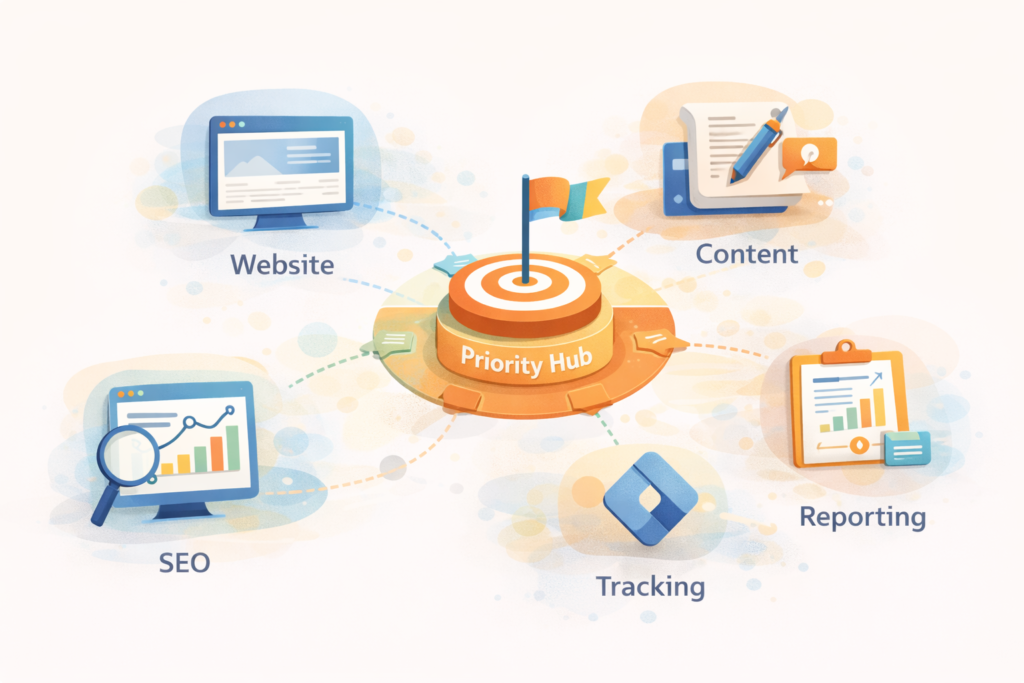
In practice, many businesses do best with a hybrid:
- A fractional lead sets priorities, aligns teams, and reviews performance.
- A retainer or specialist support executes channel work at a steady pace.
For example:
- Fractional lead drives the monthly plan and conversion priorities.
- SEO execution runs consistently (Search Engine Optimisation).
- Content production happens on a schedule (Socials, Blogs & Article Writing).
- Maintenance keeps the site stable (Essential Website Maintenance & Care).
This hybrid approach keeps the “doing” consistent while making sure the “doing” is the right doing.
The checklist: questions to ask before you sign anything
Use this checklist to stress-test fractional digital team vs marketing retainer for your business.
- □ Who owns prioritisation each month?
- □ What happens when priorities change mid-month?
- □ How will we measure lead quality, not just lead volume?
- □ What website improvements will ship monthly?
- □ What is the plan for fixing tracking or attribution gaps?
- □ How will content connect to offers and buyer intent?
- □ Who coordinates between marketing, website, sales, and ops?
- □ What does success look like in 90 days, realistically?
- □ What will we stop doing if it is not working?
If you cannot get clear answers, you will likely feel the pain later.
Common mistakes when comparing fractional digital team vs marketing retainer
Mistake 1: Buying deliverables when you need direction
If you do not have clarity, more posts or ads will not fix it.
Fix: choose a model that includes prioritisation and accountability. That usually points to fractional digital team vs marketing retainer in favour of fractional leadership, at least initially.
Mistake 2: Expecting a retainer to fix the website
Many retainers do not include ongoing website improvements or conversion work.
Fix: ensure website conversion work is in scope, or pair execution with a fractional lead and a dev pathway.
Mistake 3: Accepting reports instead of decisions
A report without a clear “so what” does not help.
Fix: insist on a monthly review that turns data into next actions.
Mistake 4: Measuring only traffic and impressions
Vanity metrics can look great while revenue stays flat.
Fix: track conversions, lead quality, and sales outcomes.
Mistake 5: Spreading effort across too many channels
When everything is a priority, nothing ships.
Fix: choose a small set of levers and run a steady rhythm. This is where fractional digital team vs marketing retainer often becomes a question of leadership, not marketing.
What to expect in the first 30 to 60 days with a fractional lead
If you choose the fractional side of fractional digital team vs marketing retainer, your early wins often look like:
- Cleaner tracking and better visibility.
- A clear “Now, Next, Later” plan.
- Key page improvements that reduce friction.
- A content plan that supports offers, not random topics.
- Faster iteration because priorities are clearer.
SEO compounding takes time, but conversion and clarity improvements can show sooner when the right pages are improved consistently.
For SEO fundamentals, this is a helpful reference:
How VVRapid can help
If you are comparing fractional digital team vs marketing retainer and want a calmer, more accountable operating rhythm, VVRapid’s Fractional Digital Team can plug in as a part-time senior lead. The focus is to set priorities, keep work moving, and align your website, SEO, content, and tracking with outcomes you can measure.
Learn more here: Fractional Digital Team
FAQ
Is fractional digital team vs marketing retainer an either-or decision?
Not always. Many businesses use a fractional lead for direction and accountability, plus retainers or specialists for execution.
What if I already have an agency retainer?
A fractional lead can complement it by setting priorities, improving measurement, and ensuring the work aligns to business outcomes.
What if I only need SEO?
If you have clear goals and good site foundations, an SEO service may be enough. If priorities are unclear or the site needs conversion work, the fractional model can help align everything.
How do I know if my retainer is working?
You should see consistent shipping, improved clarity, and measurable movement in leads, conversion rate, or revenue indicators over time.
Does a fractional lead replace my internal team?
Usually not. A fractional lead makes your team more effective by reducing confusion, setting priorities, and coordinating work that would otherwise stall.