
If you want rankings that turn into enquiries (or sales), on-page SEO keywords aren’t about sprinkling phrases everywhere. They’re about matching one clear search intent to one clear page – then making that page easy to understand, easy to trust, and easy to act on.
Table of Contents
What “on-page SEO keywords” really means (and what it doesn’t)
Let’s simplify.
On-page SEO keywords = the way you align page purpose + search intent + page elements (headings, copy, internal links, titles, images) so Google and humans immediately “get it.”
It’s not:
- stuffing one phrase into every heading
- writing for robots
- changing meta titles every week hoping for magic
Google’s own SEO guidance consistently comes back to the same idea: make pages helpful, clear, and structured so search engines can understand them and users can complete their task.
If you want this done with you (or for you), VVRapid’s SEO work includes on-page optimisation, internal linking, and ongoing tweaks: Search Engine Optimisation
The framework: map keywords to pages (before you “optimise” anything)
The biggest win in on-page SEO keywords is preventing a common issue: two pages trying to rank for the same thing (keyword cannibalisation).
Step 1: pick 3–5 “money intents” your site must win

Examples:
- “accountant for small business”
- “plumber near me”
- “wedding photographer cape town”
- “b2b saas web design”
- “bookkeeping services pricing”
These are usually:
- service + location
- service + industry
- service + outcome
- product + category + “buy”
Step 2: assign ONE primary intent to ONE primary page
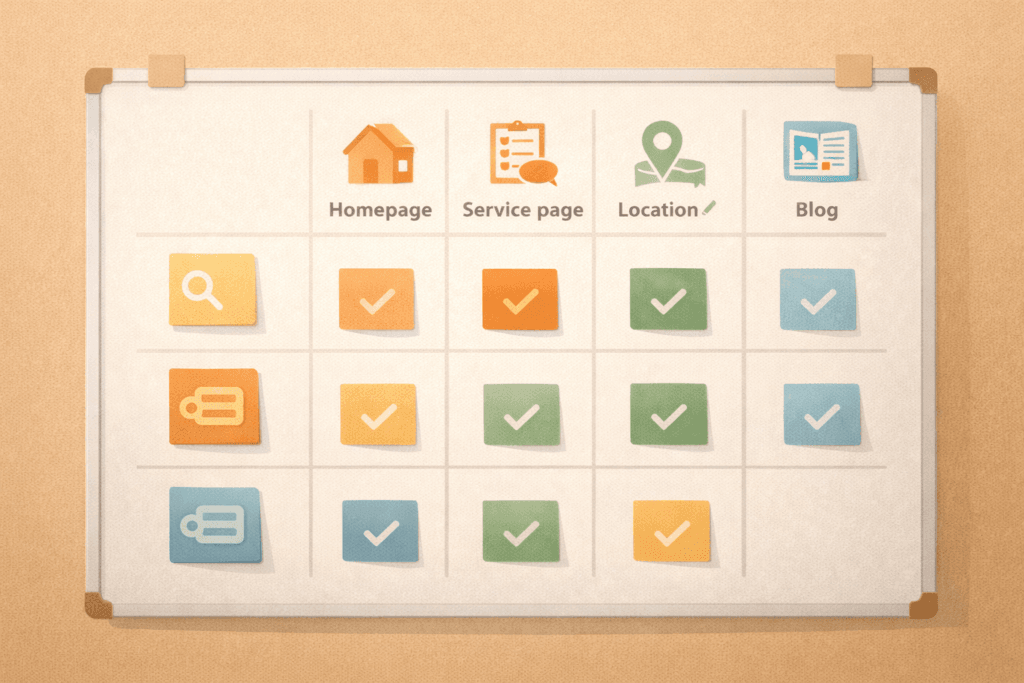
Think in page types:
- Homepage: broad brand + credibility + paths to key services
- Service pages: “I need X service” intent (core)
- Location pages (optional): “X in Y” intent (only if you genuinely serve multiple areas)
- About page: trust intent (“who are you and can I trust you?”)
- Contact page: conversion intent
- Blog posts: informational intent that supports service pages via internal links
This is the core of on-page SEO keywords: one job per page.
Page-by-page optimisation for services and local businesses
Below is the practical checklist, page by page. Use it as your template moving forward.
1) Your homepage: clarity beats cleverness
Your homepage usually won’t rank for all your services and that’s okay. Its job is to:
- confirm who you help
- explain what you do (simply)
- route visitors to the right next page
Homepage on-page SEO keywords essentials:
- One clear H1 that states what you do (not a slogan)
- Short intro paragraph that matches your primary positioning
- Links to your top 3–6 service pages
- Proof elements: FAQs, process, reviews, logos (if you have them), guarantees (only if real)
Internal linking tip: the homepage is your strongest internal link hub. Use it to push authority to service pages.
2) Service pages: the “rank and convert” pages
If your site is lead-driven, service pages are usually where on-page SEO keywords makes you money.
The service page structure that works (and stays readable)
H1: Primary service + qualifier
Example: “Small Business Tax Accounting” or “Emergency Plumbing Services”
Above the fold:
- Who it’s for
- What outcome they get
- 1–2 trust points
- A clear CTA (call / quote / book)
H2s to include (common pattern):
- What’s included (scope)
- Who it’s for (ideal fit)
- Your process (3–6 steps)
- FAQs (real questions you get)
- Pricing guidance (optional; don’t invent numbers)
- Related services (internal links)
This isn’t just copywriting. It’s on-page SEO keywords in action: Google and humans both see a page that is specific and complete.
Want a done-with-you or done-for-you approach? VVRapid’s plans include ongoing on-page improvements across key pages: LLM SEO Packages
3) Location pages: only build them if they’ll be unique
Location pages are powerful when they’re real. They’re harmful when they’re thin duplicates (“Service in City A / City B / City C” with the same text).
Use location pages if:
- you serve multiple areas
- you can add local proof (projects, reviews, photos, FAQs, service boundaries)
Location page on-page SEO keywords essentials:
- H1: service + location
- Local service area explanation (suburbs/regions)
- Local FAQs (parking, travel fees, response times, typical timelines)
- Internal links back to the main service page and related services
If your site is international (like VVRapid), you can still apply this logic by region, language, or audience segment – just avoid near-identical copies.
4) About page: it ranks less, but it converts more than you think
People click About when they’re close to deciding.
About page on-page SEO keywords essentials:
- What you do + who you do it for (in plain language)
- Your approach (how you work)
- Proof and credibility
- Clear links to services + contact
Don’t overthink keyword targeting here. The job is trust.
5) Contact page: remove friction
A contact page should be simple, fast, and reassuring.
Contact page essentials:
- One primary conversion action (form or booking)
- Alternative actions (email/phone/WhatsApp if applicable)
- What happens next (response time, required info)
- Links to relevant service pages for context
The content layer: blog posts that support service pages (without fluff)
This is where many small businesses get stuck: they blog, but they don’t connect posts back to revenue.
Rule of thumb for on-page SEO keywords in blog posts:
- Each blog post should naturally point to one related service page.
- Use internal links where a reader would genuinely want the next step.
If you want support here, VVRapid has content packages designed to pair with SEO (useful when you want consistent, keyword-informed writing without doing it all yourself): Socials, Blog & Article Writing Category or STANDARD Content Marketing Package
The on-page SEO keywords checklist (copy/paste into your workflow)
Use this checklist for every “important” page (homepage, service pages, location pages, top blog posts).
- Intent
- One primary goal for the page (lead / sale / info)
- One primary query it should answer
- Keyword mapping
- One primary phrase + 2–5 close variants
- No other page targets the same primary phrase
- Title tag
- Clear, not clever; includes primary phrase naturally
- Meta description
- Matches intent; sets expectation; includes primary phrase naturally
- Headings
- One H1 (page topic)
- H2s that reflect real questions and sections
- Copy
- Clear first 100 words (who/what/for whom)
- Scannable bullets where helpful
- Real examples (without making up case studies)
- Internal links
- Links to related services/pages (2–6)
- Links out to supporting guides (1–3)
- Images
- Compressed
- Descriptive alt text (not spammy)
- Trust
- FAQs, proof, process, policies, contact clarity
- Technical basics
- Page loads fast enough on mobile
- No broken links
- No accidental “noindex”
This is the repeatable system behind on-page SEO keywords that doesn’t depend on hacks.
Common mistakes that waste on-page SEO keywords effort
1) Optimising before mapping
If you haven’t assigned intent to pages, you’ll optimise the wrong pages and compete with yourself.
2) Writing one “mega service page” for everything
When one page tries to rank for 12 services, it usually ranks for none.
3) Treating headings as design elements
Headings should communicate structure, not just look big. Clear heading hierarchy helps both readability and search engines.
4) Thin location pages
If you can’t make each location page meaningfully different, don’t build them yet.
5) Internal links that don’t help the reader
“Click here” everywhere is not a strategy. Link when it helps someone decide.
6) Chasing “perfect” keyword density
Focus on clarity and completeness. If the page answers the query well, your on-page SEO keywords will naturally appear.
A simple 30-minute “page refresh” routine (monthly)
If you can only do one thing consistently, do this:
- Pick one key page this month (service or location page)
- Check: is intent clear in the first 100 words?
- Add: one helpful section (FAQs / process / inclusions)
- Improve: internal links to/from that page
- Track: clicks and queries in Search Console (or your SEO tool)
Small changes compound when your on-page SEO keywords are mapped properly.
How VVRapid can help (calm, practical)
If you’d rather not DIY this, VVRapid can help you map on-page SEO keywords to the right pages, optimise your key pages (headings, copy, metadata, internal links), and keep improving performance with ongoing tracking and tweaks.
When you’re ready, start here: Request a Search Engine Optimisation Quote
FAQ: On-page SEO keywords for small businesses
How many keywords should one page target?
One primary phrase, plus a handful of close variants. If you need a totally different intent, it usually needs a different page.
Should I create a page for every service variation?
Only if it’s genuinely distinct and valuable. Otherwise you’ll create thin pages that dilute quality.
Do blog posts still matter for service businesses?
Yes, when they support service pages with internal links and cover real customer questions.
How long until on-page changes show results?
Often weeks, sometimes longer. The more competitive the niche, the more important consistency becomes.
Is this different for ecommerce?
Same principles, different page types (category pages and product pages replace service pages). Mapping intent still comes first.
Possible next step
If you want a clean, page-by-page plan (what to optimise first, what to leave alone, and what will actually move rankings), start with: Search Engine Optimisation