
An SEO content brief template helps you create service pages that are clear for humans and easy for search engines to understand. If your site is not getting the right enquiries (or any enquiries), the problem is often not “more keywords”. It is that the page does not match what people are searching for, and it does not give enough clarity or trust to convert.
Table of Contents
Why most service pages do not rank (even when they look good)
A service page can look professional and still struggle in search because it misses the basics of relevance and usefulness.
Here are the usual culprits:
- Intent mismatch: the page talks about your business, but the searcher wants an answer, proof, pricing context, or a clear next step.
- One page trying to do everything: “Services” becomes a dumping ground instead of focused pages for focused searches.
- Thin content: not enough detail to prove you actually do the work, or to help someone decide.
- Confusing structure: headings and sections do not map to what the reader needs to scan quickly.
- Weak internal linking: the page exists, but nothing points to it and it is not connected to related pages.
Google’s “people-first” guidance is a useful north star here: build pages to help users first, then apply SEO best practices on top.
When to use this SEO content brief template

Use this SEO content brief template any time you are building or rebuilding:
- A core service page (your money pages)
- A location service page (if you genuinely serve that area)
- A “supporting” service page (like audits, maintenance, consulting)
- A new service offering you want to validate with search demand
If you only have time to brief a few pages, start with:
- Your top revenue service
- Your easiest service to deliver consistently
- Your highest-margin service
- Your “door opener” service that leads to bigger projects
SEO content brief template (copy and paste)
This is the full SEO content brief template. You can paste it into a Google Doc or Notion and fill it out before writing the page.
1) Page goal and offer definition
- Service name (plain English):
- Who it is for: (industry, size, location, situation)
- Main job to be done: (what problem is solved)
- Primary conversion: (call, form, WhatsApp, booking)
- Secondary conversion: (download, quote request, email)
2) Primary keyword and intent
- Primary keyword: (one main phrase)
- Search intent: informational, commercial investigation, or transactional
- What the searcher expects to see: (bullet list)
- What would make them trust you: (bullet list)
Tip: keep the primary keyword tightly aligned to the service. Save variations for headings and supporting copy.
3) Page outline (recommended structure)
Use this structure to avoid waffle and improve scan-ability.
- H1: Service + outcome (clear, not clever)
- Intro: who it is for, what you do, what result they get
- Section: what is included (deliverables)
- Section: how it works (process)
- Section: timelines and what affects them
- Section: pricing approach (context, not fake numbers)
- Section: proof and trust (real examples, credentials, FAQs)
- Section: service area (if relevant)
- FAQ: 3 to 6 real questions
- CTA: simple next step
4) Proof and trust inputs (do not skip this)
- Real differentiators: (not “great service”, actual reasons)
- Who does the work: (team, partner, seniority)
- Tools or methods: (only if relevant)
- Constraints: (what you do not do, or who you are not for)
- Examples: (portfolio links, screenshots, anonymised outcomes)
- Reviews/testimonials: (only if real and approved)
5) Internal linking plan (pages to link to and from)
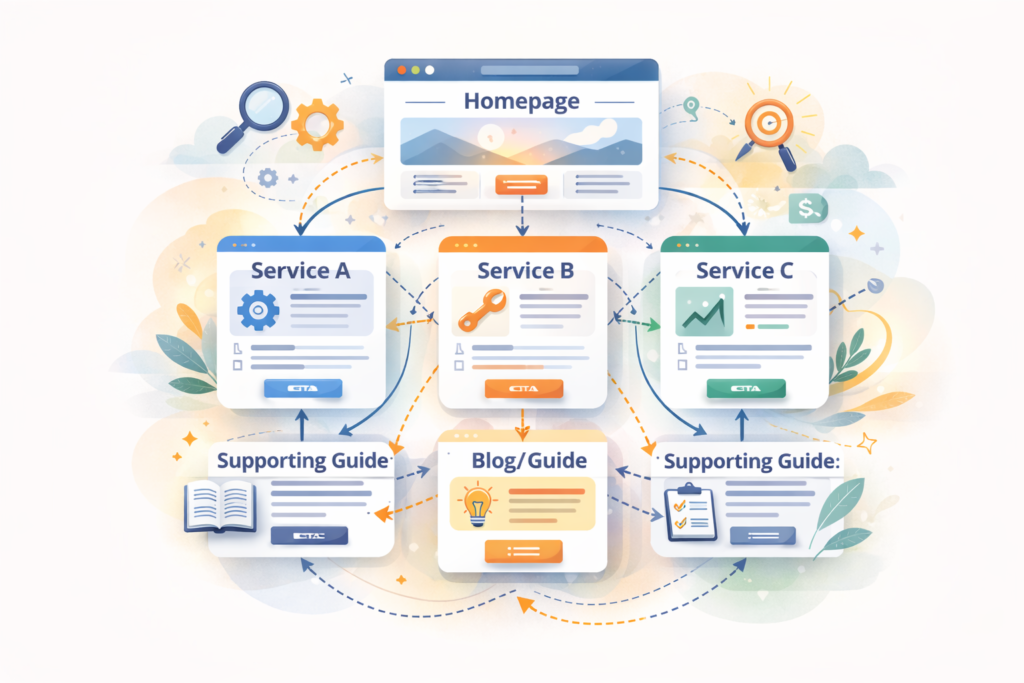
Write this before drafting. It forces a useful site structure.
- Links from this service page to:
- Related service pages
- Supporting guides (blog posts)
- Contact page or booking page
- Links to this service page from:
- Homepage
- Relevant blog posts
- Related service pages
Google’s guidance on link best practices is helpful for anchor text and crawlable linking.
6) On-page SEO essentials (light touch)
- Title tag idea: include service + outcome, keep it readable
- Meta description idea: benefit + who it is for + next step
- URL slug: short, includes primary keyword
- Image needs: 1 hero, 1 process, 1 proof (no text overlays if possible)
- Schema: FAQ schema only if you have real FAQs
Google’s documentation explains how title links work and what influences them.
7) Content quality checklist (before publishing)
Use this as a final pass:
- Does this page answer the query better than the top results?
- Is it obvious who the service is for?
- Is the offer clear in 10 seconds?
- Do you show proof or explain your process clearly?
- Is the next step frictionless?
This aligns with Google’s people-first guidance and self-assessment questions.
How to write the service page from the brief (without keyword stuffing)
Once your SEO content brief template is filled in, drafting is straightforward.
Start with clarity, not cleverness
Your first paragraph should do three things:
- Name the service
- Name the outcome
- Say who it is for
Example structure:
“[Service] for [type of customer] who need [outcome]. We handle [what you do] so you can [result].”
Use headings that match search intent
If someone searches “X cost”, your page should have a pricing context section.
If someone searches “X near me”, your page should clearly show service area and credibility.
Add “decision support” sections
These are the sections that convert:
- what is included
- what the process looks like
- what it costs (or what it depends on)
- what results are realistic
- what happens next
If you want your page to drive leads, these sections matter more than adding more keywords.
The service page section that most businesses skip: pricing context
You do not need to publish a price list if your work varies.
But you should still provide:
- what pricing depends on (scope, complexity, timelines)
- what the client needs to prepare
- the typical decision factors (budget vs speed vs quality)
- a simple next step to get an estimate
Keep it honest: “pricing varies by scope and region.”
Checklist: a service page built from your SEO content brief template
Use this checklist in WordPress before you hit publish:
- □ One focused service per page
- □ H1 matches the service and intent
- □ First screen explains who it is for and what they get
- Clear deliverables section
- □ Clear process section
- □ Pricing context section (even if no exact figures)
- □ Proof section (real examples, credentials, or clear methodology)
- □ 3–6 FAQs included
- □ Internal links added to related pages using descriptive anchor text
- □ Page has one obvious CTA
Internal links are a ranking and usability lever you control, and Google’s link best practices emphasise descriptive anchor text.
Common mistakes when using an SEO content brief template
Mistake 1: Briefing a page without a clear intent
If you cannot describe what the searcher expects to see, you will write a generic page.
Fix: write the “what the searcher expects” bullets first.
Mistake 2: Using one service page for multiple services
This is common with agencies, consultants, and trades.
Fix: split into separate pages when services have different intent and keywords.
Mistake 3: Over-optimising titles and headings
If your headings read like a list of keywords, you lose trust.
Fix: write headings for humans, then check they still communicate the topic.
Mistake 4: Ignoring duplication and canonical issues
If your site creates multiple URLs with similar content, search engines may choose a different canonical than you expect.
Google explains canonical URLs and how to consolidate duplicates.
Mistake 5: Publishing without internal links
A page that is not linked is often a page that is not prioritised.
Fix: add links from your homepage, related service pages, and at least one relevant blog post.
A simple internal linking map for service businesses
Here is a practical structure:
- Homepage links to your top 3–6 services
- Each service page links to:
- 1–3 related services
- 1 supporting guide (blog)
- contact or booking
- Each supporting guide links back to:
- the main service page
- one related service page
This creates a clear topical cluster without needing complicated SEO tactics.
If you are building out clusters over time, an example would be the VVRapid’s SEO service page would a good hub to link for our service content strategy.: Search Engine Optimisation
Example: turning one vague page into three intent-led pages
If you currently have a page called “Marketing Services”, it likely tries to rank for everything and converts poorly.
A better approach is three pages that match how people search:
- SEO services (transactional intent)
- Content writing services (commercial investigation)
- Digital strategy roadmap (higher-consideration buyers)
Then each page uses the same SEO content brief template, but targets different intent, proof, and CTAs.
The relevant internal pages on VVRapid can be linked while building this structure:
FAQ
Do I need a separate SEO content brief template for every service?
Yes, if the services are meaningfully different. A shared template is fine, but the filled content should be unique per service and intent.
How long should a service page be?
Long enough to answer intent, show proof, and make a decision easy. Many strong service pages land in the 800–1,800 word range, but it varies by industry and complexity.
Should I use FAQ schema on service pages?
Only if the page genuinely contains FAQs. Google documents FAQ structured data and notes it is not guaranteed to show as a rich result.
Can I use the same template for location pages?
Yes, but avoid copy-pasting the same content across locations. You need real differences: service area notes, proof, constraints, and local context.
What is the biggest win from using an SEO content brief template?
Consistency. You stop publishing vague pages and start publishing pages that match intent, build trust, and connect logically through internal links.
How VVRapid can help
If you want, VVRapid can turn your core offers into a structured set of service pages using an SEO content brief template, then support with SEO implementation, content writing, and ongoing maintenance so the pages keep improving over time. Start here: Search Engine Optimisation
and Website Maintenance & Care
Next step: review your most important service page against the template above, then update the brief before rewriting the page.