

Thought leadership articles are everywhere in 2026, yet most of them feel oddly the same: smooth, generic, and forgettable. The problem isn’t that people use AI tools. The problem is publishing content that reads like it was written for “everyone”, which means it lands with no one.
Table of Contents
If you’re a busy small business owner, you don’t need more “content ideas.” You need a repeatable way to produce thought leadership articles that sound like a real person with real experience and without spending your entire week writing.
What thought leadership articles are (and what they’re not)

At their best, thought leadership articles do three things:
- Clarify a confusing topic (especially when your customers are overwhelmed by options)
- Reduce risk for buyers (“Here’s how to think about this, and what to avoid”)
- Build trust by showing your experience, not just your opinions
What they’re not:
- A motivational rant with no actionable takeaways
- A “10 trends” post that could apply to any industry
- A long ad disguised as an article
Think: If your article could be published by any competitor with a quick find-and-replace, it’s not thought leadership.
Edelman’s research (with LinkedIn) has consistently found that strong thought leadership influences how B2B buyers judge competence and whether they explore a company further.
Why so many thought leadership articles feel “AI-ish” (even when they aren’t)
In 2026, readers have pattern-recognition fatigue. They’ve seen:
- The same “hook” lines
- The same tidy three-step frameworks
- The same vague advice (“focus on value”, “be consistent”)
- The same “balanced” tone that never takes a position
AI tools amplify these patterns because they’re trained on what already exists. If you give an AI a generic prompt, it gives you a statistically average result, which is exactly what your market is tired of.
This matters for search too. Google’s guidance is clear: it’s not “AI vs human,” it’s helpful vs unhelpful. Content should be people-first and genuinely useful.
The “human signal” checklist readers look for
When someone reads thought leadership articles, they’re subconsciously scanning for signs of reality:
- Specificity: named scenarios, constraints, trade-offs
- Experience: what you’ve seen happen (and what you do differently now)
- Decision support: how to choose, what to prioritise, what to skip
- Boundaries: what you don’t recommend (and why)
- Examples: not “case studies” you can’t prove, just believable mini-examples
- A viewpoint: a clear stance that isn’t extreme, but isn’t bland
These align with Google’s E-E-A-T concept (Experience, Expertise, Authoritativeness, Trustworthiness), a quality framework Google discusses publicly.
A repeatable structure for thought leadership articles (that sounds like you)
Use this structure for most thought leadership articles and you’ll avoid the “generic essay” trap.
1) Start with a real-world tension (not a trend)
Bad: “AI is transforming business.”
Better: “Most small teams want content that builds authority, but they can’t afford to publish fluff that damages trust.”
2) Explain the real cause (what’s actually happening)
Name the underlying issue: too many channels, too little time, too much sameness, unclear positioning.
3) Offer a practical model (simple and memorable)
A good model is easy to apply in a meeting, not just in an article.
Example: The 3 Layers of Human Content
- Layer 1: Facts & definitions (easy to AI-generate)
- Layer 2: Interpretation & trade-offs (needs expertise)
- Layer 3: Experience & judgement (needs you)
4) Give decision support (what to do Monday morning)
Include steps, checklists, and “if/then” guidance.
5) Close with a “next best action”
Not a hard sell. Just the logical next step (audit, outline, publish, update, get help).
How to use AI tools without losing your voice
AI can be useful in thought leadership articles, if you treat it like an assistant, not the author.
Use AI for:
- Outlining options (you pick the best one)
- Turning bullet points into rough paragraphs (you rewrite the key bits)
- Generating counterarguments (to sharpen your stance)
- Creating variations of headings (for scannability)
- Tightening clarity (“make this simpler, not longer”)
Avoid using AI for:
- Your viewpoint (it will average it out)
- Your experience (it will invent it unless you supply it)
- Anything that requires accuracy without sources (you still need to verify)
Google Search’s guidance about AI-generated content also emphasises focusing on helpfulness and avoiding content made primarily to manipulate rankings, regardless of how it’s produced.
The fastest way to sound human: interview-led writing (even if it’s just you)
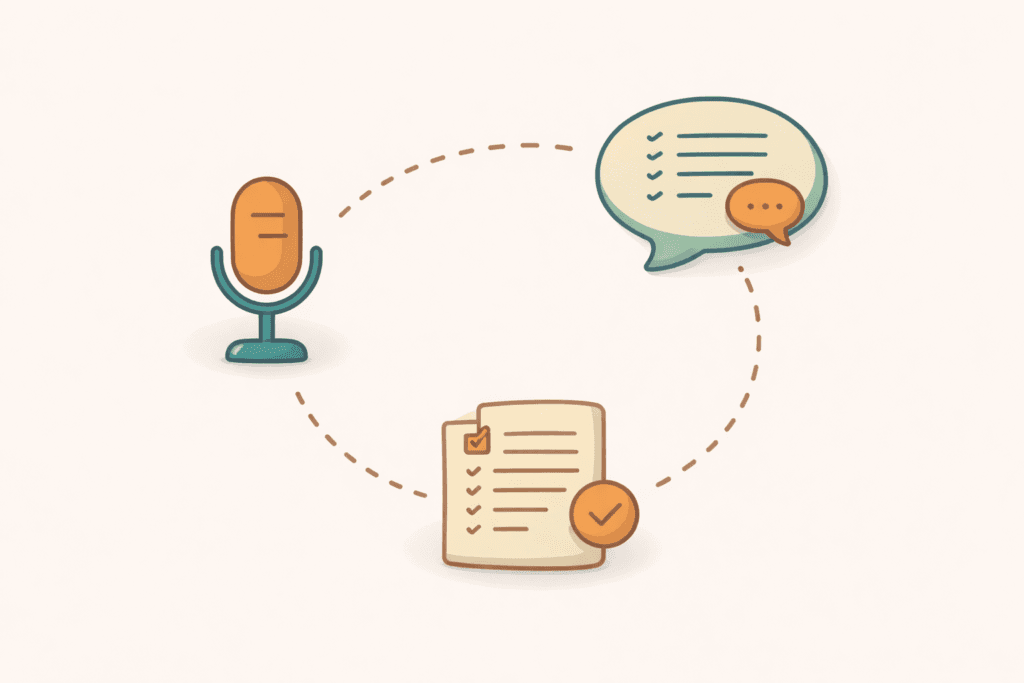
If you want thought leadership articles that sound unmistakably real, do this:
- Open a voice note (or hop on a 15-minute call with your writer)
- Answer 8–10 prompts (below)
- Turn those answers into the article
Interview prompts
- What are customers usually wrong about when they ask for this?
- What’s the common “cheap shortcut” that backfires?
- What do you never do anymore because you learned the hard way?
- What does a good result look like in plain language?
- What’s the trade-off nobody mentions?
- What would you do if you had half the budget? Double the budget?
- What’s the simplest starting point that still creates momentum?
- What’s one opinion you hold that you can defend calmly?
This is how you build “Experience” into thought leadership articles without writing a memoir.
Quality control checklist for thought leadership articles (publish-ready)
Before you publish, run this checklist:
- Is the viewpoint clear in one sentence?
- Did we include at least 3 specific examples or scenarios?
- Did we remove fluffy lines that say nothing (“in today’s world…”)?
- Are claims supported (by logic, experience, or reputable sources)?
- Is it skimmable? short paragraphs, strong headings, bullets
- Does it help a buyer decide (what to do / what to avoid / what matters)?
- Is the ending useful (a next step, not a pitch)?
If you’re posting on your site, also check:
- One primary topic per page
- Clear internal links to related services/pages
- A short FAQ at the end for quick answers and long-tail queries
Common mistakes that make thought leadership articles feel fake
Mistake 1: Writing for “everyone”
Fix: choose one reader and one decision they’re trying to make.
Mistake 2: Only sharing opinions
Fix: add “how we learned this” or “what we’ve seen” (without exaggerating).
Mistake 3: Over-polishing the tone
Fix: keep a few human lines. Not slang, just normal language.
Mistake 4: Turning the article into a brochure
Fix: keep the “how we help” section short. Let the content do the trust-building.
Mistake 5: Publishing without a content system
Fix: use an editorial rhythm (even 2 strong posts/month) and link them together into a hub over time.
(Content Marketing Institute puts it well: thought leadership is about resonance and credibility, not just chasing short-term lead metrics.)
What to publish (realistic thought leadership ideas for small teams)
Here are formats that we found work particularly well for thought leadership articles:
- “What we’d do differently” after a year in your market
- Buyer’s guide: how to choose between 3–5 options
- Trade-off post: “Speed vs quality” / “DIY vs done-for-you”
- Myth-busting: “What people assume about X (and what’s true)”
- Process clarity: “What working with us actually looks like”
- Teardown (kindly): “Why this common approach fails in practice”
If you serve South African clients (or any region with tight budgets and high expectations), trade-off articles perform especially well because they help buyers prioritise.
When to DIY vs outsource thought leadership articles
You should DIY if:
- You enjoy writing and can commit consistently
- You have a clear viewpoint and can support it with examples
- You can fact-check and edit ruthlessly
You should outsource if:
- Your expertise is strong but your time is not
- Consistency is the problem (not ideas)
- You want better structure, clarity, and SEO formatting
- You need interview-led writing to capture your voice
A good outsourced process still includes you, just not for the heavy lifting.
Where VVRapid fits (without making this complicated)
If you want thought leadership articles that feel human, the key is having a reliable system: topics, structure, voice capture, editing, and publishing rhythm.
You can explore VVRapid’s content options here: Socials, Blogs & Article Writing
And if you want something tailored to your brand voice and goals: Request a Custom Content Quote
(If your strategy also includes organic search growth, pairing content with on-page SEO work matters.)
How VVRapid can help (short + practical)
VVRapid can help you plan and produce thought leadership articles that sound like you: clear structure, interview-led insights, SEO-friendly formatting, and consistent publishing. If you’re starting small, a steady cadence keeps your brand visible. If you’re building authority, deeper articles and content hubs help you own a niche over time. See the content packages or request a quote when you’re ready.
When making a decision we recommend to take a look at the content packages and choose a cadence you can sustain or if you like feel free to Contact VVRapid
FAQ
Do thought leadership articles have to be long?
No. Many high-performing thought leadership articles land well at 900–1,400 words if they’re specific, structured, and genuinely helpful.
Will Google penalise AI-written content?
Google’s public guidance focuses on quality and helpfulness, not the tool used. People-first content matters most.
How do I make thought leadership sound like my brand?
Capture voice via short interviews, keep phrasing natural, and include real constraints, examples, and trade-offs.
What should we measure?
Look for: time on page, scroll depth, branded search growth, assisted conversions, and enquiries that reference the article. Thought leadership often builds momentum over time.
How often should we publish?
Consistency beats intensity. Even 2 strong thought leadership articles per month can compound if they’re linked and updated.
External references used (helpful resources)
- Google Search – Guidance about AI-generated content ↗
- Google Search – Creating helpful, reliable, people-first content ↗
- Edelman – Thought leadership gets B2B buyers back into the game ↗
- Content Marketing Institute – 5-step framework for genuine thought leadership ↗