
To repurpose blog content for social media, you do not need more ideas. You need a repeatable system that turns one useful article into a set of smaller, platform-friendly posts without sounding repetitive.
Table of Contents
If you are a busy small business owner, this approach is how you stay consistent without living on social media. You write one strong blog, then you slice it into bite-sized pieces that meet people where they scroll.
Why repurposing works (and why most people hate doing it)

Repurposing works because a good blog already contains the hard parts:
- the problem framing
- the logic and structure
- proof, examples, and takeaways
- a clear next step
When you repurpose blog content for social media, you are not “making more content.” You are distributing one idea in multiple formats so more of your audience actually sees it.
Why people hate repurposing is also simple:
- they copy and paste paragraphs into captions
- every post sounds the same
- they do not know what to pull out and what to leave behind
The fix is a map. If you follow a map, repurposing becomes batching, not creative pain.
What to choose as your source article
Not every blog is a great “repurpose engine.” Pick a post that has:
- one clear audience (for example: founders, ops managers, marketing leads)
- one clear outcome (what they can do after reading)
- 5 to 10 distinct points (steps, mistakes, examples, FAQs)
- at least one proof element (process, numbers, mini case, screenshots, quotes)
If you are not sure what to publish next, it often helps to start with the questions you hear repeatedly in sales calls, onboarding, support, or discovery meetings.
If you want VVRapid to help you build the right blog foundations first, Socials, Blogs & Article Writing is a good start.
Repurpose blog content for social media: the 12-piece repurpose map
This is the core system. Each “piece” is a social post type. You will create 12 posts from one blog, then schedule them across two weeks (or spread them across a month if you post less).
When you repurpose blog content for social media, your goal is variety. Different angles. Different hooks. Same core idea.
Piece 1: The one-sentence problem
Turn your intro into a single sentence the reader instantly recognises.
- Format: “If you are doing X, you are probably seeing Y.”
Example: “If your content feels random, it is usually because you are posting without a plan that your team can actually follow.”
Piece 2: The “what it is / what it is not” post
Great for B2B clarity.
- Format: “X is… X is not…”
Piece 3: The checklist
Pull a section of bullets and post it as a scannable list.
- Format: 5 to 9 bullets with a short setup line
Piece 4: The mistake spotlight
Pick one mistake and show the consequence.
- Format: “Mistake → what happens → the fix”
Piece 5: The myth vs fact
Perfect when you are correcting common assumptions.
- Format: “Myth: … Fact: …”
Piece 6: The mini framework
Extract your headings and turn them into a simple framework.
- Format: 3 steps, 4 pillars, 5 stages
Piece 7: The example
Use one example from the blog and expand it slightly.
- Format: “Here is how this looks in a real business…”
Piece 8: The objection handler
Answer a buyer objection.
- Format: “If you are thinking ‘but what about…’ here is the answer.”
Piece 9: The “before and after” story
B2B buyers love clarity about change and outcomes.
- Format: “Before: … After: … What changed: …”
No guarantees. Just describe process and results you can honestly explain.
Piece 10: The FAQ post
Pick one FAQ and answer it clearly.
- Format: question as the hook, short answer, one supporting point
Piece 11: The quote pull
Pull one strong line from the blog and build a short post around it.
- Format: quote + 2 to 3 lines of explanation
Piece 12: The CTA bridge post
Do not sell. Help people take a sensible next step.
- Format: “If you want to do X, start with Y. Here is the guide/service.”
When you repurpose blog content for social media, you rotate these formats so your feed feels varied, not recycled.
The two-week posting plan (example schedule)
Below is a simple two-week schedule for 12 posts. Adjust for your cadence.
If you post 3 times per week, this becomes a four-week plan. If you post daily, you can mix in extra engagement posts between these.
Week 1
- Mon: Piece 1 (one-sentence problem)
- Tue: Piece 2 (what it is / what it is not)
- Wed: Piece 6 (framework)
- Thu: Piece 4 (mistake spotlight)
- Fri: Piece 7 (example)
- Sat or Sun: Piece 10 (FAQ) if you post weekends, otherwise save for week 2
Week 2
- Mon: Piece 3 (checklist)
- Tue: Piece 5 (myth vs fact)
- Wed: Piece 8 (objection handler)
- Thu: Piece 9 (before and after story)
- Fri: Piece 11 (quote pull)
- Next Mon: Piece 12 (CTA bridge post)
This is the simplest way to repurpose blog content for social media without overthinking timing.
How to repurpose in 45 minutes (batch workflow)
Here is a practical batching process. You can do this monthly.
Step 1: Copy your blog into a working doc (5 minutes)
Paste the blog into a doc and add a heading: “Repurpose outputs.”
Step 2: Highlight the “pull zones” (10 minutes)
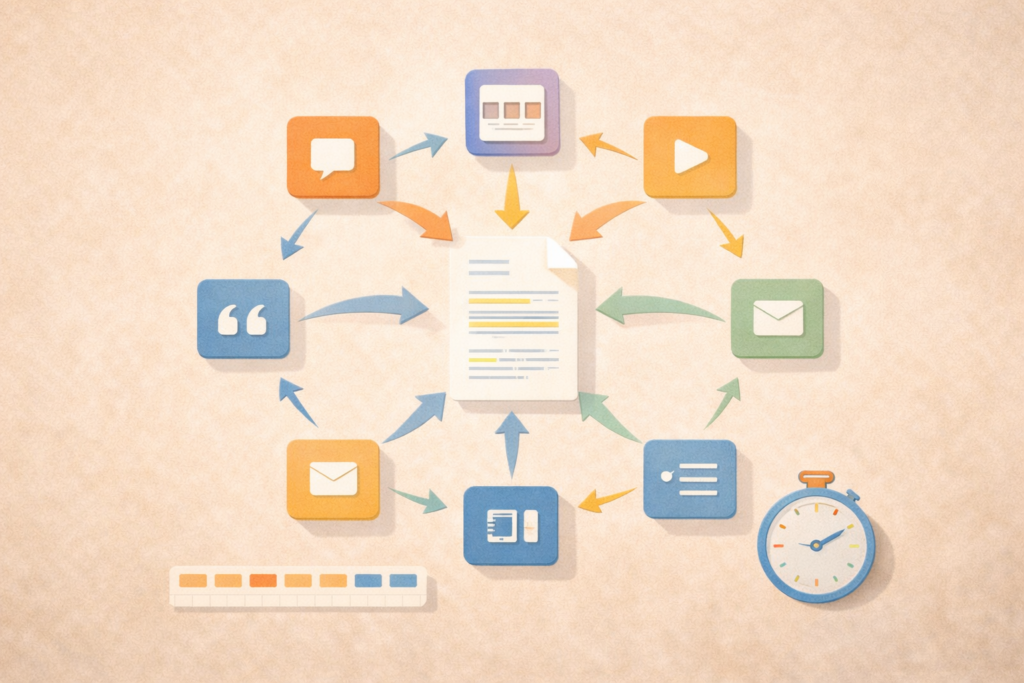
Highlight:
- intro problem statement
- all H2 and H3 headings
- bullets and checklists
- examples and mini stories
- FAQs and objections
- one strong closing paragraph
These are your raw materials.
Step 3: Fill the 12-piece map (20 minutes)
Create 12 short sections and write each post in plain language.
Helpful rule: one post equals one point.
Step 4: Add platform polish (10 minutes)
You are not rewriting. You are adjusting presentation.
- LinkedIn: short paragraphs, strong first line, 1 idea per post
- Instagram: carousel-friendly structure, shorter phrases, strong visuals
- Facebook: slightly more conversational, questions work well
- X: sharper hooks, tighter phrasing, threads for frameworks
Step 5: Schedule and move on (5 minutes)
Put it into your scheduling tool and stop touching it.
If your team struggles with workflow and consistency, VVRapid’s Fractional Digital Team can help manage the moving parts.
Platform tweaks that keep it from feeling copy-paste
When you repurpose blog content for social media, you can keep the idea the same but change the shape.
Try these simple tweaks:
- Change the hook: problem, mistake, myth, question, contrarian statement
- Change the order: start with the example, then the lesson
- Change the format: list, mini story, FAQ, framework
- Change the CTA: comment, save, read, share, DM, click
One blog can feed multiple buyer stages. That is the point.
A swipe file of post structures you can reuse
Save these. They make repurposing faster.
- “If you are seeing X, check Y.”
- “Here is the simple version: 3 steps…”
- “Most people do X. Here is why it fails.”
- “Stop doing X. Do this instead.”
- “A quick checklist before you decide…”
- “One example from a real project…”
- “FAQ: …”
- “If you only remember one thing: …”
This is how you repurpose blog content for social media without starting from scratch every time.
Checklist: repurpose blog content for social media without burning out
Use this checklist after your first repurpose batch.
- The source blog has a clear audience and outcome.
- Each social post covers one idea only.
- Hooks vary across posts.
- You used at least 6 different post formats.
- You included at least 2 posts that handle objections.
- You included at least 1 post that shares an example or proof.
- Your CTAs are helpful, not pushy.
- You scheduled everything in one session.
If you want your blog content to also support search visibility long term, VVRapid’s Search Engine Optimisation service will be able to assist.
Common mistakes when you repurpose blog content for social media
Mistake 1: Copying paragraphs into captions
That is not repurposing, that is shrinking.
Fix: pull the idea, rewrite the hook, keep one key point.
Mistake 2: Every post sounds the same
Same hook, same tone, same structure equals audience fatigue.
Fix: use the 12-piece map and rotate formats.
Mistake 3: No proof, no examples, no specifics
Generic content is easy to ignore.
Fix: add one example post and one objection post per batch.
Mistake 4: Posting with no “next step”
B2B content should guide action gently.
Fix: use one CTA bridge post at the end of the two weeks.
Mistake 5: Making the process too complicated
If it takes 3 hours per blog, you will stop.
Fix: limit yourself to 12 posts, schedule them, move on.
FAQ
How many social posts can I get from one blog?
A good target is 8 to 12 posts. The system in this guide gives you 12, which is usually enough for two weeks.
Should I change the wording for every platform?
You should adjust hooks and formatting, but you do not need to rewrite everything. Keep the idea consistent and change the shape.
What if my blog is short?
Short blogs still work if they contain clear points. If the blog is thin, add FAQs, examples, and a checklist first, then repurpose.
Do I need a newsletter too?
Not required, but newsletters work well for B2B because they build trust over time. One blog can also become one email summary.
How do I measure whether repurposing is working?
Look for saves, replies, DMs, clicks, and whether sales conversations start with “I saw your post about…” Those are trust signals.
How VVRapid can help
If you want to repurpose blog content for social media consistently without it eating your week, VVRapid can help with topic planning, blog production, and social post creation through Socials, Blogs & Article Writing. If you want content that compounds, pair that with Search Engine Optimisation so each blog also supports long-term visibility. For a connected plan across channels and priorities, Digital Strategy Roadmaps can help.
Next step
Pick one strong blog you already have and run it through the 12-piece map today. If you would rather have a team handle the writing and repurposing workflow, view VVRapid’s Socials, Blogs & Article Writing service and request a quote through the site.