

WordPress website maintenance is the quiet work that keeps your site secure, updated, backed up, and running smoothly. If your website brings in leads, bookings, or sales, it’s not a “nice-to-have” – it’s basic risk management.
A quick way to think about it: your website is software. And software needs care, even when it looks “fine”.
Table of Contents
What WordPress website maintenance actually includes

Most business owners assume maintenance means “updates”. Updates are part of WordPress website maintenance, but a good routine covers four areas:
1) Updates (core, plugins, themes)
- WordPress core updates
- Plugin updates (often where vulnerabilities appear)
- Theme updates
- Compatibility checks (updates can clash)
WordPress has docs on updating and managing plugin/theme updates if you’re curious about the mechanics.
WordPress Documentation – Updating WordPress → https://wordpress.org/documentation/article/updating-wordpress/
WordPress Documentation – Plugin & Theme Auto-Updates → https://wordpress.org/documentation/article/plugins-themes-auto-updates/
2) Security checks and hardening basics
Security isn’t just “install a security plugin and forget it”. Common maintenance security work includes:
- Checking for malware or suspicious file changes
- Reviewing admin users and permissions
- Monitoring for vulnerable/outdated components
- Basic hardening (safe logins, sane settings, safer file permissions)
If you want the official WordPress perspective, this hardening guide is a solid baseline.
WordPress Developer Handbook – Hardening WordPress → https://developer.wordpress.org/advanced-administration/security/hardening/
3) Backups and restore readiness
Backups are only useful if:
- They run reliably
- They include both files + database
- You can actually restore quickly
- You have clean restore points (not backups of an already-infected site)
4) Performance and uptime monitoring
Maintenance often includes:
- Uptime monitoring (know when the site goes down)
- Speed checks (especially after updates)
- Fixing bottlenecks (heavy plugins, database bloat, caching misconfig)
Google’s PageSpeed Insights is a decent starting point for spot-checking performance.
Do you really need WordPress website maintenance? (A quick self-check)
You probably need WordPress website maintenance if any of these are true:
- Your website is how customers find you (SEO matters).
- You run paid ads and landing pages.
- You take bookings, enquiries, or payments.
- Your site has multiple plugins (most business sites do).
- You can’t afford downtime during business hours.
- You don’t log into WordPress weekly.
- You’d struggle to restore a backup under pressure.
Think: If your website breaks on a Tuesday morning, do you know who fixes it, and how fast?
The real risks of “set and forget”
Security risk is the obvious one
Outdated plugins/themes are a common entry point for attacks. The WordPress ecosystem is large, and vulnerabilities do get discovered. That’s why WordPress website maintenance focuses on updates plus monitoring and safe rollout.
For broader context on common web security failure patterns, OWASP Top 10 is the industry reference.
Downtime and broken pages cost real money
A site can be “up” but still broken:
- forms stop sending
- checkout errors
- images don’t load
- layout breaks after a theme/plugin update
Performance creep is sneaky
Sites usually don’t become slow overnight. They become slow through:
- too many plugins doing overlapping work
- unoptimised images
- database bloat
- “temporary” scripts that never get removed
WordPress website maintenance is how you stop that drift before it affects conversions.
WordPress website maintenance checklist (simple, realistic, business-friendly)
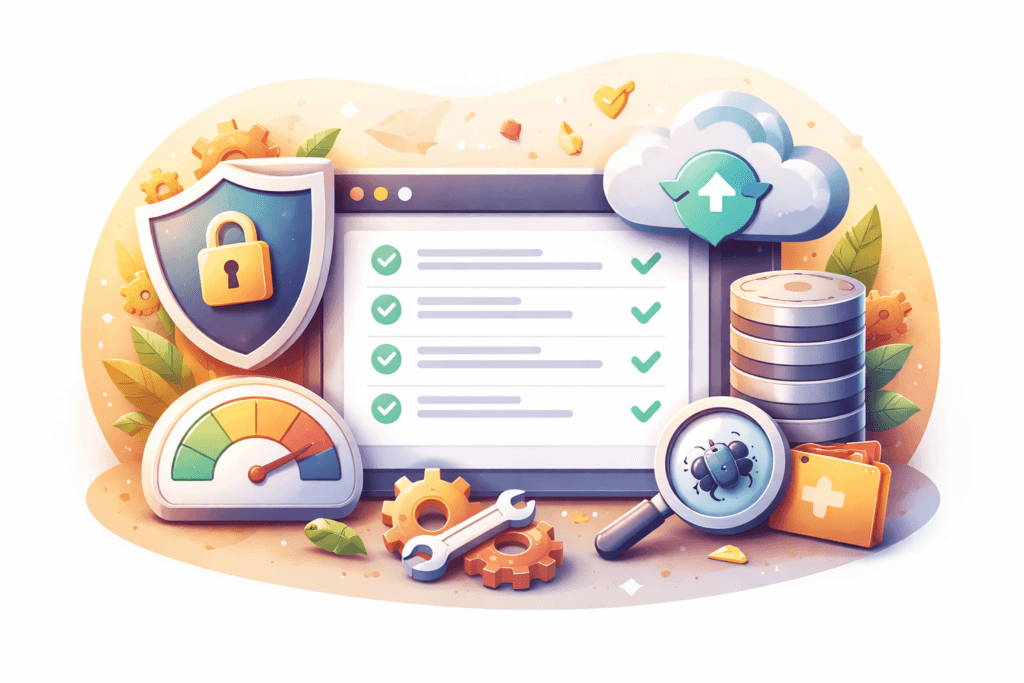
Here’s a schedule you can actually follow.
Weekly (15–30 minutes)
- Check WordPress dashboard for update notices
- Update plugins/themes (only if you have a restore point)
- Do a quick visual check: homepage + key pages + a form
- Check for obvious errors (broken layout, missing images)
- If you sell online: place a test order (or at least test add-to-cart)
Monthly (30–60 minutes)
- Confirm backups ran successfully (and where they’re stored)
- Run a malware scan / security review
- Remove unused plugins/themes (inactive still increases risk)
- Review admin users (remove old staff/contractor accounts)
- Spot-check performance (especially on mobile)
Quarterly (60–120 minutes)
- Plugin audit: do you still need everything installed?
- Review hosting performance and caching
- Database cleanup (revisions, transients, spam)
- Review core pages: outdated info, old pricing, broken CTAs
- Confirm your restore process works (a test restore is gold)
If you’re doing this yourself, write it down, make it repeatable, and treat it like finance admin: not exciting, but essential.
DIY vs outsourcing: when each makes sense
DIY can be fine if…
- It’s a simple brochure site
- You use a small number of reputable plugins
- You’re comfortable troubleshooting
- You have a reliable backup and know how to restore
- You can spare the time every week
Outsource WordPress website maintenance if…
- The site is critical to revenue
- You’ve been hacked before (or suspect issues now)
- You’re running WooCommerce or heavy plugins
- You don’t have time to test updates properly
- You want proactive monitoring (not reactive panic)
The key difference isn’t “who clicks update”. It’s who owns the risk when something breaks.
What to ask a maintenance provider before you sign
If you’re comparing providers, use these questions (and listen for clear, specific answers):
- How often do you update core/plugins/themes?
- Do you use a staging site for safer updates?
- How often are backups taken, and how long are they retained?
- What happens if an update breaks the site? (process + response time)
- Do you monitor uptime and performance – and how do you report it?
- What counts as a “small change”? (content edits, image swaps, layout tweaks)
- What’s excluded? (new features, major redesigns, custom dev)
A good WordPress website maintenance plan should be easy to understand. If it’s vague, expect surprises.
Common mistakes with WordPress website maintenance
1) Updating without a clean restore point
Updates are not the problem. Updates without backups are the problem.
2) Assuming “auto-updates” means “safe”
Auto-updates can help, but they don’t replace testing – especially for business-critical plugins.
3) Keeping piles of unused plugins “just in case”
Inactive plugins still add attack surface and admin clutter.
4) No staging environment for changes
Without staging, you’re testing on your live website. That’s a gamble.
5) Confusing hosting with maintenance
Hosting keeps your site on a server. WordPress website maintenance keeps the WordPress install healthy: updates, security checks, backups, and small fixes.
If you suspect the site is slow due to infrastructure, your hosting layer matters too. Check out: LiteSpeed WebServer Hosting
A practical decision guide: what level of maintenance do you need?
Use this as a rough guide (not a rule):
If your site is a small brochure site
You may only need monthly updates + backups, plus basic security monitoring.
If your site generates steady leads for your business
Weekly updates, stronger monitoring, daily backups, and regular performance checks are usually worth it.
If your site is mission-critical (high traffic / ecommerce / campaigns)
You want proactive monitoring, deeper optimisation, and more support time for content and changes.
This is where structured WordPress website maintenance plans save you from “emergency dev” costs and downtime stress.
How VVRapid can help (calm, practical)
If you’d rather not babysit WordPress, VVRapid offers Website Maintenance & Care plans designed for real businesses: updates, security checks, backups, monitoring, and help with small content changes.
- Basic M&C: $39 (R623)/month (monthly updates, monthly backups, light checks)
- Standard M&C: $89 (R1 423)/month (weekly updates, daily backups, uptime monitoring, staging)
- Premium M&C: $189 (R3 020)/month (proactive monitoring, deeper optimisation, more support time)
All plans are shown as cancel anytime on the service page.
You can compare the details here: Website Maintenance & Care
If you’re also trying to improve rankings and leads while keeping the site healthy, pair maintenance with ongoing optimisation: Search Engine Optimisation
FAQ
How often should WordPress website maintenance be done?
At minimum, check weekly for updates and issues. Business sites typically benefit from weekly updates plus daily backups and uptime monitoring.
What counts as “maintenance” vs “development”?
Maintenance is keeping what you already have stable: updates, security, backups, monitoring, minor content edits. Development is building new features, new sections, custom functionality, or redesigns.
What happens if an update breaks the website?
A good process is: restore → diagnose → update safely (often via staging) → re-test. This is why backups + staging matter in WordPress website maintenance.
Does maintenance include hosting?
Not always. Hosting and maintenance are related but separate services. Hosting is infrastructure; maintenance is ongoing care for WordPress itself.
Can you maintain a site you didn’t build?
Often yes – but expect an initial audit to check plugin quality, theme setup, performance, and security posture before taking responsibility.
Next step
If you want less risk and fewer website surprises, start by reviewing your current update/backups situation and comparing it to a maintenance plan.
- Explore the care options: Website Maintenance & Care
- Or if you’re not sure what you need yet, reach out with your site details: Contact VVRapid