

If you run a small business, you’ve probably seen offers for small business SEO packages that promise “#1 rankings on Google in 30 days” or “5,000 backlinks per month”. Some look suspiciously cheap. Others are very expensive. It’s hard to know what’s fair, what’s useless, and what’s dangerous.
This guide will walk you through:
- What good small business SEO packages usually include
- What realistic pricing looks like in 2026
- Classic SEO scam tactics and red flags
- A simple checklist to choose the right package for your business
- Where VVRapid’s BASIC, STANDARD and PREMIUM SEO packages fit into all of this
By the end, you should be able to invest in SEO confidently, without getting ripped off or sold empty promises.
Table of Contents
Why small business SEO packages exist at all
SEO isn’t one single task. It’s an ongoing mix of:
- Technical fixes so search engines can crawl and index your website
- On-page optimisation for your key pages
- Keyword and topic research
- Content planning and creation
- Local SEO for Google Business / Maps
- Link building and authority over time
Most small businesses don’t have an in-house SEO specialist. Small business SEO packages bundle this work into a predictable monthly service, so you get ongoing improvements without micromanaging freelancers or learning everything yourself.
The trick is choosing packages that actually include real work, not just buzzwords and automated spam.
What to expect from a good small business SEO package
While every provider uses different names, the best small business SEO packages tend to cover the same core areas.
1. Clear goals and strategy
Before anyone touches your website, they should ask:
- What do you sell and who do you want to reach?
- Which services or products matter most for your bottom line?
- Which locations or markets do you serve?
- What does success look like – calls, enquiries, bookings, ecommerce sales?
If an SEO company wants to sell you a package without understanding your business, it’s not a strategy – it’s generic busywork.
2. Keyword and topic research
Good packages include focused research around:
- Service keywords (“web design cape town”, “custom plugin development”)
- Local intent (“near me”, city/region terms) where relevant
- Topic ideas for blogs and landing pages that support those keywords
This research should map to real pages on your site and real search intent, not just a random list of phrases.
3. On-page optimisation
You should expect ongoing work on the pages that matter most:
- Page titles and meta descriptions
- Headings and page structure
- Internal linking between key pages
- Image alt text and basic media optimisation
- Content tweaks to better match what searchers expect to see
Legit small business SEO packages don’t just send you a one-off report. They make changes, review impact and refine over time.
4. Technical SEO basics
For small business sites, you usually don’t need a 200-page technical audit every month – but you do need the fundamentals:
- Fixing crawl errors and broken links
- Ensuring important pages are indexable
- Improving site speed and Core Web Vitals where possible
- Making sure your site is mobile-friendly and secure (HTTPS)
Most decent packages start with a technical SEO audit, then handle fixes over time rather than dumping a PDF on you.
5. Local SEO work (if you serve local customers)
If you rely on local customers, local optimisation should be part of your small business SEO packages:
- Setting up or optimising your Google Business Profile
- Ensuring name, address and phone are consistent
- Creating or improving local landing pages
- Helping you with a review / rating strategy
Ignoring local SEO when you’re a local business is a big missed opportunity.
6. Content support
SEO without content is like a car without fuel. Depending on the level, a package might include:
- Content guidance: topic ideas and outlines so you can write
- Or done-for-you content: blogs, SEO landing pages or service page rewrites
Higher-level small business SEO packages usually include more content and a clearer plan.
7. Ethical link building
Links still matter. Good providers:
- Focus on relevant, high-quality links from real sites
- Avoid mass spam, link farms or “private blog networks”
- Are honest that quality link building takes time and effort
If a package offers thousands of backlinks for a very low price, that’s almost always a red flag.
8. Reporting and communication
You should get:
- Regular (usually monthly) reports that you can actually understand
- Key metrics like organic traffic, rankings for important keywords, and leads or sales where possible
- A clear explanation of what was done and what’s planned next
SEO shouldn’t feel like a black box. A good provider can explain their work in plain language.
How much do small business SEO packages cost in 2026?
Pricing for small business SEO packages varies by region, competition and scope, but industry data and provider surveys show some clear patterns:
- Many small business SEO retainers sit between $500 and $2,500 per month in mature markets, depending on how competitive the niche is and how much content and link building is included.
- Smaller local or simpler sites can sometimes start in the $300–$500/month range.
- More competitive campaigns or national SEO can easily reach $2,000–$5,000+ per month.
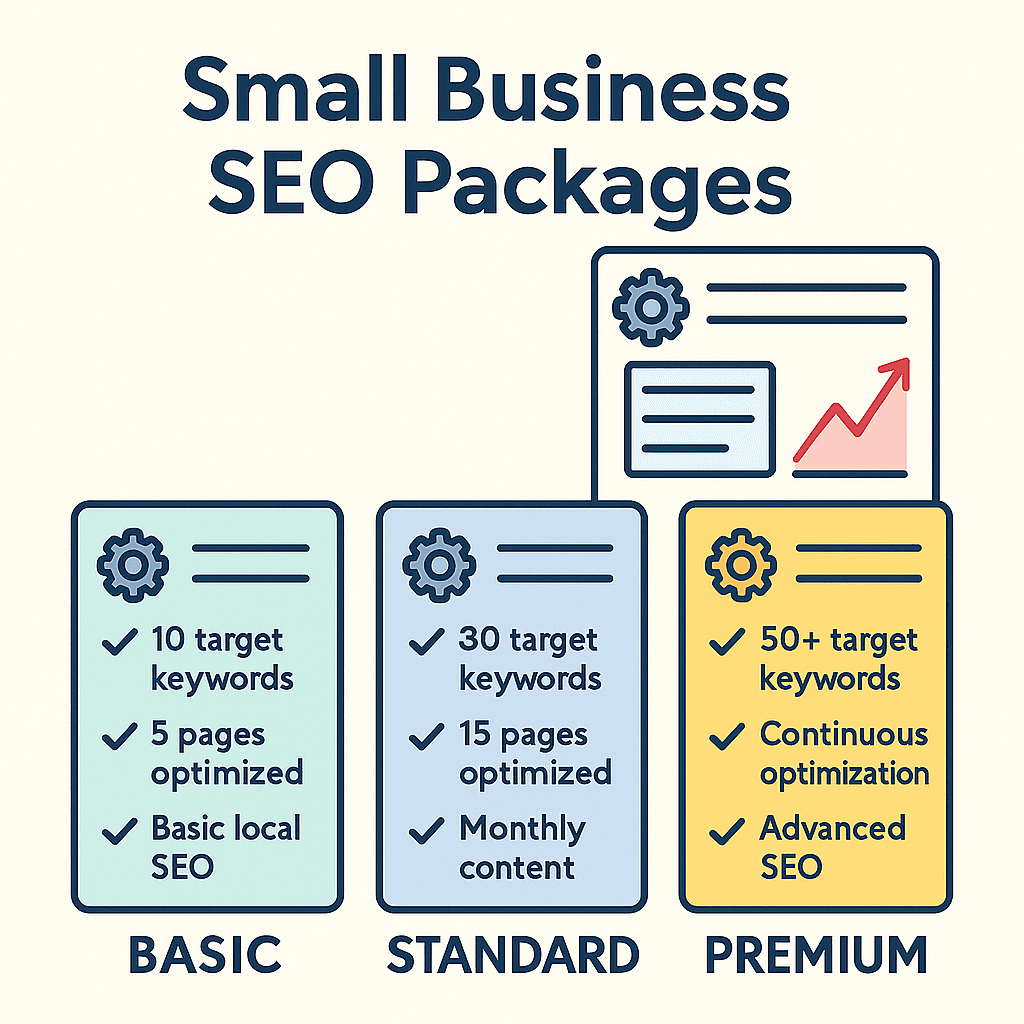
As a rough guide, typical ranges for small business look like this:
- Basic / starter SEO: around $300–$700/month
Foundations for smaller sites with a focused set of keywords and light technical/on-page work. - Growth / standard SEO: around $700–$1,500/month
For businesses that want steady growth with more keywords, more content and deeper technical improvements. - Premium / strategic SEO: $1,500–$3,000+ per month
For competitive niches, lots of content and strategic link building, where organic search is a major growth channel.
Within those typical ranges, VVRapid’s small business SEO packages are intentionally priced on the accessible/value side:
- BASIC SEO – $249/month
Essential SEO foundations for smaller sites with 10 target keywords, 5 key pages optimised, an initial light technical audit and fixes, basic local SEO (Google Business setup), internal link improvements, basic GA/GSC setup and a review call every 3 months.
- STANDARD SEO – $499/month
Ongoing growth SEO for up to 30 keywords and 15 rolling pages, with a full technical audit and ongoing fixes, regular on-page updates, an optimised Google Business Profile, a monthly content plan, natural linking, full GA/GSC setup, monthly action reports and a review call every 6 weeks.
- PREMIUM SEO – $999/month
Strategic, data-driven SEO for 50+ keywords with continuous optimisation of existing and new pages, deep-dive technical fixes, full local strategy (if relevant), detailed content strategy, strategic outreach for links, custom analytics, detailed monthly reporting and a monthly strategy call.
These packages are designed to make serious, long-term SEO accessible to small businesses, with clear deliverables and predictable monthly pricing.
Red flags: SEO package tactics that rip small businesses off
Now let’s look at some classic warning signs that a small business SEO package might be more scam than service.
1. “Guaranteed #1 rankings”
No one can guarantee #1 rankings for competitive terms. Google explicitly warns you to be wary of anyone who promises guaranteed results. Packages that guarantee #1 usually:
- Target obscure, low-value keywords
- Use risky tactics that could hurt your site
- Or simply rely on you never checking properly
Treat “guaranteed #1 rankings” as a giant red flag.
2. Ultra-cheap “all-in-one” deals
Be cautious of offers like:
“Full SEO, 50 keywords and 5,000 backlinks for $99/month!”
At that price, there is no room for real research, strategy, content, technical fixes or safe link building. You’ll likely get:
- Automated spam links on random sites
- Duplicate or spun content
- No serious technical or on-page work
These small business SEO packages can damage your site more than doing nothing.
3. Secret “special sauce” and no transparency
Be wary if a provider:
- Can’t explain what they do in normal language
- Hides behind “proprietary methods” and refuses to discuss tactics
- Dodges questions about links, content or technical changes
A good SEO company won’t give you their entire playbook, but they should be able to describe the categories of work they’ll do for you.
4. No access to your data or assets
Another big red flag:
- They set up Google Analytics or Search Console under their own accounts and don’t share admin access
- They register domains or hosting in their name, not yours
- They keep you locked out of your own website tools
You should always have full access to your own data and infrastructure.
5. Spammy link building and “private networks”
Watch out for:
- Promises of thousands of backlinks per month
- Vague references to “our private blog network” or “special network of sites”
- Links from irrelevant, low-quality sites
Modern SEO focuses on quality and relevance, not raw link volume. Bad links can lead to penalties or long-term ranking problems.
6. Meaningless reports
Reports that are full of charts but say nothing like:
- What changed
- What was done
- What’s next
…are a warning sign. If your traffic and leads aren’t moving after months of “activity”, you might be paying for noise instead of progress.
How to evaluate small business SEO packages (practical checklist)
When you’re comparing small business SEO packages, use this simple checklist:
- Do they start with your goals?
- Do they ask about your services, margins, locations and ideal clients?
- Or do they pitch a generic “bronze/silver/gold” package without context?
- Is the scope clearly defined?
- How many keywords and pages are covered?
- Is technical SEO included?
- Do they include local SEO if you’re a local business?
- Is content guidance or content creation part of the package?
- Is the pricing realistic?
- Does the price roughly match industry ranges for similar small business SEO packages?
- Or is it suspiciously cheap for what’s promised?
- Do they explain their methods?
- Can they walk you through their process for on-page optimisation, technical SEO, content and links?
- Are they willing to say what they won’t do (e.g. no spammy links)?
- What does reporting look like?
- Will you get monthly or regular reports?
- Will they track leads or conversions where possible, not just rankings?
- Are expectations realistic?
- Do they talk about SEO as a 3–6+ month effort to see meaningful results?
- Or do they promise quick, guaranteed wins?
- Who does the work and how can you contact them?
- Is there a named contact person or strategist?
- Can you schedule review calls or strategy sessions?
If a provider can answer these calmly and clearly, they’re much more likely to be legit.
Where VVRapid’s small business SEO packages fit
Using that framework, here’s how VVRapid’s small business SEO packages line up:
- BASIC SEO – $249/month
- For small sites that need solid foundations.
- 10 target keywords, 5 key pages optimised.
- Initial light technical audit and basic fixes.
- Basic Google Business setup and internal linking.
- Basic GA/GSC setup, monthly summary report and a review call every 3 months.
- STANDARD SEO – $499/month
- For growth-focused businesses that want steady, sustainable traffic increases.
- Up to 30 target keywords and 15 pages on a rolling optimisation cycle.
- Full technical SEO audit and ongoing fixes.
- Optimised Google Business Profile and monthly content plan.
- Natural linking, full GA/GSC setup, monthly action reports and a review call every 6 weeks.
- PREMIUM SEO – $999/month
- For competitive niches where organic search is a major growth channel.
- 50+ target keywords and continuous optimisation of existing and new pages.
- Deep technical work, full local strategy (if relevant) and detailed content strategy.
- Strategic outreach for links, custom analytics setup, detailed monthly reports and a monthly strategy call.
Each tier is designed to be transparent about what you get, so you can choose the level that matches where your business is right now.
Final thoughts: choosing SEO packages with confidence
SEO can be one of the highest ROI marketing channels for small businesses – but only if you avoid the traps.
Remember:
- Good small business SEO packages are realistic, transparent and aligned with your goals.
- Pricing that’s far below market averages for “full service” usually hides shortcuts.
- Guaranteed rankings, mystery methods and spammy link promises are all strong red flags.
If you pick a provider that:
- Understands your business
- Explains their process
- Focuses on technical health, content, local visibility and ethical links
- And reports clearly on progress
…then you’re on the right path to building sustainable organic traffic and turning searchers into customers.
When you’re ready, compare VVRapid’s BASIC, STANDARD and PREMIUM SEO packages and choose the one that best matches your current stage and ambitions – knowing exactly what to expect, and what you’re not paying for. If you are a little unsure, feel free to Contact VVRapid for some free friendly advice.
FAQs: Small Business SEO Packages (2026)
Can anyone guarantee #1 rankings on Google?
No. Any package that guarantees #1 rankings is a major red flag. Rankings depend on competition, your website’s current authority, technical health, content quality, and what competitors are doing – none of which a provider fully controls.
How long does SEO take to work?
For most small businesses, you typically need 3–6+ months to see meaningful momentum, and longer in competitive niches. You may see early improvements sooner (technical fixes, on-page cleanups), but sustainable growth usually takes time.
What should a real small business SEO package include?
At minimum, a good package should include:
– Goals + strategy (what matters for leads/sales)
– Keyword/topic research mapped to real pages
– On-page optimisation (titles, headings, internal links, content alignment)
– Technical SEO basics (indexing, crawl errors, speed fundamentals)
– Local SEO (if you serve a local area)
– Reporting + communication (what was done, what’s next, what changed)
Are “5,000 backlinks per month” packages ever legit?
Almost always no, at small-business budgets, that usually means spam links (link farms, irrelevant sites, automated placements). Modern SEO is about relevance and quality, not link volume.
What’s a realistic price range for SEO packages in 2026?
It varies by scope and competition. As a rough guide:
– Basic / starter: ~$300–$700/month
– Standard / growth: ~$700–$1,500/month
– Premium / competitive: ~$1,500–$3,000+/month
Your niche, location targets, content needs, and how aggressive the plan is will shift the range.
Why do some SEO packages look “too cheap”?
Because real SEO takes real time: research, planning, writing, implementing changes, and reviewing outcomes. Ultra-cheap “all-in-one” packages usually cut corners with:
– automated reports instead of real work
– copied/spun content
– spammy links
– zero technical fixes
– no strategy (generic checklists)
Should I get access to my Google Analytics and Search Console?
Yes, you should always have admin access to GA/GSC and any tools tied to your business. If a provider won’t share access (or sets it up under their account only), that’s a serious red flag.
What should monthly SEO reporting look like?
Useful reporting answers:
– What changed this month? (pages updated, fixes made, content shipped)
– What impact did it have? (traffic, rankings on key terms, enquiries/leads where possible)
– What’s next and why? (next priorities based on data)
If you get charts with no explanation, or “vanity metrics” that don’t connect to outcomes, it’s not helpful.
How many keywords should an SEO package target?
It depends on your services and how many pages you have (or plan to build). More keywords usually means:
– more pages to optimise/create
– more content planning
– more time spent refining intent and internal linking
A package should be clear about how many keywords and how many pages are actively worked on.
What’s the difference between “optimising pages” and “creating content”?
– Optimising pages = improving what already exists (titles, headings, structure, internal links, content alignment, technical fixes).
– Creating content = new blog posts, new landing pages, rewrites, and ongoing content strategy.
Higher-tier packages usually include more content planning and/or production.
Do I need local SEO if I serve a specific city/area?
If you rely on local customers, yes – local SEO is often one of the fastest wins. You want:
– an optimised Google Business Profile
– consistent name/address/phone details
– location/service pages that match local intent
– a review strategy you can actually execute
Will SEO “break” my website?
Good SEO shouldn’t. Legit providers make careful, trackable changes. Risk comes from:
– aggressive, spammy link tactics
– “secret sauce” changes you can’t review
– uncontrolled plugin installs or questionable redirects
Transparency and change logs matter.
How do I choose between BASIC, STANDARD, and PREMIUM SEO?
Use this simple guide (based on your package descriptions):
– BASIC ($249/mo): best if you need foundations (smaller site, focused keywords, key pages, basic local setup, light technical work).
– STANDARD ($499/mo): best if you want steady growth (more keywords and pages, full technical audit + ongoing fixes, monthly content plan, regular reporting and reviews).
– PREMIUM ($999/mo): best if you’re in a competitive niche where SEO is a major growth channel (50+ keywords, continuous optimisation + new pages, deep technical work, strategic outreach, advanced reporting and monthly strategy).
What’s the biggest “green flag” when choosing an SEO provider?
They ask about your business outcomes first – services, margins, locations, ideal customers, and what a lead is worth and then explain a clear plan (what they’ll do, what they won’t do, how progress is measured, and what changes will happen on your site).
Helpful external references (optional deeper reading)
- Google Search Central – SEO Starter Guide ↗ (how search engines evaluate pages, and what “good SEO” actually means)
- Google Analytics Help Center ↗ (core concepts for goals, events, and conversion tracking)
- Looker Studio Help ↗ (building simple, repeatable reporting dashboards)
- Nielsen Norman Group – UX Articles ↗ (research-backed guidance on reducing friction and improving usability)