

SEO forecasting is the process of estimating how organic search visibility, traffic and leads could develop under a defined set of assumptions. It can help a business plan budgets and priorities, but it should never be presented as a guaranteed prediction.
Table of Contents
A useful SEO forecast does not promise that a page will reach a specific ranking by a specific date. Instead, it presents a range of possible outcomes based on search demand, current visibility, competition, click-through rates, conversion performance and the work a business can realistically implement.
This approach gives decision-makers something more useful than a dramatic traffic number. It shows what must happen for the forecast to become achievable, what could slow progress and how results should be reviewed over time.
VVRapid’s Search Engine Optimisation service focuses on steady improvements to technical foundations, content, visibility and tracking rather than guaranteed rankings.
What SEO Forecasting Can and Cannot Tell You
An SEO forecast is a planning model.
It can help estimate:
- Potential organic search traffic
- Possible click growth
- Likely lead ranges
- The effect of improving existing rankings
- The value of targeting additional search topics
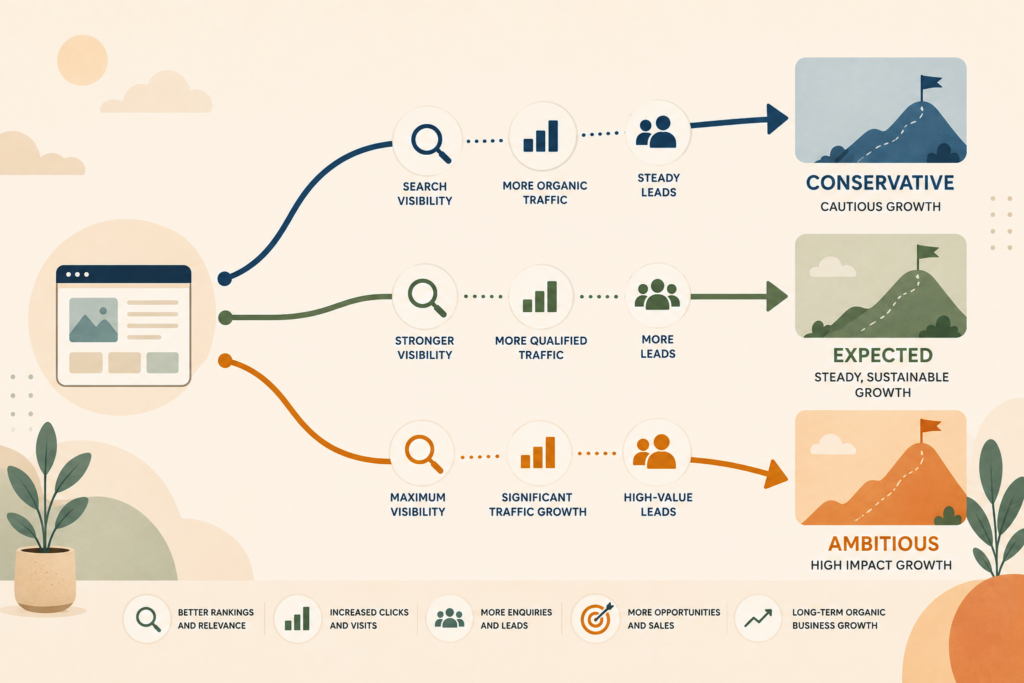
- Conservative, expected and ambitious outcomes
- The level of work required to pursue those outcomes
It cannot reliably guarantee:
- An exact ranking position
- A fixed number of monthly visitors
- A precise date when growth will happen
- That competitors will remain inactive
- That search behaviour will stay unchanged
- That every published page will perform
- That all organic traffic will convert
Search results are influenced by many variables outside a business’s direct control. Competitors publish new content, websites change, search demand fluctuates and search engines reassess pages continuously.
SEO traffic projections should therefore be treated as informed scenarios, not contractual promises.
Why Businesses Use SEO Traffic Forecasts
SEO often requires investment before the full commercial return becomes visible.
A forecast can help a business decide:
- Whether enough relevant search demand exists
- Which services or products have the strongest opportunity
- Whether to improve existing pages or create new ones
- How many leads may be possible at different traffic levels
- Which assumptions create the greatest uncertainty
- Whether the likely opportunity justifies the required work
- How SEO fits alongside paid media, referrals and outbound activity
The purpose is not to create false certainty.
The purpose is to make assumptions visible so they can be challenged, monitored and improved.
Start With the Business Outcome
A weak forecast begins with a desired traffic number.
A stronger SEO forecast begins with a commercial objective.
For example:
- Generate more qualified enquiries for a core service
- Increase bookings in a particular region
- Reduce reliance on paid advertising
- Grow sales for a profitable product category
- Create demand for a new service
- Improve lead flow during quieter periods
This matters because more organic traffic is not always the right objective.
A website could attract thousands of additional visits from broad informational searches while generating few relevant enquiries. A smaller increase in high-intent service traffic may create more value.
Before building a forecast, define:
- Which offer should grow?
- Which audience is most valuable?
- Which locations matter?
- What counts as a qualified lead?
- What is the current lead-to-customer rate?
- What is the approximate customer value?
- How much delivery capacity is available?
These questions keep the forecast connected to the business rather than rankings alone.
The Main Inputs Behind an SEO Forecast
A credible forecast should show where its numbers come from.
Current organic performance
Start with the website’s existing baseline:
- Organic clicks
- Organic sessions
- Search impressions
- Click-through rate
- Ranking queries
- Ranking landing pages
- Organic conversions
- Qualified organic leads
- Organic conversion rate
- Branded and non-branded traffic
Google Search Console can provide query, page, click, impression, position and click-through data. Google Analytics can help show how organic visitors engage and whether they complete important actions.
Using both platforms creates a fuller picture than relying on a rank-tracking tool alone.: Google Search Console Performance report ↗
Relevant search demand
Keyword search volume estimates can indicate how frequently people search for a topic, but they should not be treated as exact traffic predictions.
Search volume data may:
- Be rounded
- Combine variations
- Differ between tools
- Change seasonally
- Include searches with mixed intent
- Represent a larger region than the business serves
A keyword with high search volume is not automatically valuable.
The better question is whether the search reflects a need the business can solve.
Current ranking positions
A website already ranking on page one or near page one may have a clearer short-term opportunity than a site with no relevant visibility.
For example, moving a useful page from the lower half of page one into stronger positions may increase clicks without requiring an entirely new content section.
However, rankings should not be modelled as a simple linear progression. Moving from position 20 to position 10 is different from moving from position 5 to position 2.
The competitive gap usually becomes more demanding as a page approaches the strongest results.
Expected click-through rate
SEO forecasting often uses an assumed click-through rate to estimate how many search impressions could become visits.
The simplified formula is:
Estimated clicks = Search impressions or search volume × Assumed click-through rate
Suppose a group of relevant searches creates an estimated 10,000 monthly impressions.
At an illustrative 3% click-through rate:
10,000 × 3% = 300 estimated clicks
At an illustrative 8% click-through rate:
10,000 × 8% = 800 estimated clicks
The wide difference shows why a forecast should use ranges rather than one confident number.
Actual click-through rate depends on:
- Ranking position
- Search intent
- Brand recognition
- Page title and description
- Search-result features
- Competing advertisements
- Maps, videos and shopping results
- Whether the query receives an immediate answer
Google defines click-through rate as clicks divided by impressions. This makes it a useful measurement input, but not a fixed benchmark for every keyword.: Google explanation of impressions, position and clicks ↗
Organic conversion rate
Traffic does not become valuable automatically.
To estimate leads, apply a realistic conversion rate:
Estimated organic leads = Estimated organic visits × Organic conversion rate
For example:
- Estimated visits: 800
- Illustrative organic conversion rate: 2%
- Estimated leads: 16
The calculation would be:
800 × 2% = 16 estimated leads
A forecast should preferably use the website’s own conversion data rather than a generic industry benchmark.
Conversion performance can vary because of:
- Search intent
- Offer clarity
- Pricing
- Website usability
- Trust signals
- Page speed
- Mobile experience
- Form length
- Sales process
- Location
- Brand familiarity
If conversion tracking is incomplete, state that limitation clearly.: Google Analytics conversion information ↗
Lead quality and sales conversion
Not every enquiry becomes a suitable customer.
A realistic SEO lead forecast should consider:
- Qualified-lead rate
- Lead-to-customer rate
- Average deal value
- Gross profit
- Sales-cycle length
- Customer retention
- Delivery capacity
Suppose a forecast estimates 20 monthly organic enquiries.
If 60% are qualified:
20 × 60% = 12 qualified leads
If 25% of those qualified leads become customers:
12 × 25% = 3 customers
This is more commercially useful than forecasting 20 leads without considering quality or sales conversion.
How to Build an SEO Forecast Step by Step
Step 1: Establish the baseline
Select a reliable historical period, such as the previous six or twelve months.
Record:
- Organic traffic
- Organic leads
- Organic conversion rate
- Search impressions
- Organic click-through rate
- Important ranking pages
- Seasonal peaks and declines
- Major website or tracking changes
Avoid using an unusual month as the baseline.
A seasonal spike, website outage, tracking error or temporary campaign can distort the model.
Step 2: Group keywords by topic and intent
Do not forecast every keyword separately.
Group related searches into clusters such as:
- Core service terms
- Location-specific searches
- Problem-aware searches
- Comparison searches
- Informational questions
- Branded searches
This reduces false precision and reflects how one page can rank for several related queries.
It also helps prevent keyword cannibalisation by assigning one clear search purpose to each important page.
Step 3: Map opportunities to pages
Each opportunity should connect to a page or planned content asset.
The page may need to be:
- Created
- Expanded
- Rewritten
- Technically improved
- Better linked internally
- Consolidated with another page
- Updated to match search intent
This step turns a theoretical SEO growth projection into an implementation plan.
A keyword list without mapped pages is not a strategy.
Step 4: Estimate visibility scenarios
Create at least three scenarios:
- Conservative
- Expected
- Ambitious
Each scenario should use different assumptions about:
- Ranking improvement
- Impressions
- Click-through rate
- Publishing pace
- Technical implementation
- Conversion rate
- Competitor activity
Do not create an intentionally weak scenario simply to make the expected scenario look attractive.
Every scenario should be plausible.
Step 5: Convert visibility into traffic
Apply a click-through assumption to estimated impressions or search demand.
For example:
| Scenario | Estimated monthly impressions | Assumed CTR | Estimated clicks |
|---|---|---|---|
| Conservative | 12,000 | 2.5% | 300 |
| Expected | 18,000 | 4% | 720 |
| Ambitious | 25,000 | 6% | 1,500 |
These figures are illustrative, not benchmarks.
The model should explain why each click-through assumption was selected.
Step 6: Convert traffic into leads
Apply an organic conversion-rate range.
| Scenario | Estimated visits | Conversion rate | Estimated leads |
| Conservative | 300 | 1.5% | 4 to 5 |
| Expected | 720 | 2.5% | 18 |
| Ambitious | 1,500 | 3.5% | 52 to 53 |
The ambitious scenario may require more than better rankings. It may also depend on stronger landing pages, clearer offers and improved conversion tracking.
Step 7: Estimate qualified leads
Apply the expected qualification rate.
Suppose 60% of enquiries are typically relevant:
- Conservative: approximately 3 qualified leads
- Expected: approximately 11 qualified leads
- Ambitious: approximately 31 or 32 qualified leads
This gives the sales team a more practical expectation.
Step 8: Add timing assumptions
Forecasts should show when different activities may begin contributing.
A simple model might include:
- Months 1 to 2: Research, technical work and initial optimisation
- Months 2 to 4: Content production and page improvements
- Months 3 to 6: Early visibility and click changes
- Months 6 to 12: Broader traffic and lead impact
This is not a universal timeline.
A well-established website improving existing pages may move faster than a new domain entering a competitive category. VVRapid generally recommends allowing at least three to six months to evaluate meaningful SEO progress, while recognising that the required period depends on the site and market.
Conservative, Expected and Ambitious SEO Scenarios
Scenario planning is more honest than presenting one projected total.
Conservative scenario
This assumes:
- Slower implementation
- Modest ranking gains
- Lower click-through rates
- Existing conversion performance
- Limited content production
- Strong competitor activity
This scenario is useful for cash-flow planning and risk assessment.
Expected scenario
This assumes:
- Agreed work is implemented
- Priority pages improve gradually
- Content is published consistently
- Technical problems are addressed
- Conversion tracking works
- Competitor activity remains within a normal range
This should be the most defensible outcome, not simply the middle number.
Ambitious scenario
This assumes:
- Strong implementation speed
- High-quality content
- Significant visibility gains
- Better-than-current click-through rates
- Improved website conversion
- Strong internal linking
- Competitive performance across several topic groups
An ambitious forecast should explain the additional resources and favourable conditions it requires.
How Competition Changes SEO Growth Projections
Search volume alone says little about how difficult an opportunity may be.
A competitive review should consider:
- Strength of current ranking domains
- Relevance and depth of competing pages
- Brand authority
- Backlink profiles
- Website quality
- Local relevance
- Content freshness
- Search-result features
- Commercial value of the keyword
- Number of established specialists competing
A small business may find that a lower-volume, highly relevant topic offers a better opportunity than a broad national keyword dominated by major brands.
This is why SEO forecasting should combine demand data with competitor analysis and business relevance.
Forecast New Content Separately From Existing Pages
Existing pages and new content carry different levels of uncertainty.
Existing-page forecasts
These can use:
- Current impressions
- Current clicks
- Current ranking range
- Existing conversion history
- Historical seasonality
- Known technical issues
This often makes them easier to model.
New-content forecasts
These depend more heavily on assumptions about:
- Indexing
- Topic relevance
- Search intent
- authority
- Content quality
- Internal links
- Competition
- Time to gain visibility
Keep forecasts for new pages conservative until real impression and click data becomes available.
Account for Seasonality and Demand Changes
Some businesses experience predictable search peaks.
Examples include:
- Holiday-related products
- Tax and accounting services
- Tourism
- School applications
- Seasonal maintenance
- Event services
- Financial-year planning
Compare year-on-year performance where possible instead of interpreting every month-to-month decline as an SEO problem.
A business can rank in the same position and still receive fewer clicks if fewer people are searching.
Similarly, traffic may increase because demand has risen even when rankings remain unchanged.
Your forecast should therefore separate:
- Expected ranking improvement
- Expected market-demand changes
- Seasonal variation
- One-off events
Include Implementation Capacity in the Model
An SEO forecast is only as realistic as the implementation plan behind it.
Traffic projections may assume:
- Ten service pages will be improved
- Two articles will be published each month
- Technical problems will be fixed
- Conversion tracking will be corrected
- Internal linking will be strengthened
- Important pages will receive design updates
If only a small portion of that work happens, the original forecast becomes less relevant.
Review available capacity across:
- Copywriting
- Design
- Development
- Subject-matter input
- Approvals
- Publishing
- Analytics
- Sales follow-up
A Digital Strategy Roadmap can help connect SEO opportunities with realistic priorities, ownership and implementation capacity.
Forecasting SEO Leads for a Service Business
A service-business forecast should follow the whole commercial path.
For example:
- Estimated search impressions
- Estimated organic visits
- Estimated enquiries
- Estimated qualified leads
- Estimated proposals or consultations
- Estimated customers
- Estimated gross profit
An illustrative model could look like this:
- Monthly search impressions: 20,000
- Click-through rate: 4%
- Organic visits: 800
- Enquiry conversion rate: 2.5%
- Enquiries: 20
- Qualified-lead rate: 60%
- Qualified leads: 12
- Customer conversion rate: 25%
- New customers: 3
This model makes it easy to test assumptions.
For example, improving the website conversion rate from 2.5% to 3.5% would increase estimated enquiries without requiring more impressions.
That is why SEO and conversion improvement should not be planned in isolation.
How to Review a Forecast Over Time
A forecast should be updated when real data becomes available.
Review:
- Actual impressions against forecast impressions
- Actual click-through rate against the assumed rate
- Actual visits against projected traffic
- Actual enquiries against projected leads
- Qualification rates
- Sales conversion
- Pages gaining visibility
- Pages underperforming
- Work completed
- Work delayed
- Changes in search demand
Do not rewrite the original forecast quietly to make it appear accurate.
Keep the original assumptions visible, explain what changed and update the next period based on better evidence.
A forecast is useful because it improves decisions, not because it predicts the future perfectly.
Questions to Ask About an SEO Agency Forecast

Before accepting an SEO forecast, ask:
- Which data sources were used?
- Is the forecast based on our existing performance?
- Are branded searches included?
- How were click-through rates estimated?
- How was conversion rate calculated?
- Does the lead estimate use qualified leads or all enquiries?
- Are the figures monthly or cumulative?
- How has seasonality been handled?
- What work must be implemented?
- Which assumptions carry the most risk?
- Are the figures presented as ranges?
- How often will the forecast be reviewed?
- What happens if implementation is delayed?
- Does the model account for competitor activity?
- Are rankings or outcomes being guaranteed?
Clear answers are more valuable than an impressive spreadsheet with unexplained formulas.
Common SEO Forecasting Mistakes
Treating keyword volume as guaranteed traffic
Search volume estimates are not website traffic estimates.
A page receives only a portion of available clicks, and some searches may not produce a website visit at all.
Applying one click-through rate to every keyword
Click behaviour varies by ranking, intent, device and search-result layout.
Use ranges and adjust them as actual data becomes available.
Assuming every target keyword will rank
Some opportunities will outperform expectations. Others will gain little visibility.
Forecast at topic or page-group level rather than relying on every keyword succeeding.
Ignoring the website’s conversion rate
A forecast that ends with traffic does not show likely commercial value.
Connect projected visits to realistic conversion and qualification rates.
Using generic conversion benchmarks
Another company’s conversion rate may not apply to your offer, market or website.
Use your own data wherever possible.
Forecasting without an implementation plan
Projected results usually depend on technical fixes, content, internal linking, page improvements and monitoring.
A forecast without defined work is only a wish list.
Presenting one exact number
A single number hides uncertainty.
Use conservative, expected and ambitious ranges with documented assumptions.
Ignoring branded traffic
Strong branded demand can make a forecast look more impressive without showing new non-branded discovery.
Report branded and non-branded opportunities separately.
Promising fixed rankings or dates
No responsible provider can control search results precisely.
A forecast should describe possibilities and dependencies rather than guarantees.
SEO Forecasting Checklist
Use this checklist before approving an SEO traffic forecast:
- ☐ The commercial objective is clear.
- ☐ Current organic performance has been recorded.
- ☐ Tracking problems have been identified.
- ☐ Keywords are grouped by topic and intent.
- ☐ Opportunities are mapped to real pages.
- ☐ Search demand is relevant to the business.
- ☐ Branded and non-branded searches are separated.
- ☐ Click-through assumptions are documented.
- ☐ Conversion rates use realistic data.
- ☐ Lead quality is included.
- ☐ Lead-to-customer conversion is considered.
- ☐ Seasonality is addressed.
- ☐ Competition is reviewed.
- ☐ Existing and new pages are modelled separately.
- ☐ Conservative, expected and ambitious scenarios are included.
- ☐ Implementation requirements are listed.
- ☐ Internal capacity is considered.
- ☐ Forecast limitations are stated.
- ☐ No ranking guarantees are made.
- ☐ The model will be updated with actual results.
How VVRapid Can Help
VVRapid combines technical SEO, content planning, on-page optimisation, internal linking and analytics to improve qualified organic visibility over time.
Forecasting can help define the opportunity, but the forecast must remain connected to the work required and the data collected after implementation.
Businesses that need ongoing ownership across priorities, content and reporting can also explore VVRapid’s Fractional SEO & Content Lead.
Review the Search Engine Optimisation service for ongoing optimisation options.
For a tailored assessment, use the SEO quote request page.
Frequently Asked Questions
What is SEO forecasting?
SEO forecasting estimates potential organic visibility, traffic and leads using assumptions about search demand, ranking improvements, click-through rates and website conversion performance.
Can SEO traffic be predicted accurately?
SEO traffic cannot be predicted with complete accuracy. Forecasts are more useful when presented as ranges with documented assumptions and updated using actual performance data.
How do you calculate forecast organic traffic?
A basic calculation multiplies expected impressions or relevant search demand by an assumed click-through rate. More detailed models separate keywords by topic, ranking range and intent.
How do you forecast SEO leads?
Multiply projected organic visits by a realistic website conversion rate. Then apply the business’s qualified-lead rate to estimate how many enquiries may be commercially relevant.
Should an SEO forecast include guaranteed rankings?
No. Search rankings are influenced by variables outside the control of an SEO provider. A responsible forecast presents scenarios and dependencies rather than guarantees.
How often should an SEO forecast be updated?
Review progress monthly and consider updating the model quarterly or when major changes occur. Changes may include new performance data, website updates, shifts in demand or delays in implementation.
Should branded searches be included?
Branded search can be included, but it should be shown separately from non-branded search. This makes it easier to distinguish existing brand demand from new discovery.
What is the best period for an SEO forecast?
Many businesses use six or twelve-month projections because SEO improvements and sales conversions develop over time. The appropriate period depends on the website, market and scope of work.
Why do actual SEO results differ from forecasts?
Results may differ because ranking improvements, click-through rates, conversion performance, competitor activity, search demand and implementation speed do not match the original assumptions.
Is SEO forecasting useful for a new website?
Yes, but uncertainty is higher because the website has limited historical data. New-site forecasts should use conservative ranges and be updated once impressions, clicks and conversions are available.
SEO forecasting is most valuable when it encourages better questions. It should clarify the opportunity, reveal the assumptions and show what work is required to pursue sustainable traffic and lead growth.