

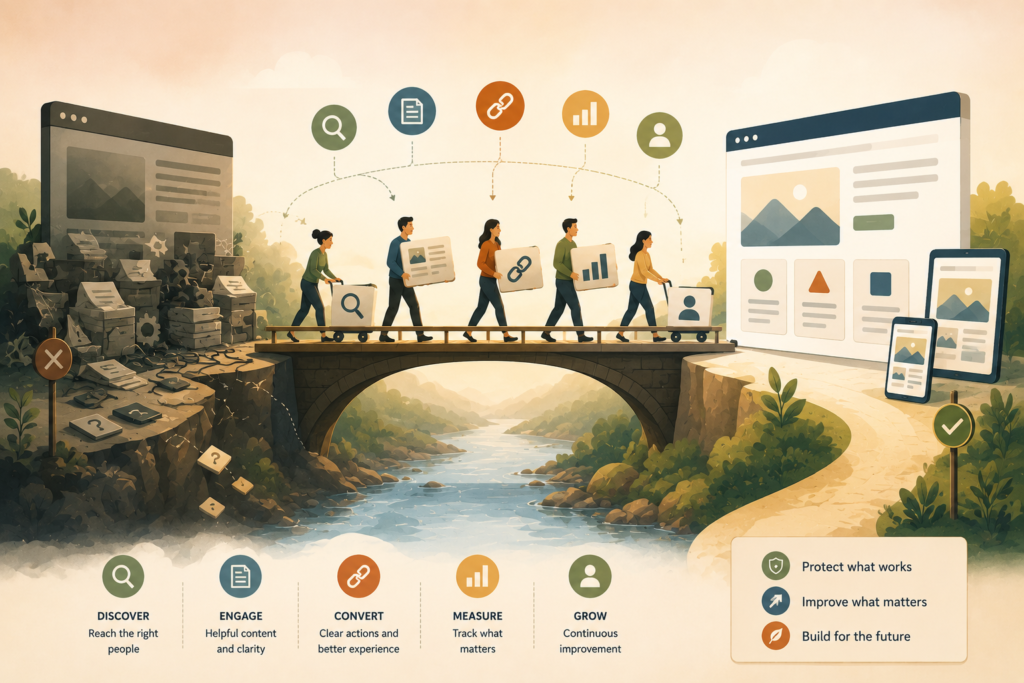
Digital strategy before website redesign work begins can prevent a new website from becoming an expensive visual update that carries the same old problems into a cleaner layout. Before wireframes, colours, page designs, or development estimates take over the conversation, decide what the website needs to achieve for the business and what must change to make that possible.
Table of Contents
This article assumes you already have a reasonable case for redesigning the website. It is not another checklist for deciding whether you need a redesign, and it is not a list of files and access details to give your developer.
The focus is the strategic layer in between.
What business change should the website support? Which customers matter most? What role should the site play in the buying journey? Which existing digital assets must be protected? What should success look like after launch?
Those decisions form the foundation of digital strategy before website redesign.
What does digital strategy before website redesign actually decide?
Good digital strategy before website redesign is less about choosing features and more about choosing direction.

It should answer questions such as:
- Why are we redesigning now?
- What has changed in the business?
- Who should the new website serve first?
- Which offers or services deserve priority?
- What role does the website play before and after an enquiry?
- Which existing search visibility and content assets must be protected?
- What should visitors be able to accomplish more easily?
- How will we know whether the redesign helped?
- What belongs in the first release and what can wait?
That is your website redesign strategy.
Once these decisions are clear, designers and developers have a stronger brief. Without them, website redesign planning can quickly become a debate about personal preferences.
If the bigger direction is still unclear, VVRapid’s Digital Strategy Roadmaps can help define priorities before the project moves into design and development.
First, define what has changed in the business
The strongest reason for redesigning a website is not simply that it looks old.
Something important usually changed.
Perhaps you:
- added higher-value services
- entered new regions
- changed your ideal customer
- repositioned the business
- introduced ecommerce
- added recurring services
- changed the sales process
- developed a stronger content strategy
- need new integrations
- now serve several customer types
- want the website to generate more qualified enquiries
Start digital strategy before website redesign by documenting those changes.
Then ask a more useful question:
What does the current website make difficult because the business has moved on?
For example, a website built when the company offered three simple services may no longer work well when there are fifteen services across several industries.
A brochure website may no longer support a business that wants bookings, online payments, lead qualification, email nurturing, or customer portals.
The redesign should respond to those changes rather than simply modernising the surface.
Decide which business outcome comes first
A website can support many goals, but your website strategy needs hierarchy.
Possible website goals include:
- generating qualified enquiries
- selling products
- securing bookings
- improving lead quality
- supporting sales conversations
- increasing repeat purchases
- helping prospects understand complex services
- building search visibility
- serving customers after purchase
- reducing repetitive admin
Choose one primary outcome and a small number of supporting outcomes.
This matters because digital strategy before website redesign should influence how attention is distributed.
A website focused primarily on qualified B2B enquiries may need strong service pathways, detailed decision-support content, credible proof, and easy consultation requests.
An ecommerce website may place greater emphasis on product discovery, category structure, product information, checkout confidence, and retention.
A redesign cannot optimise everything equally.
Priority creates clarity.
Decide who the website is really for
Many websites accumulate audiences over time.
You might serve:
- new prospects
- existing customers
- partners
- job applicants
- suppliers
- investors
- several industries
- several regions
Not all audiences deserve equal prominence.
Your website redesign strategy should identify the priority customer segments and what each needs from the site.
This is where customer journey mapping becomes more useful than simply creating personas.
For each important customer group, ask:
- What usually brings them to the website?
- What are they trying to understand?
- What questions slow down the decision?
- What proof do they need?
- What action should they take next?
- What happens after that action?
You are mapping decisions, not decorating pages.
Digital strategy before website redesign should make those journeys clearer before anyone decides exactly how the pages will look.
Clarify the role of the website in the wider customer journey
The website rarely works alone.
Someone may discover the business through Google, social media, a referral, an advertisement, an event, an email, or a salesperson.
They arrive on the website with different levels of knowledge.
Afterwards, they may move into:
- a phone call
- an enquiry form
- a CRM
- an email sequence
- a booking platform
- a sales consultation
- an ecommerce checkout
- an offline sales process
A strong conversion strategy accounts for that entire journey.
This prevents one common redesign problem: treating the website as though every visitor arrives on the homepage, reads the pages in order, and then fills out one contact form.
Real journeys are messier.
Your digital strategy before website redesign should identify the important entry points and next steps so the redesigned site can support them intentionally.
Decide which parts of the existing website have earned protection
A redesign does not start from zero.
Your current website may already have assets that are producing value:
- pages ranking in search
- blog posts attracting useful traffic
- backlinks pointing to specific URLs
- pages frequently used by customers
- landing pages with strong conversion
- downloadable resources
- internal links that support discovery
- established page URLs
- analytics history
Do not casually throw those away because a new sitemap looks tidier.
This is a critical part of SEO website planning.
Google’s guidance for site moves recommends mapping existing URLs to their new destinations, using appropriate redirects, testing the new site, and monitoring performance after migration when URLs change.: Google Search Central Site Moves ↗
Your digital strategy before website redesign should therefore identify which existing pages should be retained, improved, consolidated, redirected, or deliberately retired.
The detailed redirect map can come later.
The strategic decision comes first: what existing value are we trying to preserve?
Where organic search is an important acquisition channel, VVRapid’s Search Engine Optimisation service can support the SEO side of redesign and migration planning.
Decide what should not survive the redesign
Preserving valuable assets does not mean copying the old website into a new design.
Some things should disappear.
Examples may include:
- outdated service descriptions
- duplicate pages
- confusing navigation labels
- low-value landing pages
- irrelevant old offers
- features nobody uses
- legacy content that no longer represents the business
- unnecessary form fields
- redundant plugins or tools
- internal workflows created around old limitations
This is where website content strategy matters.
Ask of every major content area:
Does this still deserve a place in the new customer journey?
That question is different from asking whether the content can technically be migrated.
A redesign is an opportunity to reduce accumulated clutter.
Set the conversion model before designing calls to action
Buttons are not strategy.
Before choosing button wording or placement, decide which actions matter most.
For a service business, that could be:
- qualified enquiry
- consultation booking
- quote request
- call
- WhatsApp conversation
For ecommerce:
- product view
- add to cart
- purchase
- account creation
- repeat purchase
Your digital strategy before website redesign should define primary and secondary actions for the business.
Then decide what happens afterwards.
If someone requests a quote, who receives it? Is the lead added to a CRM? Does an automated email go out? Is the source recorded? Can the sales team distinguish high-fit from low-fit enquiries?
Google Analytics allows important business actions to be marked as key events, making it possible to evaluate whether users complete actions that matter to the organisation.: Google Analytics: About key events ↗
That is why measurement belongs inside website redesign planning, not on a list of things to remember after launch.
Decide what success should look like after launch
“Launch the website” is a project milestone.
It is not a business outcome.
Before development starts, define how you will evaluate the redesign.
Possible measures include:
- qualified enquiries
- ecommerce revenue
- booking completions
- conversion rate
- organic visibility
- engagement with priority service pages
- fewer abandoned forms
- improved lead quality
- reduced support enquiries
- increased use of self-service tools
Your digital strategy before website redesign should establish a baseline where possible.
If you currently receive 60 enquiries per month, know that before launch.
If three service pages generate most organic leads, know that before changing them.
If mobile visitors abandon a key step, document it.
Otherwise, the new website may feel better while nobody can clearly show whether it performs better.
Decide where the website ends and other systems begin
Modern websites often connect to other parts of the business.
That can include:
- CRM platforms
- email marketing
- accounting software
- booking systems
- payment gateways
- inventory
- customer support
- membership systems
- automation platforms
- internal databases
Do not begin with “which plugin do we need?”
Begin with the process.
For example:
A prospect submits a service enquiry, is categorised by service type, enters the CRM, receives confirmation, and is assigned to the correct salesperson.
That is a business workflow.
The technology can then be chosen around it.
This part of digital strategy before website redesign can also reveal that some planned functionality should not live directly inside the website.
Where a standard website or plugin cannot support the required workflow, VVRapid’s Custom Plugin Development service may be relevant.
Include accessibility before visual design starts
Accessibility is easier to support when it is considered throughout planning, design, content, and development.
The W3C’s Web Accessibility Initiative recommends integrating accessibility into the web production process, including objectives, responsibilities, evaluation, and ongoing monitoring.: W3C Web Accessibility Initiative ↗
That makes accessibility part of digital strategy before website redesign, not simply a technical inspection at the end.
It can influence:
- navigation
- colour choices
- contrast
- form behaviour
- headings
- link wording
- keyboard interaction
- media
- content structure
The exact legal requirements vary by country, audience, and organisation, so seek appropriate legal or accessibility advice where necessary.
Define what belongs in phase one
A redesign often attracts every idea the business has stored for several years.
New calculators. A portal. More languages. Advanced automation. A resource centre. Personalisation. New integrations.
Some may be excellent ideas.
They may not all belong in the first release.
Good digital strategy before website redesign separates:
Essential for the new website
Items required to solve the main business problem.
Valuable next
Improvements worth planning for but not necessary to launch.
Future possibilities
Ideas the technical architecture should not prevent, but that do not yet need to be built.
This creates healthier scope boundaries.
Once strategy is agreed and you are ready to turn decisions into layouts, functionality, and build requirements, VVRapid’s Website Design & Development service becomes the natural implementation step.
Checklist: digital strategy before website redesign
Before approving detailed design work, confirm that:
- You can explain why the redesign is happening now
- You know what changed in the business
- One primary website outcome has been agreed
- Priority audiences are clear
- The main customer journeys have been mapped
- You understand the website’s role within the wider sales process
- High-value existing content has been identified
- Important organic search assets are known
- You know what old content or functionality should not be carried forward
- Primary conversion actions are defined
- Measurement requirements are agreed
- Key integrations and business workflows are understood
- Accessibility has been considered
- Phase-one scope has clear boundaries
- Future ideas are separated from launch requirements
If several of those answers are still unclear, more digital strategy before website redesign work may save considerable rework later.
Common mistakes with website redesign strategy
Mistake 1: Starting with visual references
Mood boards and example websites can be useful later.
They should not decide the business strategy.
Mistake 2: Copying the old sitemap automatically
A new visual design wrapped around an old information structure may preserve the same customer journey problems.
Mistake 3: Treating every audience equally
Trying to give everyone equal prominence usually creates weak hierarchy.
Choose priorities.
Mistake 4: Forgetting what already ranks
A website redesign can affect existing search assets if URLs, content, internal links, and page relationships change without a plan.
Mistake 5: Defining measurement after launch
You should know which actions matter before the redesigned customer journey is built.
Mistake 6: Letting functionality create the strategy
Do not add tools simply because they are possible.
Start with the business process they need to support.
Mistake 7: Trying to solve every future requirement now
A clear first phase is often better than an oversized project filled with unproven ideas.
FAQ
Why is digital strategy before website redesign important?
Digital strategy before website redesign helps define what the new site needs to achieve before time and budget are committed to layouts and development. It connects the project to business goals, audiences, customer journeys, conversion, SEO, measurement, and wider digital systems.
Is website redesign strategy the same as a website brief?
No. A website redesign strategy defines direction and priorities. A detailed website brief turns those decisions into requirements such as pages, functionality, content responsibilities, integrations, and technical needs.
Should SEO be planned before a website redesign?
Yes. Important pages, URLs, search visibility, internal links, content assets, and redirect requirements should be understood before major structural changes are approved.
When should customer journey mapping happen?
Ideally before detailed page design. Customer journey mapping helps establish how different visitors discover the business, what information they need, and which actions they should take.
Should all existing content move to the new website?
No. A website content strategy should determine which content remains useful, which needs improvement, which should be combined, and which no longer supports the business.
What happens after the strategy is agreed?
The next step is to translate strategic decisions into a website scope, content plan, information architecture, design requirements, functionality, and implementation plan.
How VVRapid can help
VVRapid’s Digital Strategy Roadmaps can help clarify the direction of a website project before design and development begin.
The roadmap can assess business goals, messaging, customer journeys, website conversion, SEO, content, measurement, and priorities.
If the findings point towards a redesign or rebuild, they can help define a clearer scope, structure, and conversion flow before implementation.
VVRapid can then support the implementation through Website Design & Development, SEO, content, and related digital work.
If a redesign is already on the table but the business decisions behind it are still fuzzy, reviewing the Digital Strategy Roadmaps service is a sensible place to start.