

SEO ROI for small business is not simply the percentage increase in website traffic after a few months of optimisation. The useful question is whether organic search is producing measurable business value, such as qualified enquiries, sales, bookings or lower customer acquisition costs.
Table of Contents
That sounds straightforward, but SEO reporting can become confusing quickly. Rankings rise while leads stay flat. Organic traffic grows, but much of it comes from low-intent articles. A prospect may discover your business through Google, return directly a week later and then submit an enquiry, making the original source less obvious.
A practical measurement framework helps you avoid both extremes. You do not want to dismiss SEO because every sale cannot be attributed perfectly. You also do not want to celebrate traffic growth that has no commercial impact.
Early in the process, review how your website, technical foundations, content and tracking work together. VVRapid’s search engine optimisation services focus on these connected elements rather than treating rankings as the only outcome.
What SEO ROI for Small Business Actually Means
SEO return on investment compares the value created through organic search with the amount spent creating that value.
A basic formula is:
SEO ROI = (Value generated by SEO – Cost of SEO) ÷ Cost of SEO × 100
For example, imagine a business invests an illustrative amount of R30,000 in SEO over six months and attributes R75,000 in gross profit to organic search.
The calculation would be:
(R75,000 – R30,000) ÷ R30,000 × 100 = 150%
This means the business generated R1.50 in return above its original investment for every R1 spent.
The important detail is that the calculation should ideally use gross profit or contribution margin, not total revenue. Revenue does not account for the cost of delivering the product or service.
Any budgets or amounts in this article are illustrative. Pricing varies by scope and region.
Why Measuring SEO Results Is Often Misleading
Measuring SEO results is harder than reading a single dashboard because the customer journey is rarely linear.
Someone might:
- Find a blog article through Google.
- Leave without contacting you.
- Return through a branded search several days later.
- Read a service page.
- Click an email link.
- Submit an enquiry.
Depending on your analytics setup, the final visit may receive most or all of the conversion credit. That can hide organic search’s role in creating the initial discovery.
SEO also produces value at different stages. A service page may generate immediate enquiries, while an educational article builds awareness and helps prospects compare options before they are ready to contact anyone.
For this reason, SEO ROI for small business should be assessed through a group of connected indicators, not one isolated figure.
Start With Clear SEO Conversion Tracking
Before calculating return, define what a valuable action looks like.

For a service business, useful conversions may include:
- Contact form submissions
- Phone calls
- WhatsApp enquiries
- Appointment bookings
- Quote requests
- Email link clicks
- Demo requests
- Completed purchases
- Downloads from high-intent pages
Avoid treating every minor interaction as equal. A newsletter signup may be useful, but it should not carry the same value as a qualified sales enquiry.
Your SEO conversion tracking should separate primary conversions from supporting actions.
Primary conversions
These are actions directly connected to revenue, such as:
- A completed purchase
- A confirmed booking
- A qualified quote request
- A sales-ready enquiry
Secondary conversions
These indicate interest but do not guarantee commercial value:
- Newsletter subscriptions
- Brochure downloads
- Video views
- Pricing-page visits
- Multiple service-page visits
Both groups matter. However, your SEO ROI calculation should place more weight on primary conversions.: Google Analytics conversion documentation ↗
Include the Full Cost of SEO
A common mistake is comparing revenue only with an agency invoice.
The true cost of SEO may include:
- SEO consultant or agency fees
- Content writing
- Design and development work
- SEO tools
- Analytics or reporting software
- Website improvements
- Internal staff time
- Subject-matter expert input
- Outreach or digital PR activity
Not every cost needs complicated time tracking. A reasonable estimate is better than ignoring internal effort entirely.
For example, when a business owner spends four hours each month reviewing briefs, supplying technical information and approving content, that time forms part of the investment.
Your calculation becomes more useful when the cost side reflects the real work involved.
Choose the Right SEO Performance Metrics
Different metrics answer different questions. Some measure visibility, some measure engagement and others measure commercial outcomes.
Visibility metrics
These show whether your search presence is expanding:
- Search impressions
- Keyword visibility
- Number of ranking pages
- Average ranking positions
- Branded and non-branded search exposure
Visibility is an early indicator. It can improve before traffic or leads begin rising.
Traffic metrics
These show whether more searchers are visiting:
- Organic sessions
- Organic users
- Landing-page traffic
- Click-through rate
- New versus returning organic visitors
Traffic growth is useful, but only when the visitors are relevant.
Commercial metrics
These provide the strongest evidence of SEO performance:
- Organic enquiries
- Qualified organic leads
- Organic sales
- Conversion rate
- Cost per organic lead
- Lead-to-customer rate
- Revenue from organic search
- Estimated gross profit from organic customers
A strong report connects these layers.
Think: visibility shows whether you are being found, traffic shows whether people are visiting, and conversions show whether the activity supports the business.
How to Calculate SEO ROI for a Small Business
Use the following process to create a practical calculation.
Step 1: Select a measurement period
SEO usually needs a longer review window than a short promotional campaign.
Monthly reporting is useful for monitoring progress, but a three, six or twelve-month period often gives a clearer view of SEO ROI for small business.
The right period depends on:
- How established the website is
- How competitive the market is
- How much work is being implemented
- The average sales cycle
- Whether accurate tracking existed before the campaign
Step 2: Calculate total SEO investment
Add the direct and estimated internal costs for the selected period.
Example:
- SEO support: R24,000
- Content production: R9,000
- Development work: R5,000
- Internal time: R2,000
Total illustrative SEO investment: R40,000
Step 3: Count organic conversions
Use your analytics platform, CRM, enquiry forms and call records to identify conversions connected to organic search.
Do not stop at the number of leads. Review lead quality.
Ten relevant enquiries may be more valuable than fifty vague or unsuitable submissions.
Step 4: Estimate conversion value
E-commerce businesses can often connect transactions directly with revenue.
Service businesses may need to estimate value using:
Number of organic leads × Lead-to-customer rate × Average customer value
Suppose organic search generated 40 enquiries. Ten became customers, and the average gross profit per customer was R8,000.
The estimated value would be:
10 customers × R8,000 = R80,000
Step 5: Apply the ROI formula
Using the illustrative R40,000 investment:
(R80,000 – R40,000) ÷ R40,000 × 100 = 100%
The estimated SEO return is 100%.
This does not mean every future period will perform identically. It provides a consistent way to compare investment with measurable value.
Measure Cost per Organic Lead
Cost per organic lead gives business owners another practical comparison.
The formula is:
Total SEO cost ÷ Number of qualified organic leads
Using the earlier example:
R40,000 ÷ 40 leads = R1,000 per organic lead
You can compare this figure with leads from paid search, referrals, social media, directories or outbound sales.
Make sure you compare like with like. A cheap lead is not automatically a good lead.
A channel producing fewer but better-qualified prospects may create stronger financial results.
For a broader view of how website, content, conversion tracking and priorities fit together, see VVRapid’s Digital Strategy Roadmaps.
Separate Branded and Non-Branded Organic Search
Branded searches include your company or product name. Non-branded searches describe a need, problem, category or service.
Examples include:
- Branded: “VVRapid SEO”
- Non-branded: “SEO services for small business”
Both are valuable, but they tell different stories.
Branded traffic may reflect existing awareness created by referrals, social media or offline marketing. Non-branded traffic is more likely to show that SEO is helping new prospects discover the business.
When reviewing organic search ROI, separate these groups where possible.
This prevents strong brand demand from making an SEO campaign appear more successful than it is at reaching new audiences.: Google Search Console performance report guide ↗
Consider Assisted Conversions and Longer Sales Cycles
Last-click attribution gives the final interaction full credit. This is easy to understand, but it often undervalues educational search content.
A prospect may first discover your business through an article, return through social media, read reviews and later contact you directly.
Where your tools allow it, review:
- First user source
- Landing page
- Assisted conversions
- Conversion paths
- Time to conversion
- Number of visits before enquiry
- CRM notes about how the customer found you
For high-value services with long decision cycles, SEO ROI for small business may become clearer when analytics and sales records are reviewed together.
This is also where a fractional digital team can help connect SEO, content, conversion tracking and business reporting.
Account for SEO’s Compounding Value
Paid campaigns usually stop generating clicks when the budget stops.
An optimised service page or useful article can continue attracting search visitors after the initial work is complete, although rankings and traffic are never guaranteed.
That does not make organic traffic free. Pages still need maintenance, updates, technical support and occasional content improvements.
However, the cost profile can improve as strong pages continue producing qualified visits over a longer period.
This is why SEO ROI for small business should not be judged only on the first month after publication or optimisation.: Google Search Essentials and SEO Starter Guide ↗
SEO ROI Checklist for Small Business Owners
Use this checklist before accepting an SEO performance report:
- ☐ Primary and secondary conversions are defined.
- ☐ Forms, calls, bookings and purchases are tracked correctly.
- ☐ Organic leads are checked for quality.
- ☐ Revenue or gross profit is connected to completed sales where possible.
- ☐ Direct SEO fees and internal costs are included.
- ☐ Branded and non-branded search traffic are reviewed separately.
- ☐ High-intent landing pages are monitored.
- ☐ Cost per organic lead is calculated.
- ☐ Conversion rate is reviewed alongside traffic growth.
- ☐ Assisted conversions are considered.
- ☐ Results are compared across a sensible time period.
- ☐ Reporting explains what work was completed.
- ☐ Next actions are linked to the data.
- ☐ Limitations in attribution are stated clearly.
A useful SEO report should help you make decisions. It should not bury weak commercial results under impressive-looking charts.
Common Mistakes When Measuring SEO ROI
Treating all organic traffic as equally valuable
A large increase in informational traffic may look positive while generating few enquiries.
Review which pages attract visitors, what those visitors searched for and whether the content supports a relevant buyer journey.
Using rankings as the final result
Rankings are an important diagnostic metric, but they are not revenue.
A keyword can rank well and still produce little traffic. A page can attract traffic and still fail to convert.
Ignoring lead quality
More leads do not always mean more value.
Track which enquiries match your services, budget, region and ideal customer profile.
Expecting perfect attribution
No analytics system captures every interaction perfectly. Cookie restrictions, cross-device journeys, phone calls and offline decisions create gaps.
Use consistent estimates and document your assumptions instead of pretending the data is exact.
Judging SEO too early
Search engines need time to discover, process and reassess changes. Sales cycles also delay visible revenue.
Review early indicators, but avoid treating a few weeks of data as a final verdict.
Forgetting profit margins
Revenue is not the same as profit.
A campaign that generates substantial revenue can still deliver weak returns when fulfilment costs are high.
Changing the calculation every month
SEO ROI becomes difficult to compare when the definition of a lead, conversion value or cost changes repeatedly.
Choose a reasonable method, document it and apply it consistently.
What a Useful SEO ROI Report Should Show
A practical report does not need dozens of charts.
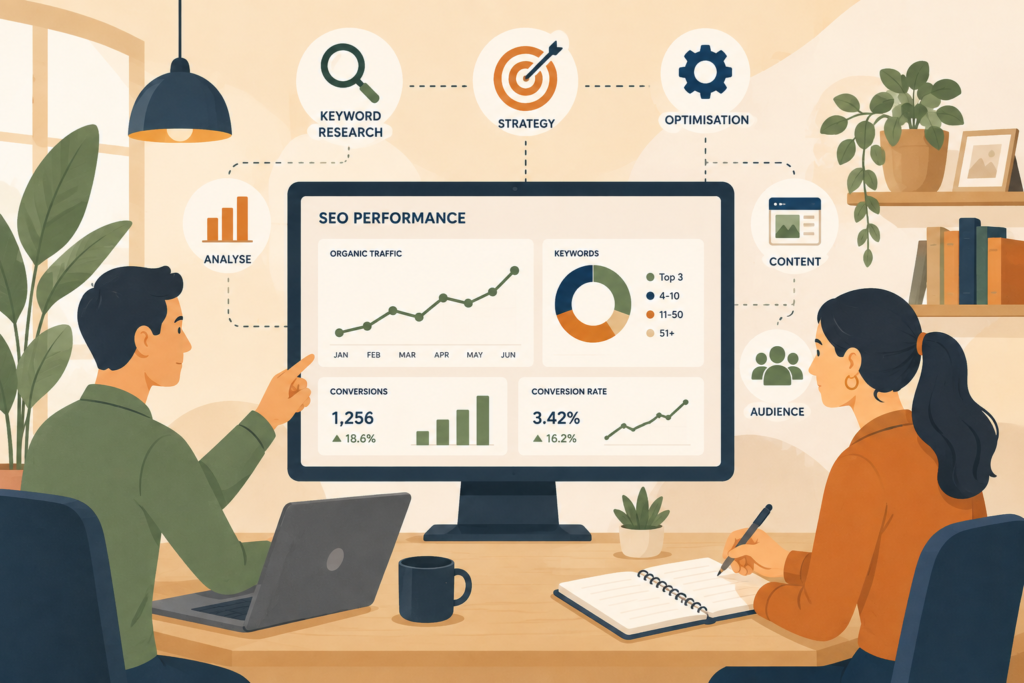
It should answer:
- What work was completed?
- What changed in search visibility?
- Which pages gained or lost traffic?
- How many relevant conversions came from organic search?
- What was the cost per organic lead?
- What commercial value can reasonably be attributed to SEO?
- What limitations affect the data?
- What should happen next?
The purpose is not to make every number look positive. The purpose is to learn where organic search is producing value and where the strategy needs adjustment.
How VVRapid Can Help
VVRapid approaches SEO as a combination of technical foundations, useful content, relevant search visibility and measurable business outcomes.
Support can include keyword research, technical reviews, on-page improvements, content planning, internal linking, analytics setup and ongoing reporting.
The focus is on steady, data-informed improvement rather than guaranteed rankings or inflated traffic claims.
You can review the Search Engine Optimisation service to see the available levels of support.
For a tailored discussion, use the VVRapid contact page.
Frequently Asked Questions
What is a good SEO ROI for a small business?
There is no universal percentage that applies to every business. A useful result depends on profit margins, customer value, sales cycles, competition and the full cost of the work. Compare SEO ROI with your own targets and alternative acquisition channels.
How long should I wait before measuring SEO ROI?
Track indicators from the beginning, but assess commercial return across a longer period such as three, six or twelve months. New websites and competitive markets may require more time before stable patterns appear.
Can I calculate SEO ROI without e-commerce tracking?
Yes. Service businesses can use qualified leads, lead-to-customer rates and average gross profit to estimate value. Keep the assumptions conservative and apply the same method consistently.
Should I include branded traffic in the calculation?
You can include it, but report branded and non-branded performance separately. This helps distinguish existing brand demand from new discovery created through search visibility.
Is organic traffic enough to prove SEO is working?
No. Traffic is one indicator. You also need to review relevance, conversion rate, lead quality, customer value and cost per organic lead.
How accurate is SEO attribution?
It is rarely perfect. Customers may use several channels and devices before converting. Combine analytics, CRM records, form data, call tracking and reasonable assumptions to create the most reliable view available.
A clear SEO ROI for small business framework will not remove every data gap. It will help you ask better questions, compare channels more fairly and invest based on commercial evidence rather than traffic alone.