
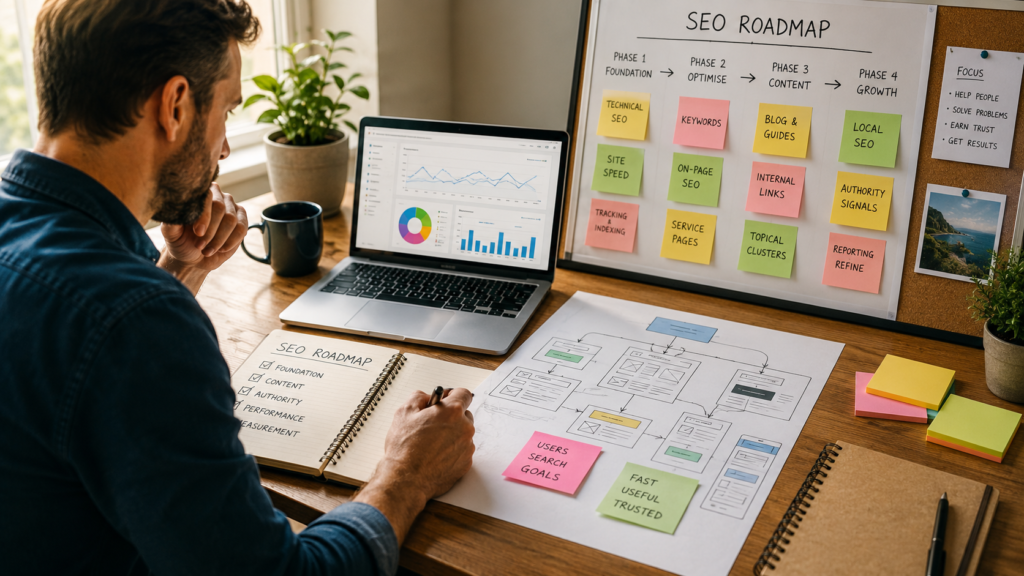
An SEO roadmap for small business helps you stop guessing, stop chasing random tips, and start improving your website in the right order. Instead of doing “a bit of SEO” whenever traffic drops, you work through clear priorities that make your site easier to find, easier to trust, and easier to turn into enquiries.
Table of Contents
For many small business owners, search engine optimisation feels like a long list of unrelated tasks: keywords, page speed, blog posts, meta descriptions, Google Business Profile, backlinks, analytics, content updates, and technical fixes. The problem is not that these things are unimportant. The problem is deciding what comes first.
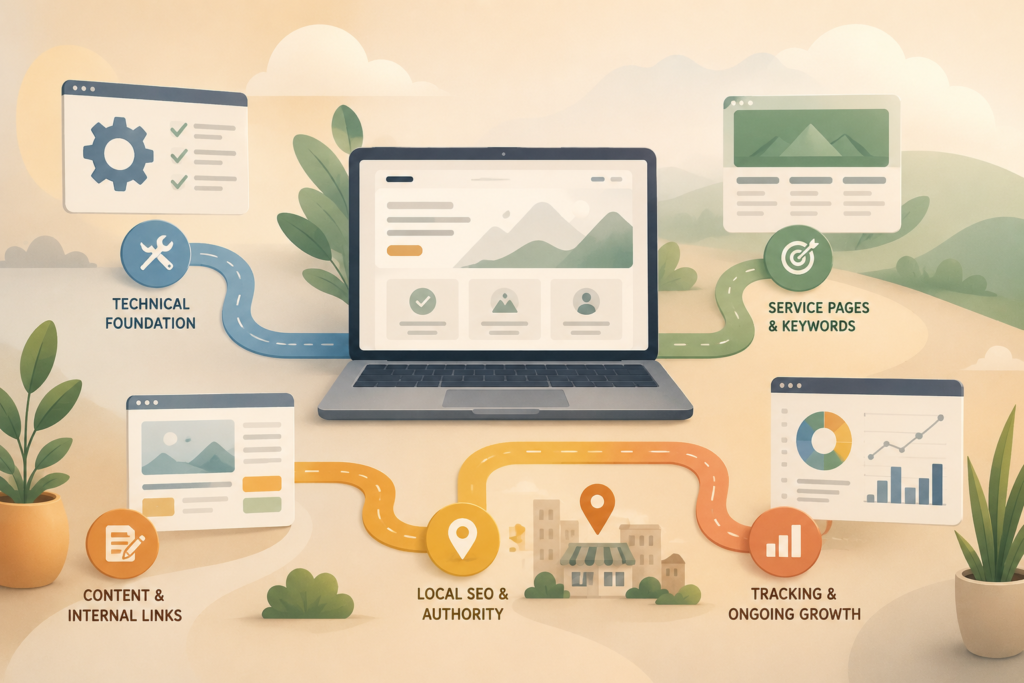
A good SEO roadmap for small business gives you that order.
Think: foundation first, visibility next, growth after that.
This guide walks through a practical sequence you can use whether you are just starting SEO, trying to recover from inconsistent work, or preparing to hire help. It is designed for busy owners who want a small business SEO plan that makes sense, not a 90-page strategy document nobody uses.
If you need structured support, VVRapid’s Search Engine Optimisation service can help turn scattered SEO tasks into a clear plan.
Why an SEO Roadmap for Small Business Matters
An SEO roadmap for small business matters because SEO is cumulative. The work you do this month should support the work you do next month.
When there is no roadmap, businesses often jump between tactics. One week they rewrite a homepage. The next week they publish a blog post. Then they install a speed plugin, change page titles, add a few keywords, and wonder why nothing feels connected.
That scattered approach creates three problems:
- You fix low-impact things while bigger issues remain untouched.
- You publish content before your core service pages are ready.
- You measure rankings without knowing whether the traffic is useful.
A clear SEO strategy puts your effort where it is most likely to help. For a small business, that usually means starting with the pages that explain what you sell, who you help, where you operate, and why someone should contact you.
Your roadmap does not need to be complicated. It needs to answer one question:
What should we fix first so the next SEO task works better?
Phase 1: Make Your Website Crawlable, Fast, and Measurable
The first phase of an SEO roadmap for small business is not glamorous, but it matters. Before you worry about publishing more content, make sure search engines can access, understand, and index the pages that already exist.
This phase usually includes technical SEO foundations, website performance, and basic measurement.
Check that important pages can be found
Start by looking at your core pages:
- Homepage
- Main service pages
- Location pages, if relevant
- About page
- Contact page
- Key blog or guide pages
- Product or booking pages, if applicable
Each important page should be accessible through your navigation, footer, or internal links. If a page is buried, orphaned, blocked, duplicated, or missing from your sitemap, it may struggle to perform.
A practical SEO roadmap for small business should flag these issues early because they affect everything else.
Set up your measurement tools
You cannot improve what you cannot see.
At minimum, your website should have Google Search Console and Google Analytics configured properly. Search Console helps you understand search performance, indexing, queries, clicks, and technical issues. Analytics helps you understand visitor behaviour, conversions, and which channels are contributing to enquiries.: Google Search Console Help ↗
Do not wait until “later” to set these up. If your measurement is missing now, you lose useful baseline data.
Improve speed and mobile usability
Fast pages are better for users, especially on mobile. They also make your website feel more trustworthy. For small businesses, performance problems often come from oversized images, bloated themes, weak hosting, unused plugins, and poorly built page layouts.
Use PageSpeed Insights as a starting point, then prioritise the fixes that affect real users most.: PageSpeed Insights ↗
This is also where hosting and maintenance matter. A technically weak website makes organic traffic growth harder than it needs to be.
If performance is holding the site back, reliable LiteSpeed WebServer Hosting can support faster load times and a stronger technical foundation.
Phase 2: Clarify Your Core SEO Priorities
Once the foundation is working, the next part of an SEO roadmap for small business is choosing the right SEO priorities.
This is where many businesses go too broad too soon. They try to rank for every service, every location, every problem, and every buyer question at once.
Start smaller.
Choose your most valuable services
List your main services or offers. Then mark which ones are:
- Most profitable
- Most requested
- Easiest to deliver well
- Most aligned with future growth
- Most likely to attract the right customers
Your SEO strategy should support business priorities, not just search volume.
A keyword with 200 searches per month from serious buyers may be more useful than a broad keyword with 5,000 searches from people who will never enquire.
Match pages to search intent
Search intent is the reason behind the search.
Someone searching “what is technical SEO” probably wants to learn. Someone searching “SEO services for small business” may be comparing providers. Someone searching “local SEO consultant near me” may be ready to act.
Your SEO roadmap for small business should separate informational pages from commercial pages.
Service pages usually target commercial investigation or high-intent searches. Blog posts support those pages by answering related questions and building topical authority.
Avoid creating too many thin pages
A small business SEO plan should not produce dozens of weak pages just to target tiny keyword variations.
For example, if you serve multiple nearby areas, you may need location pages. But each page should have genuinely useful, specific content. Copying the same page and swapping the town name is not a strong long-term strategy.
Better pages. Better structure. Better intent matching.
Phase 3: Optimise Your Main Service Pages
Your service pages are usually the commercial centre of your website. If they are unclear, thin, slow, or poorly structured, your SEO content may bring traffic without creating enquiries.
This phase of an SEO roadmap for small business focuses on making key pages rankable and useful.
What a strong service page should include
A good service page should explain:
- What the service is
- Who it is for
- What problem it solves
- What is included
- How the process works
- What makes your approach credible
- What the next step is
It should also include clear headings, relevant keywords, helpful internal links, strong meta data, and a natural call to action.
This is not about stuffing keywords. It is about making the page easier for both people and search engines to understand.
When your service pages need clearer structure, stronger messaging, or better conversion flow, VVRapid’s Website Design & Development service can help improve the pages SEO depends on.
Use keywords where they help clarity
Your primary keyword should appear in the page title, opening copy, headings where natural, meta title, meta description, and URL. Related phrases can appear throughout the copy.
For a service page, these related phrases may include:
- Search engine optimisation services
- SEO strategy
- Organic traffic growth
- SEO priorities
- SEO timeline
- Small business SEO plan
The goal is to describe the topic fully, not repeat the same phrase until the page sounds robotic.
Add internal links that guide the buyer journey
Internal links help users and search engines understand which pages matter.
For example, a service page about SEO might link to related pages about website design, hosting, blog writing, maintenance, and digital strategy. A blog post about an SEO roadmap for small business should link back to the main SEO service page and other relevant support services.
This helps turn useful reading into a clearer next step.
Phase 4: Build Supporting Content Around Buyer Questions
Once your main pages are solid, content becomes more powerful.
This part of an SEO roadmap for small business is where blog posts, guides, FAQs, and comparison content support your service pages.
The best content does not chase random keywords. It answers the questions buyers ask before they enquire.
Build content around the buying journey
Useful content often fits into three stages:
Starter stage: The reader is learning what the problem is.
Example: “Why is my website not showing on Google?”
Growth stage: The reader understands the problem and wants options.
Example: “How long does SEO take for a small business?”
Authority stage: The reader is comparing approaches and providers.
Example: “SEO roadmap vs SEO audit: which do you need first?”
A strong SEO roadmap for small business should include all three stages over time.
Connect blog posts to service pages
Every blog post should have a job.
Some posts attract early-stage readers. Some help people compare options. Some support local SEO. Some explain technical ideas in plain language. But each post should connect back to a relevant commercial page where appropriate.
This is where Blog & Article Writing Services can support a broader search engine optimisation services strategy.
For consistent supporting content, VVRapid’s Socials, Blog & Article Writing Services can help build useful articles around buyer questions and search intent.
Refresh before you overpublish
Publishing new content is useful, but old pages often need attention too.
If you already have blog posts or service pages, check whether they are outdated, thin, poorly linked, or missing important buyer questions. Refreshing useful content can sometimes be a better SEO priority than publishing something new.
Phase 5: Strengthen Local and Trust Signals
For businesses that serve specific regions, local visibility can be a major part of an SEO roadmap for small business.
This is especially relevant for small businesses in South Africa and other location-based markets where customers often search with city, suburb, or “near me” intent.
Optimise your Google Business Profile
Your Google Business Profile should be complete, accurate, and consistent with your website. Include the right business category, service areas, opening hours, contact details, photos, and service information.: Google Business Profile Help ↗
Local SEO is not about tricking maps results. It is about making your business easier to verify and choose.
Keep business details consistent
Your name, address, phone number, and website should be consistent across your website, business listings, directories, and social profiles.
Inconsistent details create confusion. Confusion slows trust.
Show credibility on your website
Trust signals can include clear contact details, real team information, service explanations, process notes, transparent expectations, privacy pages, policies, and helpful FAQs.
For SEO, credibility is not only about backlinks. It is also about whether your website looks like a real, reliable business.
Phase 6: Create a Practical SEO Timeline
An SEO roadmap for small business should include a timeline, but it should not pretend every result is predictable.
SEO depends on your website condition, competition, content quality, technical issues, location, budget, and consistency. Pricing varies by scope and region. Timelines vary too.
Still, a simple sequence helps.
Month 1: Audit, tracking, and quick fixes
Focus on:
- Google Search Console and Analytics setup
- Technical checks
- Indexing issues
- Sitemap and robots.txt review
- Core page review
- Basic speed improvements
- Priority keyword mapping
Months 2 to 3: Service page improvements
Focus on:
- Main service page optimisation
- Meta titles and descriptions
- Heading structure
- Content gaps
- Internal links
- Local signals
- Conversion improvements
Months 3 to 6: Content and authority building

Focus on:
- Supporting blog content
- Topic clusters
- FAQs
- Content refreshes
- Local content, if relevant
- Natural link opportunities
- Ongoing reporting
Month 6 and beyond: Refine based on data
Focus on:
- Pages gaining impressions but not clicks
- Pages ranking on page two
- Content that needs expansion
- Keywords attracting poor-fit visitors
- Conversion tracking
- New opportunities from Search Console
A useful SEO roadmap for small business is not fixed forever. It should evolve as data improves.
SEO Roadmap for Small Business Checklist
Use this checklist to shape your first roadmap:
- □ Confirm your website can be crawled and indexed.
- □ Set up Google Search Console and Google Analytics.
- □ Identify your most important services and locations.
- □ Map one primary search intent to each key page.
- □ Improve page speed and mobile usability.
- □ Optimise your homepage and main service pages first.
- □ Add clear internal links between related pages.
- □ Create content around real buyer questions.
- □ Refresh outdated pages before publishing too much new content.
- □ Improve Google Business Profile and local trust signals.
- □ Track enquiries, not only rankings.
- □ Review progress monthly and adjust your SEO priorities.
This checklist keeps the SEO roadmap for small business practical. It gives your team a repeatable way to decide what matters now and what can wait.
Common Mistakes When Building an SEO Roadmap
Even a simple SEO strategy can go off track if the order is wrong.
Mistake 1: Starting with blog posts before service pages
Blog posts can attract traffic, but service pages usually convert buyers. If your service pages are weak, content may bring people into a website that does not explain your offer clearly.
Fix the commercial pages first.
Mistake 2: Treating every keyword as equal
Not every keyword deserves the same effort. Some bring researchers. Some bring buyers. Some bring people outside your service area. Some bring visitors who cannot afford or do not need your offer.
An SEO roadmap for small business should prioritise keywords based on business value and intent.
Mistake 3: Ignoring technical issues
If your site is slow, hard to crawl, poorly structured, or full of broken links, content will work harder than it should.
Technical SEO fixes create a cleaner base for organic traffic growth.
Mistake 4: Measuring traffic but not enquiries
More visitors are useful only if they include the right visitors.
Track form submissions, calls, bookings, quote requests, and other meaningful actions. SEO is not only a visibility channel. It should support lead quality.
Mistake 5: Changing direction too quickly
SEO needs consistent improvement. If you change the plan every few weeks, you may never give your work enough time to show useful data.
Review monthly, but avoid panic edits.
How to Know What to Fix First
When everything feels urgent, use this simple filter:
- Does this affect whether search engines can access the page?
- Does this affect whether users understand the offer?
- Does this affect whether the page matches search intent?
- Does this affect whether visitors can enquire?
- Does this support a high-value service or location?
If the answer is yes to several of these, it belongs near the top of your SEO roadmap for small business.
This is why a roadmap is so helpful. It stops SEO from becoming a list of disconnected tasks and turns it into a sequence of decisions.
FAQ: SEO Roadmap for Small Business
What is an SEO roadmap for small business?
An SEO roadmap for small business is a prioritised plan that shows what SEO work to do first, next, and later. It usually includes technical fixes, keyword planning, service page optimisation, content creation, local SEO, and reporting.
How long should a small business SEO plan cover?
A practical small business SEO plan usually covers the next three to six months, with monthly reviews. The direction can be longer term, but the actions should stay close enough to adjust based on data.
Should I do an SEO audit before creating a roadmap?
Yes, but the audit should lead to decisions. A long list of issues is not enough. The roadmap should turn audit findings into clear SEO priorities.
Is SEO worth it for a small local business?
SEO can be valuable when customers search for your services online and your website is able to turn visitors into enquiries. For local businesses, SEO often works best when website optimisation and Google Business Profile improvements support each other.
Can I build an SEO roadmap myself?
Yes. Start with tracking, technical basics, service pages, internal links, and useful content. If your website is large, competitive, or technically messy, professional search engine optimisation services can help you prioritise faster.
How VVRapid Can Help
VVRapid helps small businesses turn SEO from scattered tasks into a clear, practical plan.
The Search Engine Optimisation service covers technical foundations, on-page SEO, local SEO, analytics, reporting, and ongoing improvements. If your website also needs stronger structure, faster hosting, better content, or regular care, VVRapid can connect those pieces into one joined-up roadmap.
No hype. Just steady, useful SEO work that supports better visibility and better enquiries.
For a broader plan across SEO, content, website improvements, and digital priorities, VVRapid’s Digital Strategy Roadmaps can help map the next steps.
To start, view VVRapid’s Search Engine Optimisation service page or contact the team for a practical recommendation based on your website, goals, and current SEO position.