Choosing one page website vs multi page website is one of the first real decisions a small business has to make when planning a new site. The right answer depends less on trends and more on your offer, your goals, and how much information your visitors need before they contact you or buy.
Table of Contents
A one-page site can be clear, fast, and cost-effective. A multi-page site can create more room for small business website SEO, clearer service targeting, and future growth. The best structure is the one that matches how your business actually sells.
If you are still shaping your brief, it helps to review your goals first, then compare structure options with your likely user journey. For businesses planning a new build, Website Design & Development can be a practical starting point for getting the right small business website structure in place.
One page website vs multi page website: the practical difference
The core difference in one page website vs multi page website is simple.
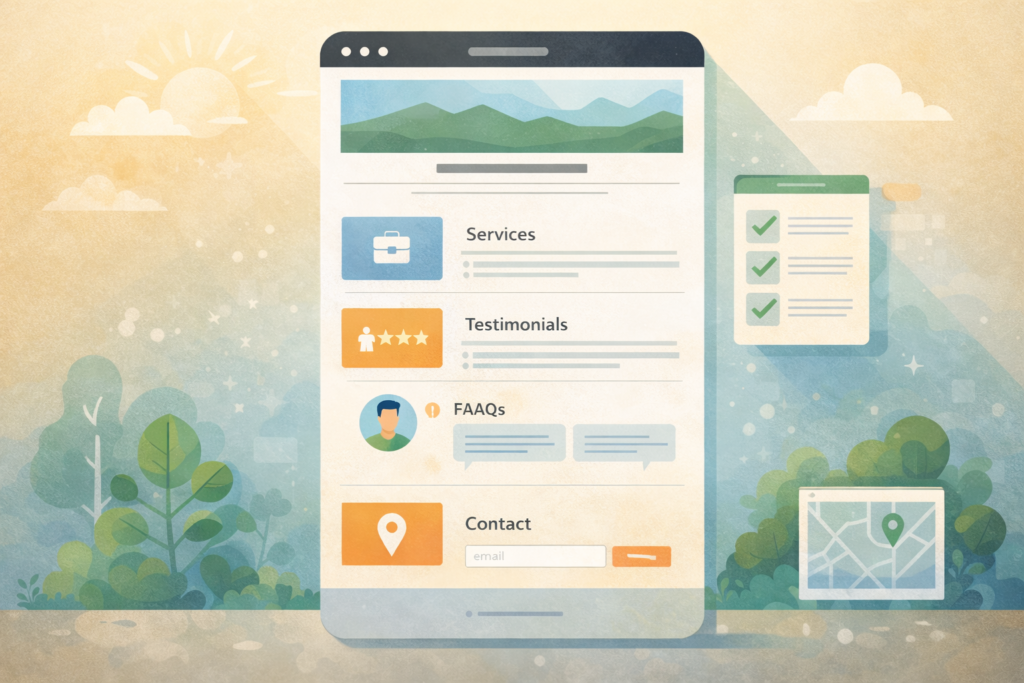
A one-page website puts most or all key information on a single scrolling page. Navigation links usually jump to sections like About, Services, Pricing, FAQ, and Contact. For some businesses, a one page website for small business can be enough to create clarity and drive enquiries.
A multi-page website separates content into dedicated pages. You might have a homepage, individual service pages, an about page, FAQs, case studies, blog posts, and a contact page. In many cases, a multi page website for small business gives you more flexibility as your offer grows.
Neither is automatically better.
The better option depends on things like:
- how many services you offer
- how different those services are
- whether SEO matters now or later
- how much proof or explanation a buyer needs
- whether your business is likely to grow its content over time
Think: a simpler business usually needs a simpler structure. A more layered offer usually needs more room.
When a one-page website makes sense
A one-page site can work very well for the right business.
It is often a good fit when:
- you offer one clear service
- your audience already understands what you do
- your site’s main goal is contact or a quote request
- you need to launch quickly
- you have limited content right now
- you want a lower-maintenance starting point
Examples might include a solo consultant, a local service provider with one main offer, a trades business in a specific area, or a new business validating demand. In those cases, a one page website for small business can support a simple website conversion strategy without adding unnecessary pages.
Benefits of a one-page website
1. Simpler decision path
Visitors do not have to choose between lots of pages. They can scroll from overview to proof to contact in one flow.
2. Faster to plan and launch
With less architecture to map, content and design can move faster. That can be useful when website planning for small business needs to stay lean and practical.
3. Lower content burden
You do not need polished copy for six or ten separate pages on day one.
4. Good for early-stage businesses
If your offer is still evolving, a one-page build can be a sensible first step.
Limits of a one-page website
This is where one page website vs multi page website becomes more important.
A one-page site can start to feel cramped when:
- you have multiple services with different buyer intent
- you need to target multiple keywords
- you want dedicated landing pages for ads or SEO
- you have a lot of proof, process detail, or FAQs
- users need to compare options before enquiring
It can also become harder to expand cleanly later if too much gets stacked onto one page. That is often where service business website design needs a broader structure.
When a multi-page website makes more sense
A multi-page site is usually the stronger choice when the business is more than a simple brochure.
It often suits businesses that:
- offer several distinct services
- want to rank for more than one topic or location
- need stronger trust-building content
- want a blog or resource section
- expect the site to grow over time
- need clearer paths for different audiences
For many service businesses, a multi page website for small business creates better clarity. Instead of squeezing everything into one scroll, each service can have its own page, each audience can find the right information faster, and each page can support a distinct search intent.
Benefits of a multi-page website
1. Better SEO potential
This is one of the biggest factors in one page website vs multi page website. Dedicated pages give you more chances to target specific services, questions, and search terms. That matters if small business website SEO is part of your growth plan.
2. Clearer user journeys
A visitor looking for one service does not need to scan past three unrelated sections. This often leads to a stronger website user experience.
3. More room for proof
You can include deeper FAQs, process pages, project examples, team pages, and detailed service content.
4. Easier future scaling
If you plan to add new services, locations, articles, or campaigns, a multi-page structure is easier to grow. It usually creates a stronger website architecture for SEO too.
Limits of a multi-page website
A multi-page site is not automatically smarter.
It can be the wrong move when:
- you do not yet have enough content to support it
- the structure creates too many weak or thin pages
- you overcomplicate the menu
- the business has only one simple offer
- you do not have time to maintain the content
More pages only help if those pages are useful.
SEO, UX, and conversion trade-offs
The real question in one page website vs multi page website is not just design. It is also about visibility, usability, and conversion.
SEO
A multi-page site usually has the edge for SEO because it gives search engines clearer topic separation and gives users a better chance of landing on the exact page they need.
That said, a one-page site can still perform for branded searches, local intent, or a very narrow service if the page is strong, technically sound, and clearly written. Good website design for small business is not only about looks. It also needs to support search visibility and action.
If organic growth matters to you, Search Engine Optimisation should be part of the planning discussion early, not bolted on later. This is especially true when deciding whether your small business website structure should support future service pages, landing pages, and content clusters.
UX
A one-page site often feels smooth on mobile because the journey is linear. But long pages can also become tiring if too much content is packed in without good sectioning.
A multi-page site can improve clarity, but only if navigation is simple and page hierarchy is logical. Strong website user experience depends less on page count and more on whether visitors can quickly find what they need.
Conversion
For very warm traffic, a one-page site can convert well because everything is in one place.
For more considered decisions, a multi-page site often wins because it gives buyers more confidence. They can explore service details, process, proof, pricing approach, and FAQs before taking action. That is often where a stronger website conversion strategy shows up in the structure itself.
A simple decision checklist
Use this checklist if you are stuck on one page website vs multi page website.
Choose a one-page website if most of these are true:
- You sell one main service
- Your offer is easy to explain quickly
- Your priority is a quick launch
- You do not need many SEO landing pages yet
- Most visitors just need enough confidence to contact you
- Your proof and FAQs are still limited
Choose a multi-page website if most of these are true:
- You have multiple services or service variations
- Different buyers need different information
- You want stronger SEO growth over time
- You need dedicated pages for services, locations, or industries
- You have enough content to support several useful pages
- You want your site to scale without a restructure in six months
This kind of website planning for small business works best when you focus on what users need now, not just what might be nice later.
Common mistakes when choosing site structure
1. Choosing based on aesthetics alone
The one page website vs multi page website decision is not just a design preference. It should come from business goals and user needs.
2. Starting too big
Some small businesses launch with too many weak pages. That usually creates clutter rather than trust.
3. Starting too small for a complex offer
A one-page site can work, but not if it forces three services, pricing questions, trust proof, and industry-specific details into one overwhelming scroll. In that situation, service business website design usually needs more breathing room.
4. Ignoring future growth
A site should fit now, but it should also leave room for what comes next. If content growth is likely, plan for that early.
5. Treating SEO as separate from structure
Site structure affects crawlability, internal links, keyword targeting, and content expansion. It is not just a UX decision. A well-planned website architecture for SEO can make future growth much easier.
A smart middle-ground option
For many small businesses, the answer to one page website vs multi page website is not extreme.
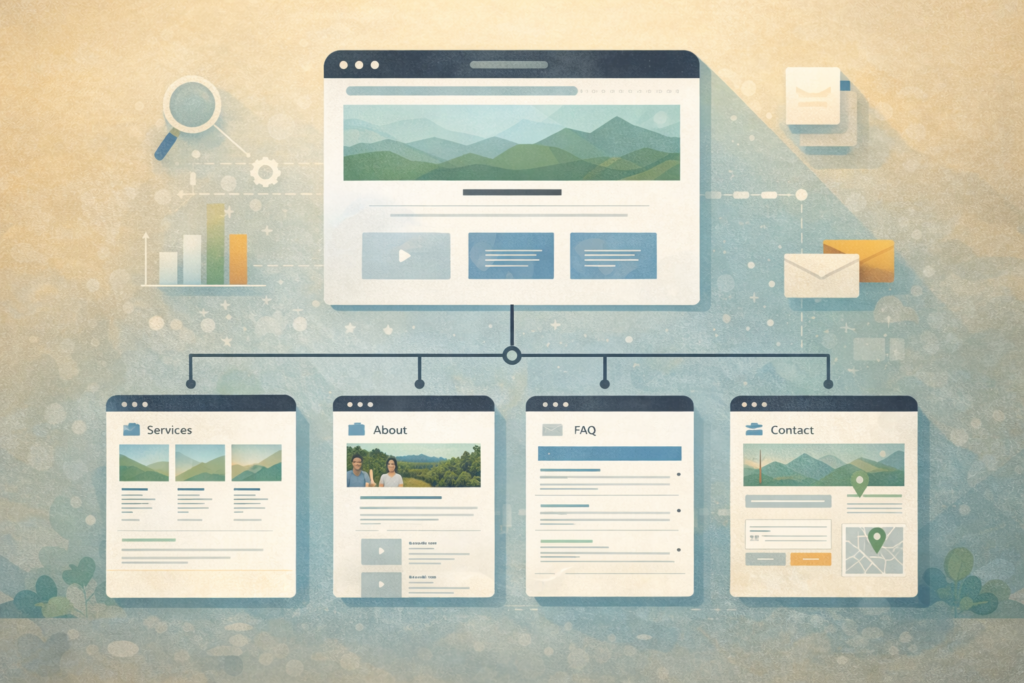
A practical middle ground might be:
- a lean homepage
- 2 to 4 focused service pages
- one clear contact page
- a simple FAQ or about page
This gives you clarity without overbuilding.
It also creates room to grow. You can start with a manageable structure, then add blog content, case studies, or landing pages later once you see what users actually respond to. This can be a very effective version of website design for small business because it balances simplicity with growth potential.
If you go this route, ongoing updates matter. Website Maintenance & Care can help keep a growing WordPress site secure, backed up, and stable as content expands.
How to decide in 15 minutes
If you need a practical answer fast, do this:
Step 1: list your services
Write down every service or product you want the site to support.
Step 2: group them by intent
Ask whether each item needs its own explanation, proof, or CTA.
Step 3: check your traffic goals
If SEO and content growth matter, a multi-page structure usually gives you more room.
Step 4: review buyer hesitation
If prospects ask lots of questions before contacting you, they probably need more than a one-page summary.
Step 5: decide what must exist now
Launch what is necessary, not everything imaginable.
If the result still feels messy, a strategy-first planning session can save time. Digital Strategy Roadmaps are useful when your website planning for small business has become scattered across too many ideas.
FAQ: One page website vs multi page website
Is a one-page website bad for SEO?
Not always. A one-page site can work for a simple offer or branded search intent. But a multi-page site usually gives you more flexibility to target different services and search topics.
Is a multi-page website always better?
No. If your business is simple and your content is thin, more pages can just create noise.
Can I start with one page and expand later?
Yes. That is often a sensible route for a new or lean business. Just make sure the structure can expand cleanly later.
What is better for local businesses?
It depends on the service range. A single local service may be fine on one page. Multiple services or service areas usually benefit from a multi-page setup.
How many pages should a small business website have?
There is no perfect number. What matters is whether each page earns its place by helping users and supporting a real business goal.
How VVRapid can help
If you are weighing one page website vs multi page website and want a structure that feels clear, realistic, and growth-ready, VVRapid can help. The focus is not on pushing the biggest build. It is on matching the site to your business, your content, and your next stage. Website Design & Development, SEO, hosting, maintenance, and strategy support can all work together when your site needs to do more than just look good.
A good next step is to review the Website Design & Development service page or contact VVRapid to map the right structure before design starts.
External links used