
If you are planning a rebuild, website redesign ROI should be the question before design direction, page count, or platform debates. A redesign can absolutely be worth it, but only if it improves the things that matter to the business, such as qualified enquiries, conversion rate, average order value, lead quality, or operational efficiency.
Table of Contents
A lot of small businesses talk about a redesign as if it is automatically a growth move. Sometimes it is. Sometimes it is just an expensive cleanup project wearing growth language. Website redesign ROI is really about deciding whether the likely business gain is big enough, clear enough, and measurable enough to justify the cost, the disruption, and the opportunity cost of doing it now.
VVRapid’s own content already separates redesign, rebuild, and fix decisions at a practical level, which is useful context here. This article goes one step further and asks: if you do invest in a rebuild, how do you judge whether that investment is actually worth it?
What website redesign ROI actually means
At a simple level, website redesign ROI is the return you expect from redesigning or rebuilding your website compared with what that project costs.
That return does not have to mean ecommerce revenue only.
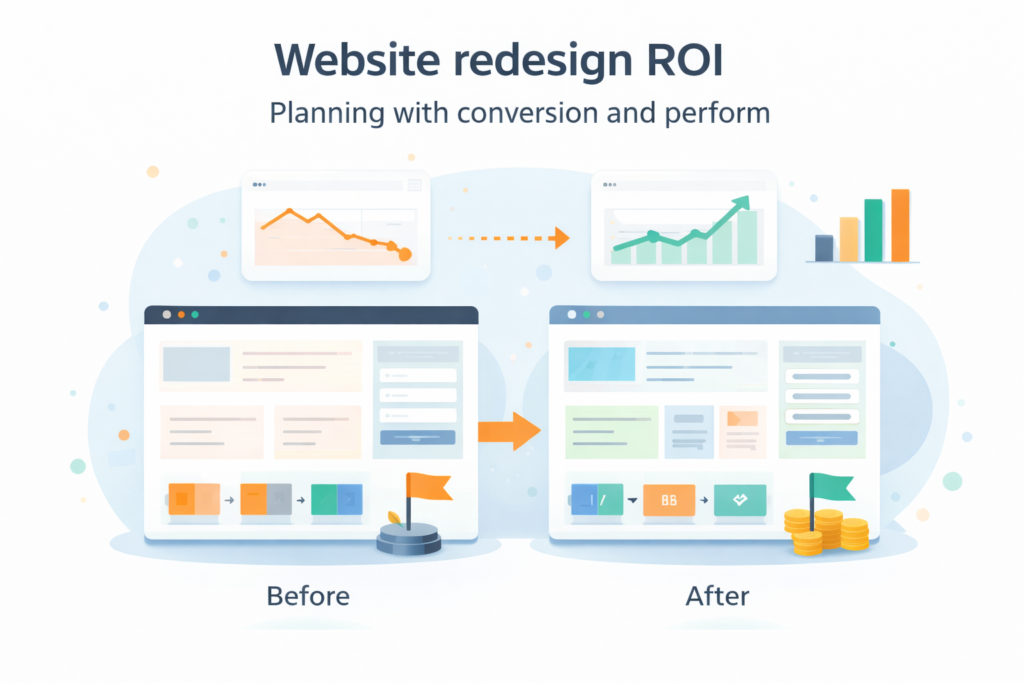
Depending on the business, website redesign ROI may come from:
- more qualified leads
- higher enquiry-to-sale conversion
- better average order value
- improved booking volume
- fewer wasted sales calls
- reduced support friction
- lower maintenance costs
- better performance from SEO or paid traffic already being sent to the site
This matters because a redesign is rarely valuable just because the site looks newer. A new look can support trust and usability, but the business case usually sits underneath that. Nielsen Norman Group’s research on first impressions and trust shows that design quality influences how users judge credibility, but credibility alone is not the full ROI story unless it changes behaviour in a measurable way.
When website redesign ROI is likely to be real
There are situations where website redesign ROI is often easier to justify.
1) Your traffic is decent, but conversion is weak
If you already have traffic through SEO, referrals, ads, or direct visits, the redesign question becomes more commercial.
For example:
- people visit service pages but do not enquire
- quote requests are low compared with traffic
- mobile drop-off is high
- forms are clunky
- the CTA path is unclear
- trust is weak at decision points
In cases like these, the redesign may not need to “create demand” from scratch. It may simply need to convert existing attention better. That is often where ROI becomes more believable.
VVRapid’s Fractional Digital Team page reflects this practical KPI mindset, focusing on leads, calls, bookings, sales, and qualified enquiries rather than vanity metrics.
2) Your current website is slowing sales down
Sometimes a website creates invisible cost.
Examples:
- the team repeats the same explanations on every call
- poor structure sends low-intent enquiries
- pricing or process confusion wastes time
- customers contact support for information the site should already answer
- the site cannot present the offer clearly enough for buyers to self-qualify
In these cases, website redesign ROI includes saved time and better sales efficiency, not just headline lead numbers.
3) You are already investing in traffic acquisition
If you are spending on SEO, content, or paid traffic, a weak website can reduce the return on all of it.
That is one reason VVRapid’s recent content keeps connecting website structure, content, SEO, and conversion instead of treating them as separate silos. Search visibility without conversion is incomplete.
4) Your offer has changed and the site no longer matches reality
A redesign can be worth it when the business has moved on but the site has not.
Common examples:
- you serve a different market now
- you dropped lower-value services
- the business shifted from generalist to specialist
- you need stronger service pages for higher-intent searches
- your current structure reflects the old business, not the current one
In that case, website redesign ROI may come from clearer positioning and better-fit leads.
When website redesign ROI is usually weak
Not every redesign deserves a green light.
1) You have little traffic and no reliable measurement
If hardly anyone visits the website and tracking is messy, ROI is harder to estimate honestly.
You may still choose to redesign, but that decision is then more about foundational quality than provable return. VVRapid’s Fractional Digital Team page explicitly notes that many businesses first need measurement basics in place so they can trust the numbers.
2) The real problem is offer clarity, not design
A cleaner interface cannot fix an unclear offer.
If the business cannot answer:
- who it helps
- what problem it solves
- why it is different
- what the next step is
then the issue may be positioning and messaging before it is visual design.
3) You are redesigning mostly out of frustration
Sometimes businesses want a rebuild because:
- the backend feels messy
- the site looks old
- editing is annoying
- a competitor launched something new
Those can be valid signals, but on their own they do not guarantee strong website redesign ROI.
4) You have not considered the cost of disruption
A rebuild can absorb serious time from founders, marketers, developers, and sales teams. If that time is taken away from urgent revenue work, the project may be more expensive than the quote suggests.
How to estimate website redesign ROI without fake precision
You do not need perfect data to think clearly. You just need a sensible framework.
Step 1: Define the one or two outcomes that matter most
Choose the main business outcomes.
Examples:
- increase qualified leads by 25%
- improve booking conversion from service pages
- reduce low-quality enquiries
- improve ecommerce revenue per visitor
- reduce manual admin around common pre-sale questions
Keep it tight. Website redesign ROI gets fuzzy when every possible benefit is included at once.
Step 2: Start with current baseline numbers
Use the best baseline you have.
Examples:
- monthly sessions to key pages
- current conversion rate
- current monthly leads
- average close rate
- average job value or customer value
- current support load linked to website confusion
If your numbers are rough, label them rough.
Step 3: Estimate a realistic upside range
Avoid fantasy forecasts.
A better way to estimate website redesign ROI is to use a conservative, mid, and optimistic range.
For example:
- conservative: conversion improves from 1.5% to 1.8%
- mid: conversion improves to 2.1%
- optimistic: conversion improves to 2.4%
Then translate that into commercial impact using average lead value, close rate, or sales value.
The goal is not certainty. The goal is disciplined thinking.
Step 4: Include the full cost, not just the build quote
This is where people undercount badly.
Include:
- design and development cost
- copywriting or content support
- SEO migration work if URLs or structure change
- analytics and tracking setup
- internal review time
- image or asset preparation
- post-launch fixes
- training or handover
- ongoing maintenance
VVRapid already has a separate website migration SEO checklist because redesigns can affect rankings, traffic, and leads when URLs, domains, or platforms change. That is a real cost factor in website redesign ROI, not an optional extra.
Step 5: Ask what happens if you do nothing
This is often the missing comparison.
What does it cost to leave the site as-is for another 6 to 12 months?
That cost may include:
- lost leads
- weak conversion from existing traffic
- lower trust
- ongoing editing pain
- plugin or performance debt
- more patchwork fixes
VVRapid’s content on plugin bloat and maintenance plan decisions supports this point. Sometimes not redesigning is cheaper. Sometimes repeated patching becomes its own hidden cost.
Checklist: questions to ask before approving a rebuild
Use this website redesign ROI checklist before saying yes.
- What specific business outcome should the redesign improve?
- Are we fixing conversion, trust, SEO, operations, or all of the above?
- What baseline numbers do we already have?
- What metrics will define success after launch?
- What is the realistic upside range?
- What are the full project costs, including internal time?
- What are the migration or SEO risks?
- Could a smaller fix solve the main problem?
- What happens if we delay for 6 months?
- Are we redesigning because of evidence or because we are tired of the current site?
Common mistakes
Mistake 1: Treating website redesign ROI as a design-only question
Visual quality matters, but website redesign ROI is usually driven by behaviour change. Better structure, stronger messaging, cleaner CTA paths, improved speed, and clearer trust often matter more than a dramatic visual change alone.
Mistake 2: Counting traffic growth as guaranteed
A redesign does not automatically increase traffic.
In some cases, traffic can dip if migration and SEO handling are poor. That is why migration planning matters so much during a redesign.
Mistake 3: Ignoring lead quality
More leads are not always better leads.
A redesign may be worthwhile because it improves fit, not just volume. For many service businesses, fewer but better enquiries can deliver stronger website redesign ROI than a spike in weak leads.
Mistake 4: Forgetting maintenance and content reality
A rebuild is not the end of the work.
If the new site needs stronger service pages, fresher content, or regular updates to stay effective, that ongoing workload should be part of the decision. VVRapid’s content on maintenance and content writing makes this especially relevant for growing sites.
Mistake 5: Skipping the “fix vs rebuild” comparison
Sometimes the highest-ROI move is not a rebuild at all.
VVRapid’s redesign checklist article exists for a reason: some businesses should redesign, some should rebuild, and some should simply fix what already exists. Website redesign ROI is strongest when you compare those options honestly first.
A practical example of website redesign ROI thinking
Imagine a service business gets 1,500 visits a month to its key pages and converts 1.2% of those visitors into enquiries.
That produces about 18 enquiries a month.
If a redesign improves that to 1.8%, the site produces about 27 enquiries a month.

That is 9 extra enquiries monthly.
Now assume:
- 40% are qualified
- 30% of qualified leads close
- average project value is illustrative only, and pricing varies by scope and region
You can now estimate whether those extra opportunities justify the total redesign cost over 6 to 12 months.
The point is not the exact formula. The point is that website redesign ROI becomes easier to discuss once it is tied to business outcomes instead of vague phrases like “a more modern brand feel.”
FAQ
What is website redesign ROI?
Website redesign ROI is the return you expect from a redesign or rebuild compared with the full cost of the project, including build costs, internal time, migration risk, and post-launch work.
How do I know if a website rebuild is worth it?
A rebuild is usually worth it when the likely gain is clear and measurable, such as better conversion from existing traffic, stronger lead quality, improved operational efficiency, or better support for SEO and growth.
Can a redesign be worth it even if traffic is low?
Yes, but the case is usually more strategic than provable. If traffic is low and tracking is weak, you may be investing in foundations first rather than immediate ROI.
Should I redesign or just fix what I have?
That depends on the real source of the problem. If the issue is localised, smaller fixes may offer better ROI. If the structure, UX, content, and technical setup are all working against you, a rebuild may be justified.
How VVRapid can help
If you are trying to judge website redesign ROI, VVRapid can help you separate cosmetic frustration from real commercial opportunity. That may mean a rebuild through Website Design & Development, a tighter performance and conversion review through Fractional Digital Team, or a more strategic decision first through Digital Strategy Roadmaps.
The goal is not to make every website project bigger. It is to make sure the work is worth doing.
See VVRapid’s Website Design & Development service page or get in touch if you want help judging whether a redesign is likely to pay for itself.