
If you are launching a new site, one of the most common worries is simple: what do you show when you do not have testimonials yet? Proof before testimonials matters because people still need reasons to trust you, even when your business, website, or service offer is new.
Table of Contents
The good news is that a website does not need a review slider to feel credible. People judge trust using a mix of signals, including design quality, clarity, transparency, contact details, and whether the business appears real and current. Nielsen Norman Group’s research notes that users often read reviews before choosing a company, but they also judge trust through layout, disclosure, and the overall professionalism of the site.
For a new business, that is actually useful. It means you can build confidence before you have a bank of glowing client quotes. The question is not “How do I fake social proof?” The question is “What honest proof can I show right now?”
Why proof before testimonials matters for a new website
A new website has less margin for doubt.
If a visitor lands on a fresh site and sees vague copy, no real contact details, no clear service explanation, and nothing that signals a real business, they are likely to hesitate. First impressions happen fast, and visual design plays a major role in whether people feel interest and trust.
That does not mean you need to pretend to be more established than you are.
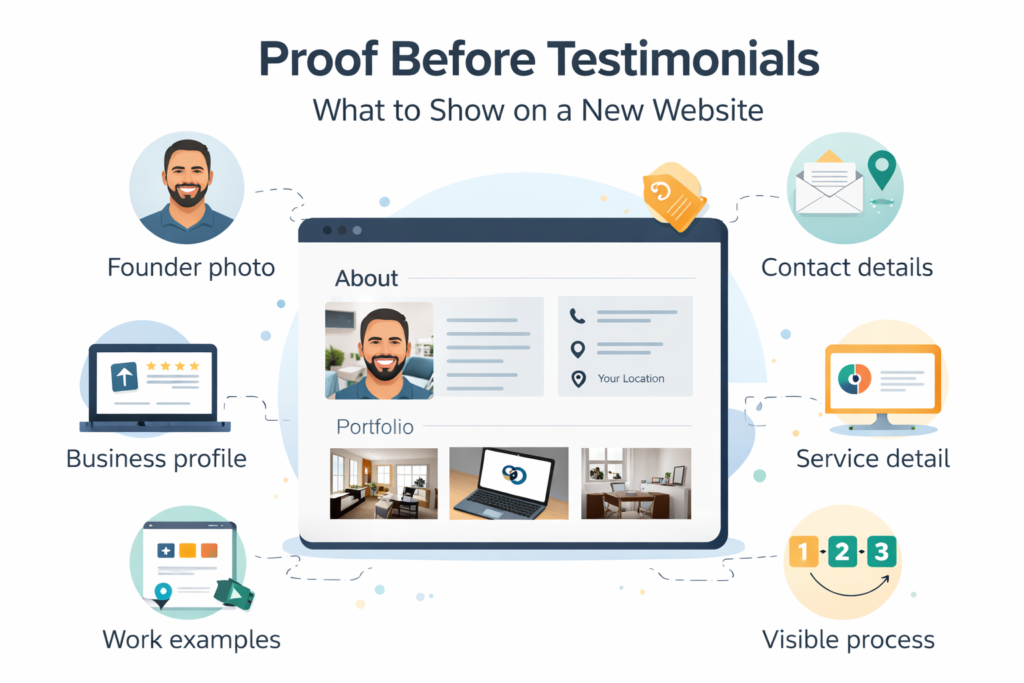
It means you need to replace missing testimonials with other forms of evidence, such as:
- clear business identity
- transparent service information
- real-world contact details
- process clarity
- relevant work samples
- current business profiles
- specific, useful copy
This fits VVRapid’s own service-page positioning well. The Website Design & Development page talks about websites that make it easy for customers to find you, contact you, and trust you. That is exactly the job here.
Proof before testimonials: what you can show instead
The best approach to proof before testimonials is to show evidence that is true, specific, and easy to verify.
1) A clear About section that feels human
A thin About page creates doubt.
Users expect About content to be clear, authentic, and transparent, and they often compare what a company says about itself with outside signals before making decisions.
That means your new website should show:
- who is behind the business
- what the business does
- who it helps
- where it operates
- why it exists, in plain language
This does not need to be dramatic. A short founder section, a real team photo, or a grounded company story can do more than generic marketing lines.
Good proof here looks like:
- named founder or team members
- original photos
- a clear service focus
- local area or region served
- years of relevant experience, only if accurate
For a new business, proof before testimonials often starts with showing the real people behind the work.
2) Real contact information
People trust websites more when they can see that a real business is reachable.
For local and service businesses, that includes basics such as:
- a working email address
- a real phone number
- a physical address or service area where appropriate
- contact options that match how customers actually reach you
Google’s Business Profile guidance emphasises that business information should accurately represent the real-world business and location. Keeping your details consistent and real is part of trust, not just local SEO.
This is one reason a good Website Design & Development build should never treat the contact page as an afterthought.
Accurate contact details are one of the simplest forms of proof before testimonials because they show there is a real business behind the site.
3) A complete and verified Google Business Profile
If you do not have testimonials on your own site yet, a properly set up Google Business Profile can still help show that the business exists and is active.
Google provides official guidance on editing and verifying your business information, managing reviews, and keeping profile details up to date. A complete profile with accurate hours, category, contact details, and photos gives visitors another place to validate that you are real.
This is especially useful for:
- local service businesses
- new agencies
- consultants
- studios
- trades and professional services
Even before many reviews come in, your profile itself can support trust.
4) Work samples, examples, or a portfolio
You may not have testimonials yet, but you may still have proof of capability.
That can include:
- previous work from freelancing or prior roles, where appropriate and allowed
- portfolio samples
- before-and-after examples
- demo projects
- sample deliverables
- screenshots of your process or outputs
The key is honesty. Do not imply client work if it is a self-initiated example. Label things clearly.
For example:
- “Sample landing page concept”
- “Internal demo project”
- “Previous design work from independent freelance projects”
- “Example service workflow for illustration”
That kind of clarity builds more trust than vague claims.
5) A visible process
When people cannot rely on testimonials yet, they often look for signs that the business knows how it works.
A simple process section can help a lot:
- discovery
- quote
- kickoff
- delivery
- review
- support
This works because it reduces uncertainty. Visitors want to know what happens after they make contact. Process transparency is a practical form of proof.
For service businesses, this is often more useful than decorative homepage sections. It shows that the business has a real way of working.
6) Specific service pages instead of generic promises
Generic copy weakens trust fast.
Google’s guidance on helpful, reliable, people-first content is relevant here. Pages should be created to help people, not just to chase visibility with empty claims.
A new business can build trust by writing service pages that answer real buyer questions:
- What do you actually do?
- Who is it for?
- What is included?
- What is not included?
- What happens next?
- How should someone decide if this is right for them?
Specificity is proof.
That is one reason businesses often pair design with Search Engine Optimisation and content support. Good service-page clarity helps both trust and search visibility.
7) Policies, practical details, and small signs of seriousness
Not every trust signal needs to be dramatic.
Small details matter:
- privacy policy
- terms where relevant
- refund or cancellation information if applicable
- response-time expectations
- service area details
- pricing approach or quote process
- business registration details if appropriate to show
These details help visitors feel that the business is organised and real.
They also reduce friction before contact.
Checklist: what to add if you have no testimonials yet
Use this checklist before launch.
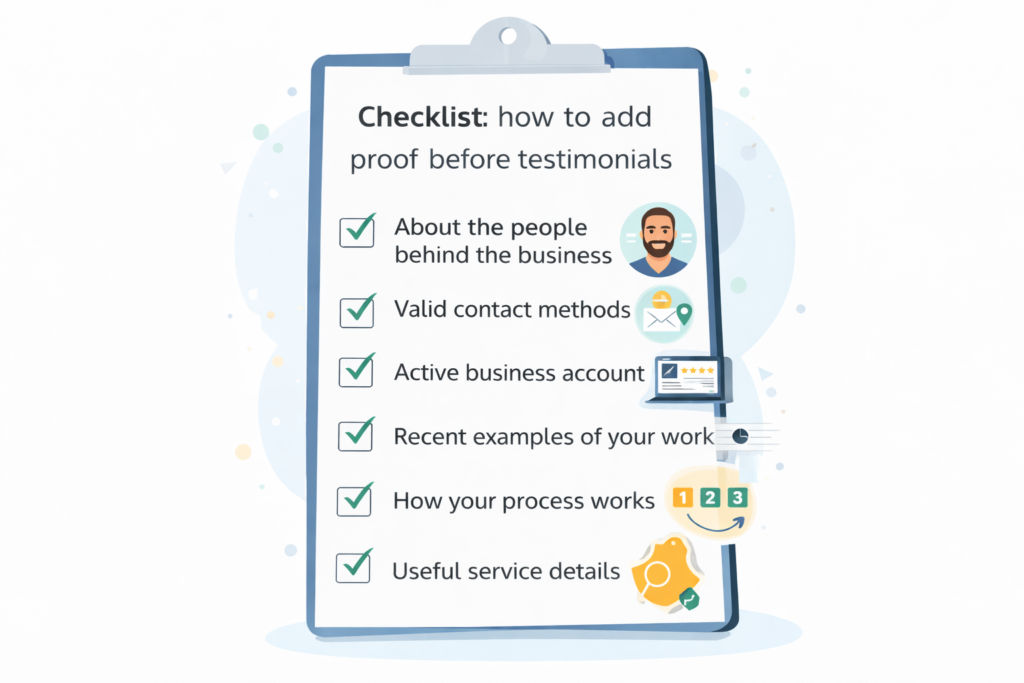
Add:
- ☐ a real About section
- ☐ named people or founder info
- ☐ original photos where possible
- ☐ accurate contact details
- ☐ a complete contact page
- ☐ a verified Google Business Profile
- ☐ examples of work or sample outputs
- ☐ a short process section
- ☐ specific service-page copy
- ☐ practical policies and expectations
If you can only fix a few things first, start with:
- About
- contact details
- service clarity
- process
- one strong example of work
Common mistakes
Mistake 1: Leaving placeholder trust sections in place
Nothing weakens credibility faster than an empty testimonial slider, fake logos, or a “coming soon” section that looks abandoned.
If you do not have proof yet, leave it out and use other proof instead.
Mistake 2: Using stock-heavy imagery with no real business identity
Professional design helps, but an entirely generic site can feel ungrounded. Research from Nielsen Norman Group shows that first impressions and visual presentation strongly shape perceived credibility.
Use at least some real elements:
- founder photo
- workspace
- local cues
- original screenshots
- process visuals
Mistake 3: Making claims you cannot support
Avoid claims like:
- best in the industry
- trusted by hundreds
- proven results
- award-winning
Unless those are true and supportable, they create doubt instead of confidence.
Mistake 4: Hiding basic information
If visitors cannot quickly find who you are, what you do, and how to contact you, trust drops.
People scan websites rather than reading every line, so the basics need to be easy to spot.
Mistake 5: Waiting for reviews before launching properly
You do not need to wait until you have testimonials to publish a solid website.
A cleaner strategy is to launch with honest proof, then add testimonials and third-party reviews as they come in. Google also provides guidance on how reviews and third-party reviews may appear across Business Profiles, which makes it useful to build your profile presence early.
What to do once reviews start coming in
Once you begin collecting reviews, add them carefully.
Google’s Business Profile help includes guidance on managing reviews and keeping your business information current.
A sensible approach is:
- start with third-party reviews where people already trust the source
- add short on-site testimonials only when they are real and attributable
- keep screenshots tidy and readable
- place testimonials near relevant service pages or contact points
- update old proof so the site still feels current
Nielsen Norman Group notes that people tend to trust external reviews more than testimonials shown only on the company website, which is worth remembering when you decide how much weight to place on each.
FAQ: Proof Before Testimonials
Can I launch a website without testimonials?
Yes. A new website can still feel trustworthy if it shows honest proof such as a clear About section, real contact details, process transparency, useful service pages, and examples of work.
Can proof before testimonials really work on a new website?
Yes. Proof before testimonials can work well if the site shows clear identity, accurate contact information, useful service detail, and visible signs that the business is real and current.
Should I add a testimonials section now and fill it later?
No. Empty or placeholder testimonial sections usually hurt more than they help. Launch with real proof you already have.
Do Google reviews count as trust proof?
Yes. A complete and maintained Google Business Profile can support trust, especially for local businesses, even before you have many reviews.
What does proof before testimonials mean?
Proof before testimonials means the honest credibility signals you show on a website before you have reviews, such as real contact details, a clear About section, work examples, process transparency, and useful service-page content.
How VVRapid can help
For a new business website, the goal is not to make the site look established through filler. It is to make the site feel clear, credible, and useful from day one. VVRapid can help shape that through practical structure, better service-page messaging, and a build that supports trust even before testimonials are available. Related support can also include Digital Strategy Roadmaps for planning and Website Maintenance & Care as the site evolves.
A new website does not need fake proof. It needs honest proof, placed well.
See Website Design & Development if you want help building a website that earns trust before the testimonials arrive.