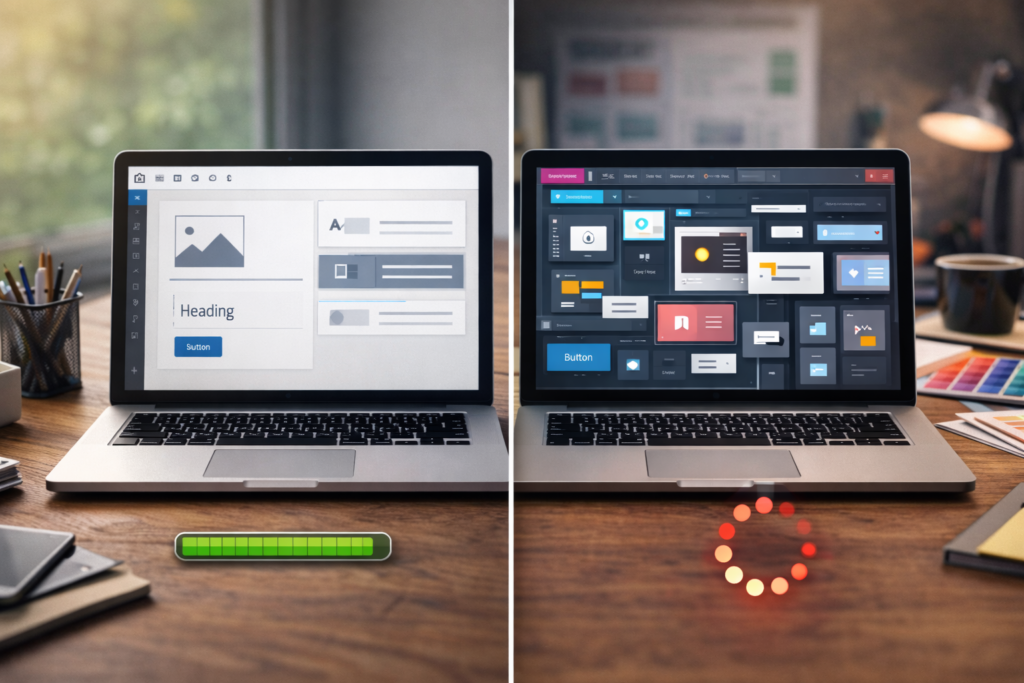

Mobile website speed matters because most visitors will not patiently wait for a slow page to load before deciding whether your business feels credible, useful, and easy to contact.
Table of Contents
For small business owners, speed is not just a technical score. It affects enquiries, bookings, sales, ad performance, SEO, and the first impression people get when they land on your site from a phone.
Think: your website can be beautifully designed and still feel broken if it loads too slowly.
This guide explains what mobile website speed really means, how fast is fast enough, what slows small business websites down, and what to fix first.
Why mobile website speed matters
A fast website feels easier to trust.
When a page opens quickly, visitors can read, compare, enquire, book, or buy without friction. When it loads slowly, people may leave before they even see your offer.
For a small business, that can mean lost leads from:
- Google search traffic
- Paid ads
- Social media campaigns
- WhatsApp or email links
- Local search results
- Referral links
- Returning customers
Mobile website speed is especially important because phones are often used in less-than-perfect conditions. Someone may be browsing on mobile data, switching between apps, walking into a meeting, comparing suppliers, or trying to contact you quickly.
Speed also connects directly to mobile user experience. A visitor should not have to pinch, wait, reload, close popups, or guess what is happening. The page should load, settle, and respond.
Google’s Core Web Vitals measure real-world page experience across loading performance, interactivity, and visual stability, which makes them useful signals when assessing whether a site feels smooth to users.
Mobile website speed: how fast is fast enough?
A practical target is simple: your key mobile pages should feel usable within the first few seconds.
That does not mean every script, image, animation, and tracking tag must finish instantly. It means the visitor should quickly see meaningful content, understand where they are, and be able to take the next step.

For small business websites, focus on these outcomes:
- The first visible content appears quickly
- The main heading and offer are easy to read
- The page does not jump around while loading
- Buttons respond when tapped
- Forms are usable on mobile
- Images load without delaying the entire page
- The site feels stable on slower connections
Google’s PageSpeed Insights documentation identifies the current Core Web Vitals as LCP, INP, and CLS. These measure loading, responsiveness, and layout stability. PageSpeed Insights can show both lab data and real-user field data where available.
In plain English:
- LCP asks: how quickly does the main content appear?
- INP asks: how quickly does the page respond to interaction?
- CLS asks: does the layout stay stable while loading?
If your mobile pages are slow, jumpy, or hard to interact with, visitors will feel it before they understand the metric.
What usually slows small business websites down?
Most slow small business websites are not slow because of one huge problem.
They are slow because of many small decisions stacking up over time.
Common causes include:
- Oversized hero images
- Too many plugins
- Heavy WordPress themes
- Unused scripts
- Poor hosting
- Uncompressed images
- No caching
- Large background videos
- Too many tracking tags
- Bloated page builders
- Third-party chat widgets
- Sliders with multiple large images
- Fonts loading from several sources
- Old plugins or outdated code
This is why website performance optimisation should start with diagnosis, not guesswork.
A common mistake is to install yet another speed plugin without understanding the actual problem. That can help in some cases, but it can also create conflicts, hide deeper issues, or make the site harder to maintain.
If your current site feels slow, VVRapid’s website design and development service can help you rebuild around clearer structure, better mobile UX, and stronger performance foundations.
How to check mobile website speed
You do not need to become a developer to check mobile website speed.
Start with a small group of important pages:
- Homepage
- Main service page
- Contact page
- Product or category page
- Booking page
- Checkout page
- A high-traffic blog post
Then test those pages using PageSpeed Insights and, where available, Google Search Console’s Core Web Vitals report. Search Console groups URL performance by status and metric type, including LCP, INP, and CLS.
When reviewing a speed report, avoid obsessing over one perfect score.
Instead, ask:
- Is the mobile score much worse than desktop?
- Is the main content taking too long to appear?
- Are images too large?
- Are scripts blocking the page?
- Is the page shifting while it loads?
- Is the server response slow?
- Are third-party tools adding unnecessary weight?
A website speed test is useful, but it is only the start. The real question is what the visitor experiences on the pages that matter most.
Core Web Vitals explained for business owners
Core Web Vitals can sound technical, but the business meaning is straightforward.
Largest Contentful Paint
Largest Contentful Paint, or LCP, measures how long it takes for the largest visible image or text block to appear in the viewport. On many small business websites, that will be the hero image, banner, headline block, or main content area.
If your LCP is poor, visitors may stare at a blank or half-loaded screen.
Common LCP fixes include:
- Compressing hero images
- Using the correct image dimensions
- Improving hosting and server response
- Reducing render-blocking scripts
- Avoiding huge sliders above the fold
- Prioritising the main image or heading
Interaction to Next Paint
INP measures how responsive the page feels when someone interacts with it.
For example, when a visitor taps a menu, opens a filter, clicks a button, or starts using a form, the page should respond quickly.
If INP is poor, the site may feel laggy even after it loads.
Common INP fixes include:
- Reducing heavy JavaScript
- Removing unnecessary plugins
- Simplifying interactive elements
- Avoiding overloaded page builders
- Optimising third-party scripts
Cumulative Layout Shift
CLS measures whether content moves around unexpectedly.
You have probably seen this before. You try to tap a button, but an image, ad, cookie banner, or font shift moves the button at the last second.
That feels frustrating.
Common CLS fixes include:
- Setting image dimensions
- Reserving space for banners and embeds
- Loading fonts properly
- Avoiding late-loading popups
- Keeping mobile layouts stable
For a small business owner, Core Web Vitals are not just SEO jargon. They help explain why a website feels smooth or frustrating.
Practical fixes that improve mobile page speed
Improving mobile website speed usually starts with the biggest visible issues.
Here is a practical order.
Compress and resize images
Image optimisation is often the quickest win.
Upload images at the size they actually need to display. A phone screen does not need a massive original photo straight from a camera.
Use modern formats where appropriate, compress images before upload, and avoid using multiple large banner images on one page.
Reduce plugin weight
For WordPress speed optimisation, plugin review is essential.
Ask:
- Do we still use this plugin?
- Does one plugin duplicate another?
- Is this plugin loading scripts sitewide?
- Is this feature worth the performance cost?
- Is there a lighter way to achieve the same result?
Plugins are useful, but every plugin should earn its place.
Use caching correctly
Caching helps returning visitors and repeat page loads by reducing how much work the server and browser need to do.
Good caching can improve perceived speed, but it needs careful setup. Bad caching can break forms, carts, logged-in areas, or dynamic features.
Improve hosting
Hosting affects server response, uptime, caching options, and how well your website handles traffic.
Cheap hosting can be enough for a very simple starter site. But if your website is important for leads, bookings, ecommerce, or content marketing, hosting quality matters more.
VVRapid’s LiteSpeed WebServer Hosting page separates hosting from maintenance and frames hosting as the server environment for speed, uptime, storage, email, and backups.
A well-configured LiteSpeed WebServer hosting setup can support faster loading, caching, and a more stable experience for growing business websites.
Remove unnecessary scripts
Third-party scripts can slow a page down.
Examples include:
- Chat widgets
- Heatmaps
- Social embeds
- Review widgets
- Ad pixels
- Multiple analytics tools
- Marketing automation scripts
Some are useful. Some are not.
Keep the ones that support a clear business purpose. Remove or delay the rest.
Simplify above-the-fold design
The top of the page should load quickly and explain clearly.
Avoid heavy sliders, huge videos, complex animations, or decorative elements that delay the first meaningful content.
For mobile website speed, simple often wins.
A mobile website speed checklist
Use this checklist before redesigning, rebuilding, or paying for advanced optimisation.
- □ Test key pages in PageSpeed Insights
- □ Compare mobile and desktop results
- □ Check Core Web Vitals in Search Console
- □ Compress large images
- □ Replace oversized hero images
- □ Remove unused plugins
- □ Review theme and page builder weight
- □ Enable suitable caching
- □ Check hosting performance
- □ Reduce unnecessary third-party scripts
- □ Avoid heavy sliders above the fold
- □ Set image width and height attributes
- □ Test forms on mobile
- □ Check that buttons respond quickly
- □ Review mobile menu performance
- □ Test on real mobile devices
- □ Retest after each major change
A checklist keeps website performance optimisation focused. It also helps you avoid random fixes that do not move the needle.
How mobile speed affects SEO and conversions
Speed alone will not make a weak website rank or convert.
But slow speed can hold back a good website.
For SEO, slow pages can make crawling, user experience, and engagement weaker. For conversions, slow pages create friction before the visitor reaches your offer.
This matters most when traffic is expensive or hard-earned.
If you are running paid ads, publishing SEO content, building local visibility, or sending people from social media, slow mobile pages reduce the value of that traffic.

A faster site can support:
- Better landing page experience
- More completed forms
- Lower frustration
- Stronger trust
- Better browsing depth
- Smoother ecommerce journeys
- More useful SEO content sessions
VVRapid’s search engine optimisation service can help connect technical SEO, content structure, speed, and search visibility into one practical improvement plan.
Common mistakes with mobile website speed
Chasing a perfect score instead of a better experience
A perfect score is not always realistic or necessary.
The goal is not to win a lab test. The goal is to make the site fast, stable, useful, and easy to act on.
Optimising only the homepage
Your homepage matters, but it may not be the page that drives leads.
Service pages, blog posts, landing pages, product pages, and contact pages also need testing.
Installing too many speed plugins
More speed plugins do not always mean more speed.
They can overlap, conflict, or hide the real issue. Start with diagnosis first.
Uploading huge images again after optimisation
This happens often.
A site gets optimised, then new large images are uploaded during content updates. Speed slowly gets worse again.
Ignoring mobile testing
Desktop performance can look fine while mobile performance struggles.
Always test mobile separately.
Forgetting maintenance
Speed is not a once-off job. Themes, plugins, scripts, images, tracking tags, and content changes can all affect performance over time.
Ongoing website maintenance and care helps keep performance, updates, backups, security, and content changes under control after launch.
When should you rebuild instead of optimise?
Sometimes optimisation is enough.
Sometimes the website foundation is the problem.
Consider a rebuild if:
- The theme is outdated
- The site depends on too many plugins
- The page builder is overloaded
- The mobile layout is hard to use
- The design relies on heavy sliders or animations
- The website structure is confusing
- The site has recurring technical issues
- Speed fixes keep breaking other features
A rebuild can be more sensible when the website has outgrown its original setup.
For a starter business, a simple fast site may be better than a complex site with features nobody uses. For a growth-stage business, performance should support SEO, paid traffic, lead generation, ecommerce, and ongoing content.
A digital strategy roadmap can help you decide whether to optimise, redesign, rebuild, or phase improvements over time.
How VVRapid can help
VVRapid helps small businesses improve websites with a practical focus on speed, usability, SEO, hosting, and long-term maintainability.
That might include performance reviews, image optimisation, WordPress speed optimisation, LiteSpeed hosting setup, website maintenance, or a cleaner rebuild.
The aim is not to add complexity.
It is to make the website faster, clearer, and easier for customers to use.
FAQ: mobile website speed
What is mobile website speed?
Mobile website speed is how quickly and smoothly your website loads and responds on a mobile device. It includes how fast content appears, whether the layout stays stable, and how quickly taps, menus, buttons, and forms respond.
How do I test mobile website speed?
Use PageSpeed Insights for a page-level test and Google Search Console’s Core Web Vitals report for real-user performance data where available. Also test important pages on real phones, especially forms, menus, and key calls to action.
What is a good mobile page speed?
A good mobile page should feel usable within the first few seconds. The visitor should quickly see the main content, understand the offer, and interact without delays, layout shifts, or broken elements.
Does hosting affect mobile website speed?
Yes. Hosting can affect server response time, caching, reliability, and how quickly your site starts loading. Hosting is not the only factor, but weak hosting can limit the impact of other speed improvements.
What is the fastest way to improve a slow WordPress site?
Start with image optimisation, plugin review, caching, hosting quality, and removal of unnecessary scripts. For WordPress speed optimisation, avoid adding tools blindly. Test first, fix the biggest issues, then retest.
Final thought
Mobile website speed is not just a developer concern.
It is part of how customers experience your business.
A fast mobile site helps people understand your offer, trust your brand, and take action without unnecessary friction. Start with the pages that matter most, test them properly, fix the biggest blockers, and keep performance healthy over time.
To improve speed as part of a stronger website, visit VVRapid’s website design and development service page or explore LiteSpeed WebServer hosting.