

A monthly content plan for small business helps you stay visible without trying to create content from scratch every week. When you know what to publish, where it should go, and how it supports your business goals, content becomes easier to manage.
Table of Contents
For many small business owners, content is important but rarely urgent. Client work, admin, staff, suppliers, and sales usually come first. Then social media goes quiet. The blog gets ignored. The newsletter never gets sent.
That is why a monthly content plan for small business is useful. It gives you a simple publishing rhythm across your blog, social channels, and website updates, without expecting you to become a full-time content team.
Why a Monthly Content Plan for Small Business Works
A monthly content plan for small business gives your marketing a repeatable structure. Instead of asking “What should we post today?” you decide the main focus for the month and build content around it.

That can include:
- one useful blog post
- a few social media posts
- one email or newsletter
- a website update
- a customer FAQ
- a service explanation
- a simple offer or enquiry prompt
The goal is not to post everywhere all the time. The goal is content consistency.
A good monthly content plan for small business helps you show up regularly, support SEO blog planning, and make better use of each idea. One strong topic can become several useful pieces of content.
Think: fewer rushed posts, more connected communication.
What Should Be in a Monthly Content Plan?
A practical monthly content plan for small business should be simple enough to use every month.
At minimum, include:
- your monthly business priority
- your main content theme
- one primary blog topic
- supporting social media content ideas
- one customer education topic
- internal links to relevant service pages
- a clear call to action
- publishing dates
- who is responsible for each item
You can manage this in a spreadsheet, Google Sheet, project board, or calendar. The tool matters less than the habit.
If your content needs to connect more clearly with your bigger digital goals, consider linking your planning to Digital Strategy Roadmaps.
Start With One Monthly Business Priority
Before building a monthly content plan for small business, choose one priority.
This might be:
- promoting a specific service
- educating leads before a sales call
- improving local visibility
- answering repeat customer questions
- supporting a seasonal offer
- building trust around a complex service
- improving website traffic
For example, a bookkeeping business may choose “tax season preparation” as the monthly focus. A web design business may choose “website refresh planning.” A restaurant may focus on “winter menu updates.”
Once the business priority is clear, blog post planning becomes much easier. Your content calendar has a centre point.
Choose One Core Content Theme
A monthly content plan for small business works best when each month has one main theme.
Your theme should sit between what your audience cares about and what your business can genuinely help with.
Examples include:
- getting ready for year-end
- improving website enquiries
- preparing for peak season
- choosing the right service package
- avoiding common customer mistakes
- maintaining an existing product or service
- understanding a new process
This theme should guide your blog, social media content plan, and any supporting emails.
For SEO support, connect your theme to a keyword or cluster of related keywords. Google’s SEO Starter Guide is a useful reference here: Google Search Central – SEO Starter Guide ↗
Build the Month Around One Strong Blog Post
For many small businesses, one good blog post per month is a realistic starting point.
Your blog post can become the anchor for the rest of the month. This makes a monthly content plan for small business more efficient because you are not inventing new ideas every few days.
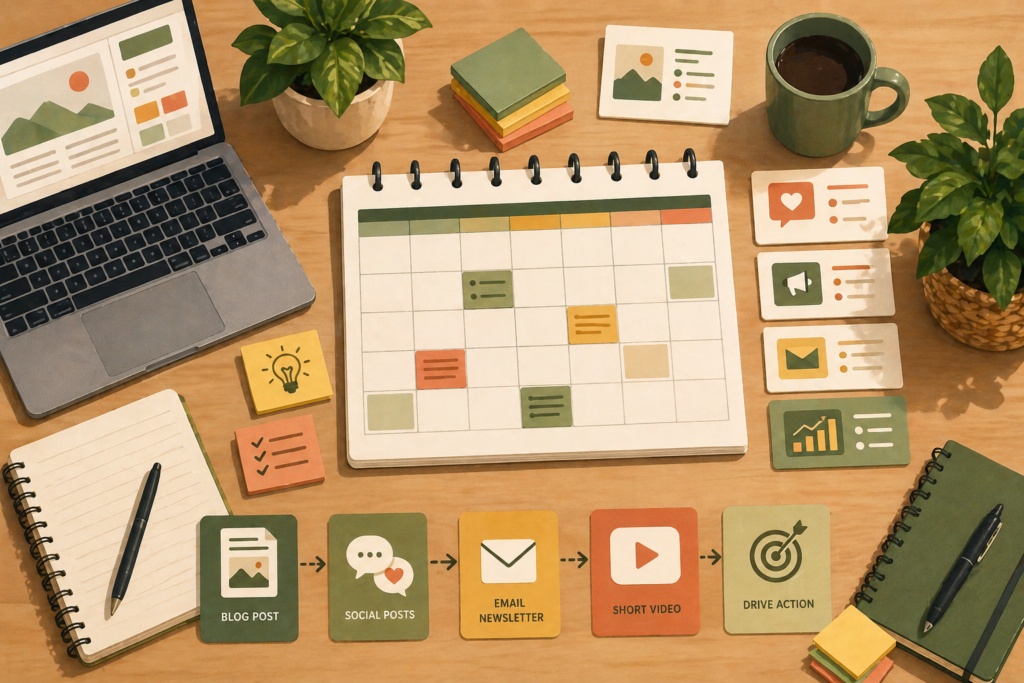
A single blog can become:
- three to five social posts
- one newsletter
- a short FAQ section
- a sales follow-up link
- a LinkedIn post
- a website resource
- a short video outline
This is especially useful when time is limited.
For example, if your blog topic is “How to prepare your website for holiday traffic,” your social posts could cover speed, mobile experience, enquiry forms, promotions, and customer questions.
If you need help turning ideas into structured articles, link readers naturally to Socials, Blogs & Article Writing
A Simple Monthly Content Mix
A realistic monthly content plan for small business might look like this:
Week 1: Educate
Publish a helpful blog post or article that answers a common customer question.
Example:
“How to choose the right website care plan for your business”
Week 2: Explain
Create social posts that break down your process, service, or product.
Example:
“What is included in monthly website maintenance?”
Week 3: Build trust
Share a behind-the-scenes insight, customer education post, checklist, or useful tip.
Example:
“Three website tasks small businesses forget after launch”
Week 4: Invite action
Add a calm call to action.
Example:
“If your website has not been checked this month, review our care options.”
This kind of structure keeps your content workflow manageable. You are not selling every week, and you are not educating without ever guiding the reader to a next step.
Monthly Content Plan for Small Business Checklist
Use this checklist when planning your next month:
- □ Choose one monthly business priority
- □ Pick one main content theme
- □ Select one primary blog topic
- □ Choose a focus keyword
- □ Plan three to five social media posts
- □ Add one customer education piece
- □ Identify internal links to service pages
- □ Decide on one clear CTA
- □ Confirm publishing dates
- □ Assign responsibilities
- □ Repurpose the blog into smaller content pieces
- □ Review basic performance at the end of the month
This keeps your monthly content plan for small business focused and realistic.
Content Ideas by Business Stage
Your monthly content plan for small business should match where your business is now.
Starter-stage businesses
Starter businesses usually need clarity and trust.
Good content ideas include:
- what your service includes
- who your service is for
- common beginner mistakes
- how your process works
- simple buying guides
- answers to frequent questions
At this stage, content should reduce confusion.
Growth-stage businesses
Growth-stage businesses often need more structured content.
Good ideas include:
- comparison posts
- service explainers
- blog series
- case-style educational content without inventing results
- content pillars
- more consistent social posting
- stronger internal linking
At this stage, content should support decision-making.
Authority-stage businesses
Authority-stage businesses can use content to lead conversations.
Good ideas include:
- thought leadership articles
- industry trend commentary
- deeper guides
- original frameworks
- expert FAQs
- strategic newsletters
At this stage, content should build recognition and trust.
How to Keep Content Consistent When You Are Busy
The best monthly content plan for small business is the one you can actually maintain.
Here are practical ways to keep going:
Batch your ideas
Set aside one planning session per month. Choose the theme, blog topic, and social post angles in one sitting.
Repurpose first
Do not treat every platform as a separate job. Turn one blog into several smaller posts.
Keep a question bank
Every time a customer asks a good question, save it. Those questions often become strong blog topics.
Use repeatable formats
You do not need a new content style every week. Use reliable formats such as checklists, FAQs, explainers, mistakes, comparisons, and how-to posts.
Link content to services
Every useful article should give the reader a sensible next step. For example, content about SEO visibility can point to Search Engine Optimisation.
Review before adding more
If one post per month is working, then increase slowly. More content is only helpful when the quality and workflow can keep up.
Common Mistakes in Monthly Content Planning
A monthly content plan for small business can fall apart when it becomes too ambitious or too vague.
Planning too much
Four blogs, daily social posts, weekly emails, and videos may sound productive, but it can overwhelm a small team quickly.
Start smaller. Build rhythm first.
Posting without a purpose
Every post should have a role. It may educate, build trust, answer a search query, support a service page, or invite an enquiry.
Ignoring your website
Social content matters, but your website is still a key destination. Blog posts and service pages give your content a longer life.
If your website needs to support content more effectively, see Website Design & Development.
Forgetting SEO
A content calendar without keywords can become a list of nice ideas that do not attract search traffic. Keep SEO blog planning simple, but do not skip it.
Making every post a sales post
A healthy monthly content plan for small business should educate more than it sells. A useful balance is mostly helpful content, with clear but calm commercial guidance.
Not checking results
At the end of each month, review:
- which posts were published
- which topics got engagement
- which pages received traffic
- which content supported enquiries
- what should be repeated or improved
The Nielsen Norman Group has long shown that people scan web content rather than read every word, which is why clear formatting and useful headings matter: Nielsen Norman Group – How Users Read on the Web ↗
A Simple Example Monthly Content Plan
Here is a basic example of a monthly content plan for small business for a local service provider.
Monthly priority
Get more enquiries for maintenance packages.
Main theme
Keeping your website healthy after launch.
Blog post
“Website Maintenance Checklist for Small Business Owners”
Social posts
- Why websites need monthly updates
- Three signs your site needs attention
- What happens when plugins are ignored
- How backups protect your business
- When to ask for help
Email idea
“Is your website ready for the month ahead?”
CTA
Review website maintenance options.
Internal link
Point readers to Website Maintenance & Care.
This is simple, but it works because every piece connects to the same goal.
Tools and Sources That Can Help
You do not need a complicated software stack. A useful monthly content plan for small business can be built with:
- Google Sheets
- Notion
- Trello
- a shared calendar
- Google Search Console
- your website analytics
- a simple notes app
For audience research, the U.S. Small Business Administration has a useful guide to market research and understanding customers: U.S. Small Business Administration – Market research and competitive analysis ↗
For content quality, Google’s helpful content guidance is also useful: Google Search Central – Creating helpful, reliable, people-first content ↗
How VVRapid Can Help
VVRapid helps small businesses plan and produce practical content across blogs, articles, and social media.
That can include monthly blog posts, content calendars, article writing, social media captions, and content workflows that connect back to your services. If your team is too busy to plan from scratch every month, VVRapid can help create a simple content rhythm that supports visibility and decision-making.
You can explore Socials, Blogs & Article Writing to see how content support can fit into your wider marketing activity.
FAQ: Monthly Content Plan for Small Business
What is a monthly content plan for small business?
A monthly content plan for small business is a simple schedule that outlines what you will publish during the month, including blogs, social posts, emails, website updates, and calls to action.
How many blog posts should a small business publish per month?
One or two monthly blog posts is a realistic starting point for many small businesses. Quality and consistency matter more than volume.
What should I include in a monthly content calendar?
Include your monthly theme, blog topic, social media content plan, focus keyword, publishing dates, internal links, CTA, and the person responsible for each task.
Can I use one blog post for social media content?
Yes. One useful blog post can often become several social posts, a newsletter, FAQ content, and short sales follow-up material.
How far ahead should a small business plan content?
Planning one month ahead is usually enough for a small team. Once your content workflow is stable, you can plan quarterly themes as well.
Final Thought
A monthly content plan for small business does not need to be complicated. It needs to be clear, realistic, and connected to your business goals.
Start with one monthly priority. Choose one main theme. Publish one useful blog post. Repurpose it into social content. Review what worked.
That is enough to build content consistency without turning marketing into a daily scramble.
For help planning and producing blogs, articles, and social content, view VVRapid’s Socials, Blogs & Article Writing service page or contact VVRapid for a practical next step.