

A marketing measurement plan helps small business owners stop guessing and start seeing which marketing activities lead to enquiries, bookings, calls, sales, repeat purchases, and real business outcomes.
Table of Contents
Without a plan, marketing reports can become noisy. You may see traffic, likes, clicks, impressions, and email opens, but still not know what is actually helping the business grow. That is frustrating, especially when budgets are tight and every decision matters.
A good marketing measurement plan does not need to be complicated. It needs to be clear. It should show what to track, where to track it, how often to review it, and what decisions the data should support.
What Is a Marketing Measurement Plan?
A marketing measurement plan is a simple framework for tracking whether your marketing is working.
It connects your business goals to measurable actions.
For a service business, that might include quote requests, contact form submissions, consultation bookings, phone calls, WhatsApp clicks, email enquiries, and qualified leads.
For a product business, it might include product views, add to cart events, checkout starts, purchases, average order value, repeat purchases, abandoned carts, and revenue by channel.

The plan answers four practical questions:
- What are we trying to achieve?
- Which actions show progress?
- Where will we measure those actions?
- How will we use the data to make better decisions?
A marketing measurement plan is not the same as a dashboard. A dashboard displays numbers. A measurement plan explains which numbers matter and why.
Think: a dashboard is the screen. The plan is the logic behind it.
Why Small Businesses Need a Marketing Measurement Plan
Small businesses often work with limited time, limited budget, and limited team capacity. That makes measurement more important, not less.
Without a marketing measurement plan, it is easy to fall into common traps:
- Spending more on channels that feel busy but do not convert
- Judging marketing by traffic instead of enquiries or sales
- Treating every lead as equal
- Ignoring repeat customers
- Missing checkout or form problems
- Making decisions from opinions instead of evidence
- Reporting on vanity metrics because they are easy to find
A service business might think social media is not working because posts get low engagement, while those posts are quietly helping referral leads trust the brand.
A product business might think paid ads are failing, when the real issue is unclear delivery information or a weak checkout experience.
A marketing measurement plan helps you see the difference between a traffic problem, a conversion problem, a tracking problem, and an offer problem.
That clarity saves money.
Start With Business Goals, Not Metrics
Before choosing tools or reports, define the business goal.
A weak goal sounds like this:
- Get more traffic
- Improve social media
- Do more SEO
- Send more emails
A stronger goal sounds like this:
- Increase qualified enquiries for a specific service
- Sell more of a high-margin product category
- Improve online bookings
- Reduce abandoned carts
- Increase repeat purchases
- Improve local enquiry volume
- Reduce wasted ad spend
- Increase marketing ROI
Your marketing measurement plan should begin with one to three business goals. Any more than that can become messy.
For example, a local service company may choose:
- Increase qualified quote requests
- Improve phone call tracking
- Understand which pages generate leads
An ecommerce business may choose:
- Increase conversion rate on key product categories
- Reduce checkout abandonment
- Track revenue by marketing channel
Once the goal is clear, the right marketing KPIs become easier to choose.
If you need helpfinding some clearity, visit VVRapid’s Digital Strategy Roadmaps.
Choose the Right Marketing KPIs
Marketing KPIs are the numbers that show whether your marketing is supporting the business.
Not every metric deserves KPI status.
A useful KPI should be connected to a decision. If nobody will act on the number, it probably does not need to be in your main report.
Good KPIs for Service Businesses
For service businesses, useful KPIs may include:
- Qualified enquiries
- Contact form submissions
- Phone calls
- WhatsApp clicks
- Booking requests
- Consultation requests
- Cost per lead
- Lead source
- Lead to customer conversion rate
- Revenue by lead source
- Main service page conversion rate
Lead tracking is especially important. A high number of enquiries is not always good if most are poor fit, too small, outside your region, or not aligned with your services.
A marketing measurement plan should help you track quality as well as quantity.
Good KPIs for Product Businesses
For product businesses, useful KPIs may include:
- Product page views
- Add to cart rate
- Checkout start rate
- Purchase conversion rate
- Average order value
- Revenue by channel
- Cart abandonment rate
- Repeat purchase rate
- Email revenue
- Return rate
- Best performing products or categories
Ecommerce tracking matters because product businesses need to understand the full path from discovery to purchase.
A marketing measurement plan should show where customers drop off and which channels bring profitable sales.
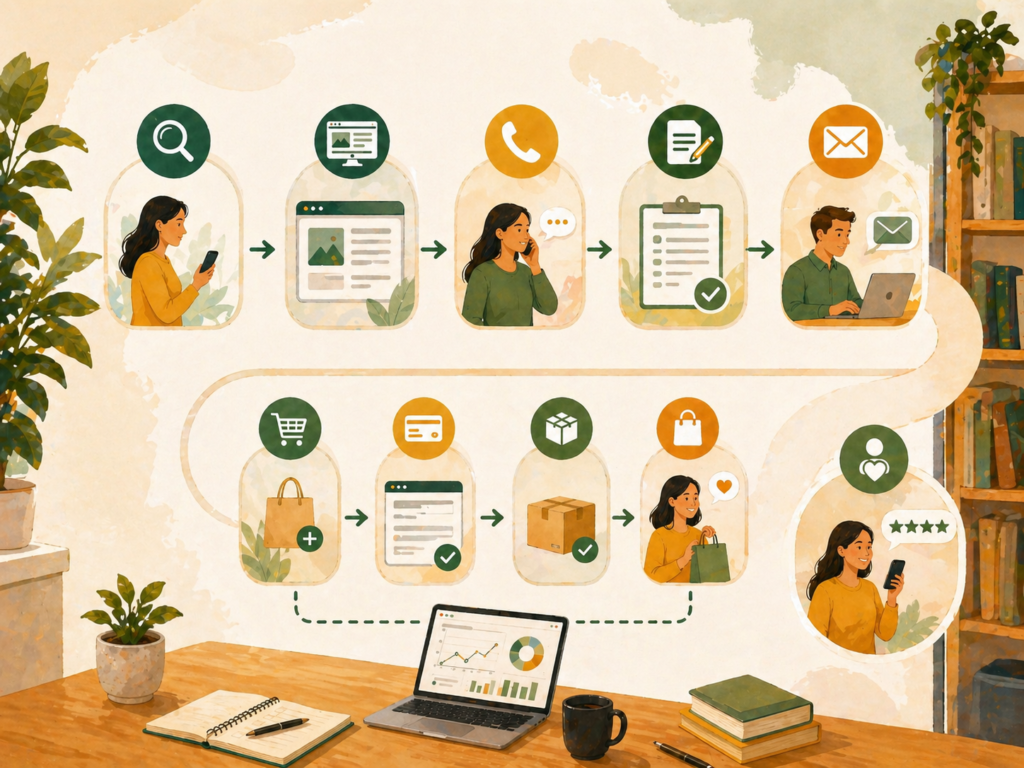
Map the Customer Journey Before You Track
Tracking makes more sense when you understand the customer journey.
A simple service business journey might look like this:
- Visitor searches on Google
- Visitor lands on a service page
- Visitor reads proof, process, pricing guidance, or FAQs
- Visitor clicks to call, email, WhatsApp, or complete a form
- Lead is reviewed by the business
- Lead becomes a customer or does not
A product business journey might look like this:
- Shopper discovers a product through search, social, email, or ads
- Shopper views a category page
- Shopper compares products
- Shopper adds to cart
- Shopper starts checkout
- Shopper purchases or abandons
- Customer receives follow-up email
- Customer buys again or does not
Your marketing measurement plan should track the meaningful steps in that journey.
This is where many small businesses miss important signals. They track traffic but not form submissions. They track purchases but not abandoned carts. They track calls but not which channel generated them. They track leads but not whether those leads became customers.
The goal is not to track everything. The goal is to track the path that matters.
Set Up Conversion Tracking Properly
Conversion tracking is the foundation of a useful marketing measurement plan.
A conversion is an important action that shows someone moved closer to becoming a customer. In GA4, these are typically tracked as events and marked as key events when they matter to the business.
Examples include:
- Submit contact form
- Click phone number
- Click WhatsApp
- Complete booking
- Request quote
- Sign up for email
- Download guide
- Add to cart
- Begin checkout
- Purchase
For service businesses, do not stop at form submissions. Track phone clicks, email clicks, WhatsApp clicks, booking clicks, and quote request forms where possible.
For product businesses, ecommerce tracking should show product views, add to cart events, checkout steps, purchases, revenue, and product performance.
For some helpfull reading you cand visit Google Analytics Help ↗
A marketing measurement plan should also document what counts as a conversion. This avoids confusion later when different people interpret reports differently.
Use GA4, Search Console, and Other Tools Together
No single tool tells the full story.
GA4 can help you understand user behaviour, traffic sources, events, conversions, and ecommerce performance.
Google Search Console can help you understand search visibility, impressions, clicks, search queries, indexed pages, and technical search issues.
Your CRM or spreadsheet can help you understand lead quality, sales outcomes, and revenue.
Call tracking tools can show which campaigns or pages generate phone calls.
Ecommerce platforms can show product sales, order value, returns, and customer behaviour.
A strong marketing measurement plan connects these tools instead of relying on one report.
For example, Search Console may show that a service page gets impressions but few clicks. GA4 may show that the same page gets visits but few enquiries. Your CRM may show that the few enquiries it does generate are high quality.
That combination gives you a better decision than one metric alone.
Visit VVRapid’s Search Engine Optimisation (SEO) service page to learn a bit more.
Track Local Visibility and Calls
For local businesses, a marketing measurement plan should include local visibility.
This applies to service businesses, clinics, restaurants, studios, trades, retail stores, showrooms, and any business that depends on local customers.
Track:
- Google Business Profile views
- Website clicks from local listings
- Direction requests
- Phone calls
- Review growth
- Review quality
- Local landing page performance
- Location-based enquiries
For South African small businesses, this can be especially useful where customers search by suburb, city, service area, or “near me” terms before choosing who to contact.
Call tracking is also worth considering if phone enquiries are important. Many small businesses undercount calls because they only measure website forms.
A marketing measurement plan should reflect how customers actually contact you, not only the channels that are easiest to report.
Measure Website Performance and Conversion
Website performance metrics help explain whether your website supports or blocks results.
Review:
- Mobile performance
- Page speed
- Landing page conversion rate
- Form completion rate
- Bounce or engagement signals
- Top exit pages
- Checkout drop-off
- Click-through to contact pages
- Scroll depth on key pages
- User journey paths
You can check your website now with PageSpeed Insights ↗
For service businesses, important pages often include the homepage, service pages, about page, contact page, and booking or enquiry pages.
For product businesses, focus on category pages, product pages, cart, checkout, delivery information, return policy, and payment flow.
A marketing measurement plan should make website performance measurable because a weak website can make every channel look worse than it is.
Marketing Measurement Checklist
Use this checklist to build or improve your marketing measurement plan.
- □ Define one to three business goals
- □ List the key actions customers take before buying
- □ Choose KPIs for leads, bookings, calls, sales, or purchases
- □ Decide what counts as a conversion
- □ Check GA4 setup
- □ Mark important events as key events
- □ Connect Google Search Console
- □ Review Google Business Profile performance if local search matters
- □ Track phone calls, WhatsApp clicks, email clicks, and forms
- □ Set up ecommerce tracking for product businesses
- □ Track revenue by channel where possible
- □ Review lead quality, not only lead volume
- □ Check page speed and mobile performance
- □ Create a monthly reporting rhythm
- □ Assign one person to own measurement
- □ Turn reports into actions
A checklist keeps measurement practical. The best marketing measurement plan is the one your business can actually maintain.
Common Mistakes to Avoid
Mistake 1: Tracking Too Many Metrics
More metrics do not automatically mean better decisions. Too many numbers can make reports harder to use.
Focus on the KPIs that connect to business goals.
Mistake 2: Measuring Traffic Without Conversions
Traffic is only part of the story. A marketing measurement plan should show what visitors do after they arrive.
Mistake 3: Ignoring Lead Quality
A campaign that generates many poor-fit leads may look good in a report but waste sales time. Track whether leads become real opportunities or customers.
Mistake 4: Forgetting Phone and WhatsApp Enquiries
Many small businesses receive valuable enquiries through calls, WhatsApp, email, or social messages. If those are not tracked, the report is incomplete.
Mistake 5: Treating All Channels the Same
SEO, paid ads, referrals, social, email, and local search can influence customers differently. A marketing measurement plan should help you understand contribution, not just last-click numbers.
Mistake 6: Reporting Without Action
A monthly report should lead to decisions. If the report never changes what you do, it needs to be simplified.
A Simple Monthly Review Rhythm
Measurement works best when it becomes a habit.
Here is a simple monthly review structure:
Week 1: Collect the Numbers
Pull data from GA4, Search Console, Google Business Profile, your ecommerce platform, CRM, call tracking, and ad platforms where relevant.
Week 2: Review the Customer Journey
Look for drop-offs. Are people visiting but not enquiring? Adding to cart but not buying? Calling but not becoming customers? Reading content but not moving to service pages?
Week 3: Choose Actions
Pick a small number of improvements. For example:
- Improve a weak landing page
- Rewrite a product description
- Add FAQs to a service page
- Fix tracking gaps
- Improve internal links
- Test a clearer call to action
- Update Google Business Profile
- Improve checkout messaging
Week 4: Document What Changed
Record what you changed and why. This helps future reporting make sense.
A marketing measurement plan is not only about watching numbers. It is about creating a clear feedback loop.
How VVRapid Can Help
VVRapid’s Digital Strategy Roadmaps are built for small businesses that need clarity before spending more time or budget.
We can help identify the right KPIs, review tracking gaps, map the customer journey, and turn measurement into a practical Now, Next, Later action plan.
Where useful, VVRapid can also support implementation through SEO, website improvements, content, maintenance, hosting, custom plugins, or a fractional digital team.
FAQ: Marketing Measurement Plan
What is a marketing measurement plan?
A marketing measurement plan is a simple framework that connects business goals to the metrics, tools, conversions, and reports needed to understand whether marketing is working.
What should a small business measure first?
Start with leads, calls, bookings, purchases, revenue, conversion tracking, and website performance metrics. Then add channel-specific KPIs such as organic search clicks, local listing actions, email revenue, or ecommerce conversion rate.
Do I need GA4 for a marketing measurement plan?
GA4 is useful for tracking traffic, events, conversions, and ecommerce activity. It should usually be part of a marketing measurement plan, but it works best alongside Search Console, CRM records, call tracking, and sales data.
How often should I review marketing performance?
Monthly is a practical rhythm for most small businesses. Weekly reviews can be useful for active campaigns, but monthly reviews are usually better for strategic decisions.
What is the difference between marketing KPIs and normal metrics?
Marketing KPIs are the key numbers tied to business goals. Normal metrics may still be useful, but they are often supporting signals rather than primary decision points.
Can product and service businesses use the same measurement plan?
They can use the same structure, but the KPIs should differ. Service businesses usually track qualified leads, calls, bookings, and enquiries. Product businesses also need ecommerce tracking, revenue, add to cart events, checkout behaviour, and repeat purchases.
Final Thought
A marketing measurement plan gives small business owners a calmer way to make marketing decisions.
You do not need to track everything. You need to track the actions that show whether customers are moving closer to buying, booking, enquiring, or returning.
Start with the business goal. Choose the right KPIs. Set up conversion tracking. Connect GA4, Search Console, local visibility, sales data, and ecommerce data where relevant. Then review the numbers monthly and turn them into action.
For a structured next step, view VVRapid’s Digital Strategy Roadmaps service page or contact VVRapid to discuss a practical measurement plan for your website, funnel, and marketing channels.