

A blog content strategy for small business helps you stop guessing, publish with purpose, and turn blog writing into something that supports visibility, trust, and lead generation. If your current approach is “write when we have time,” a simple blog content strategy for small business can bring structure without making content feel complicated.
Table of Contents
Many small business owners know blogging matters, but that does not mean they have a clear system. One month they publish three posts. The next two months, nothing happens. Then the blog starts to feel like another unfinished task.
That is why a practical blog content strategy for small business matters. It helps you decide what to publish, who it is for, how it supports SEO blog planning, and how to connect each post to real business goals.
Think: less random content, more useful content.
What a Blog Content Strategy for Small Business Actually Means
A blog content strategy for small business is not a huge document. It is a working plan that answers a few key questions:
- Who are we trying to help?
- What problems are they searching for?
- What topics support our services or products?
- What content pillars should we focus on?
- How often can we realistically publish?
- How will we measure whether our blog strategy is working?
For a small business, the goal is not to publish the most content. The goal is to publish the right content consistently.
A strong blog content strategy for small business usually sits at the intersection of three things:
- what your audience needs
- what your business wants to be found for
- what you can sustain over time
That is why content planning for small business works best when it is simple, repeatable, and linked to the buyer journey.
Why Random Blogging Usually Underperforms
Without a blog content strategy for small business, blogs often become a collection of disconnected ideas. A post might be well written, but if it is not linked to search intent, service relevance, or the reader’s decision stage, it may not do much for the business.
Here is what random blogging often looks like:
- topics chosen at the last minute
- no clear primary keyword
- no internal links to service pages
- no clear call to action
- no editorial calendar
- no link between blog posts and sales conversations
The result is usually low momentum. Teams feel like they are creating content, but there is little compounding value.
Google’s guidance on helpful content is useful here: Google Search Central – Creating helpful, reliable, people-first content ↗
A better blog content strategy for small business gives each article a role. Some posts attract awareness. Some educate. Some support commercial investigation. Some help buyers compare options before making contact.
How to Build a Blog Content Strategy for Small Business
1. Start with one clear business goal
Before choosing topics, decide what your content needs to support.
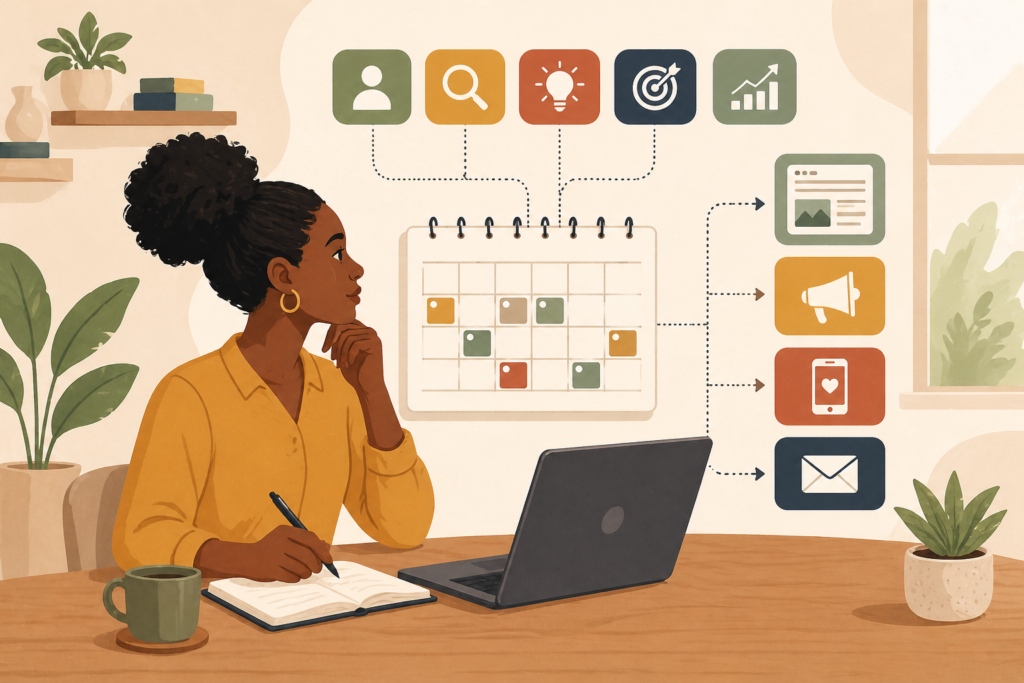
Common goals include:
- improving organic traffic
- supporting local SEO
- generating qualified enquiries
- educating leads before sales calls
- building authority in a niche
- supporting social media content plan execution
For example, if you want more leads from your website, your blog content strategy for small business should include articles tied to service intent, common customer questions, and related search terms.
If your wider digital goals are not yet clear, this is where a roadmap can help: Digital Strategy Roadmaps
2. Identify your audience by buyer stage
A useful blog content strategy for small business should speak to where the reader is in their journey.
A simple way to structure buyer journey content is:
Starter stage
The reader is learning and trying to understand the problem.
Example topics:
- what a content strategy is
- how blogging helps small businesses
- signs your website content is outdated
Growth stage
The reader is comparing options and looking for direction.
Example topics:
- how often should a small business blog
- content calendar examples
- blog writing vs social posting
Decision stage
The reader is closer to action and needs confidence.
Example topics:
- when to outsource blog writing
- what to expect from blog article writing services
- how to brief a content writer
This keeps your small business blogging balanced. Not every post should be top-of-funnel, and not every post should be sales-led.
3. Choose 3 to 5 content pillars
Content pillars are the main themes your blog will consistently cover. They are the backbone of a blog content strategy for small business.
If you are a service business, your pillars might include:
- industry education
- common client problems
- service explainers
- pricing or scope guidance
- process and decision support
If you are an ecommerce or product business, your pillars may include:
- product use cases
- buying guides
- comparisons
- maintenance or care tips
- seasonal content
Good content pillars make SEO blog planning easier because you are not starting from scratch every month.
4. Match topics to search intent and keyword themes
A blog content strategy for small business works best when every article has a primary keyword and a clear reason to exist.
This does not mean stuffing keywords into every sentence. It means choosing a focus phrase that reflects a real search need, then supporting it with related language such as:
- content planning for small business
- editorial calendar
- buyer journey content
- monthly blog plan
- content pillars
- SEO blog planning
Google’s SEO Starter Guide is also worth reviewing: Google Search Central – SEO Starter Guide ↗
You can also use your own business data. Look at:
- sales questions you hear often
- contact form enquiries
- email questions
- search terms in Google Search Console
- the language customers use in consultations
That gives your blog content strategy for small business a grounded, commercial edge.
5. Create a simple 90-day editorial calendar
This is where the strategy becomes practical.
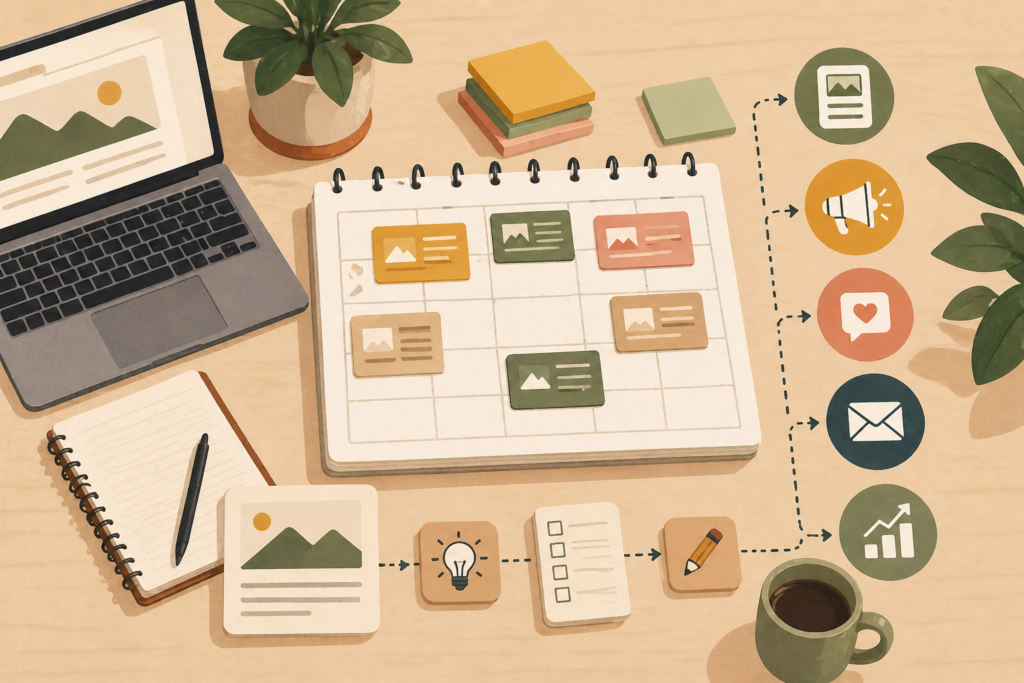
A lightweight editorial calendar might include:
- publish date
- working title
- primary keyword
- search intent
- target reader stage
- linked service page
- CTA
- repurposing notes for social media
You do not need a complicated tool. A spreadsheet works. A task board works. The important thing is consistency.
A good blog content strategy for small business often starts with one post per month, then grows to two or four when the system is working. Consistency beats bursts.
If you want your blog plan connected to search performance, see Search Engine Optimisation.
Blog Content Strategy for Small Business Checklist
Use this checklist before you start writing:
- □ Clear business goal defined
- □ Primary audience identified
- □ Buyer stage selected
- □ Primary keyword chosen
- □ Supporting keywords noted
- □ Content pillar assigned
- □ Search intent confirmed
- □ Internal link opportunity identified
- □ CTA matched to the topic
- □ Publish date scheduled
- □ Social repurposing noted
- □ Performance metric chosen
This kind of checklist keeps a blog content strategy for small business manageable, even for a busy owner or small team.
Common Mistakes That Weaken Content Plans
A blog content strategy for small business does not need to be perfect, but a few mistakes can cause problems quickly.
Writing only what you want to say
Many businesses publish posts based only on internal priorities. The better approach is to combine business priorities with search demand and customer questions.
Choosing topics that are too broad
“Marketing tips” is too broad. “How to plan monthly blog posts for a plumbing business” is clearer and more useful.
Ignoring internal linking
A blog post should not sit alone. It should guide readers to the next relevant step. For content production support, that might be Socials, Blogs & Article Writing.
Publishing inconsistently
A blog content strategy for small business should match your real capacity. One strong post every month is better than five rushed posts followed by silence.
Forgetting repurposing
One blog post can support multiple assets:
- a LinkedIn post
- email content
- short social captions
- website FAQs
- sales follow-up content
This is where content workflow efficiency makes a real difference.
Measuring nothing
You do not need complicated reporting, but you do need a few signals:
- impressions
- rankings
- clicks
- time on page
- enquiries from blog-assisted journeys
Should You Build It In-House or Get Help?
Some businesses can manage their blog content strategy for small business internally. Others do better with outside support, especially when time is limited or consistency is a struggle.
You may be able to manage it in-house if:
- you have someone who can write clearly
- you already know your audience well
- you can maintain an editorial calendar
- you have time to brief, edit, and publish
You may want help if:
- content keeps slipping down the priority list
- your blog lacks structure or SEO alignment
- you need stronger conversion support
- you want content that works across blog and social channels
- you need a calm, repeatable content process
If your blog is part of a broader website growth plan, Website Design & Development and Fractional Digital Team may also be relevant depending on your setup.
How VVRapid Can Help
VVRapid helps small businesses turn ideas into structured, useful content that supports visibility and decision-making.
That can include topic planning, blog writing, article writing, content structure, and links back to the right service pages. If your business needs a practical blog content strategy for small business, VVRapid can help you create a simpler publishing system without making the process feel heavy.
You can explore Socials, Blogs & Article Writing or contact VVRapid to discuss what kind of content rhythm makes sense for your business. We are always happy to help.
FAQ: Blog Content Strategy for Small Business
What is a blog content strategy for small business?
A blog content strategy for small business is a practical plan that helps you choose the right topics, publish consistently, target relevant keywords, and connect blog content to business goals.
How often should a small business publish blog content?
For many small businesses, one or two high-quality posts per month is a good starting point. The best frequency is the one you can sustain consistently.
What should be included in a blog content strategy for small business?
It should include your audience, business goals, content pillars, keywords, search intent, publishing rhythm, internal links, and basic performance measures.
Do blog posts still help SEO for small businesses?
Yes. Useful, well-structured posts can help you target long-tail searches, answer customer questions, and support your service pages through internal linking and topical relevance.
Can one blog post also support social media?
Yes. A good article can be repurposed into social captions, LinkedIn posts, short tips, newsletter content, and supporting website copy.
Final Thought
A blog content strategy for small business does not need to be elaborate to be effective. It just needs to be clear, relevant, and repeatable. Once you know your audience, choose your content pillars, and set a realistic publishing rhythm, blogging becomes much easier to manage.
If you want support building or executing a blog content strategy for small business, view the relevant VVRapid service page or get in touch for a practical next step.