

Customer education content for small business helps potential buyers understand what you do, how your process works, what it costs in broad terms, what results to expect, and whether you are the right fit. For many small businesses, that kind of content does more than fill a blog. It reduces repeated sales questions, builds trust earlier, and helps people move from curious to ready.
Table of Contents
Most small business owners already explain the same things every week in calls, WhatsApp chats, emails, and proposals. That is usually the best clue that you need better customer education content for small business. When your content answers those questions before a prospect gets in touch, your website starts doing more of the heavy lifting.
A lot of content fails because it tries to sound impressive instead of useful. Buyers do not just want polished words. They want clarity. They want to know whether your service fits their situation, how your process works, what might delay the project, and what they should prepare before they enquire.
That is where customer education content for small business becomes valuable. It turns your expertise into practical guidance that removes friction.
What customer education content for small business actually means
Customer education content for small business is content designed to help buyers make informed decisions. It is not just promotional copy, and it is not a random stream of generic blog posts. It sits in the middle of marketing and sales.

Good examples include:
- Articles that explain how a service works
- Posts that compare two common options
- Guides that answer pricing questions carefully
- Content that explains timelines, scope, or deliverables
- Articles that help buyers spot common mistakes before they commit
- FAQ-style posts built around real objections
Think: if a prospect asks it often, it probably deserves a page or article.
This type of content also works especially well when supported by Search Engine Optimisation because it lines up closely with real search intent.
Why it matters more than many small businesses realise
Many small businesses publish content that is loosely related to their niche but not closely tied to buying decisions. That may attract some traffic, but it does not always bring the right visitors.
Customer education content for small business is different because it helps with three important jobs at once.
1. It builds trust
Clear content signals competence. When you explain your process simply and honestly, buyers feel safer.
2. It saves time
If your site answers the basics well, you spend less time repeating yourself in every lead conversation.
3. It improves lead quality
People who enquire after reading educational content often have more realistic expectations. They already understand the basics of how you work and what the service involves.
For service businesses, this can also support website performance when paired with Website Design & Development so the content is easy to read, structured properly, and simple to navigate.
The buyer questions you should answer first
The easiest way to create customer education content for small business is to start with the questions you already hear.
Look at:
- Discovery call notes
- Sales emails
- Contact form submissions
- Client onboarding questions
- Common objections
- Team WhatsApp or Slack conversations
- Questions asked after a quote is sent
Then sort those questions into themes.
Best themes to prioritise
Process questions
People want to know what happens after they say yes.
Examples:
- What does onboarding look like?
- How long does it take?
- What do you need from us?
- What causes delays?
Fit questions
People want to know whether they are a good match.
Examples:
- Who is this service best for?
- Who is it not for?
- What size business usually benefits most?
- When should you wait before investing?
Outcome questions
People want a realistic picture of results.
Examples:
- What can this service improve?
- What does success look like?
- What should we expect in the first 30 to 90 days?
Cost and scope questions
You do not need to publish exact pricing if that is not your model. But buyers still want context.
Examples:
- What affects project cost?
- Why do quotes vary?
- What is included and what is not?
When you organise content this way, customer education content for small business becomes easier to plan and easier for buyers to follow.
Best content formats for educating buyers
Not every topic needs a long article. Choose the format that fits the question.
Blog posts
Best for:
- Explaining a topic in depth
- Targeting search demand
- Answering one focused buyer question
This is often the best starting point, especially if you want evergreen traffic and helpful resource content. VVRapid’s Socials, Blogs & Article Writing service is a strong fit here because educational posts need both clarity and structure.
Service page support content
Best for:
- Questions directly tied to a service
- Objections that block enquiries
- Clarifying deliverables and process
A service page should stay focused. Supporting blog posts can go deeper.
FAQs
Best for:
- Short, direct answers
- Small but important concerns
- Quick pre-enquiry reassurance
Content hubs
Best for:
- Businesses with multiple related services
- Topics that need a connected set of pages
- Long-term SEO growth
If you already have several useful articles, a structured hub can make them much more effective.
A simple framework for planning your content
You do not need a huge strategy deck to make this work. Use this simple framework.
Step 1: List the questions buyers ask before they buy
Keep the wording natural. Use their language, not internal jargon.
Step 2: Group questions by buying stage
Split them into:
- Early stage curiosity
- Mid-stage comparison
- Late-stage decision questions
Step 3: Match each question to a format
Some need a full blog post. Others belong in a service FAQ or guide.
Step 4: Prioritise the questions that affect revenue
Start with the questions that:
- Delay decisions
- Cause confusion
- Create repeated back-and-forth
- Filter out poor-fit leads
Step 5: Build a realistic publishing rhythm
Consistency matters more than volume. One useful article a month is better than four weak ones.
A Digital Strategy Roadmap can help if you want to map this work against wider growth goals.
Checklist: what strong educational content should include
Use this checklist before publishing any customer education content for small business.
- □ A clear question or problem at the centre of the article
- □ Plain language instead of vague marketing phrases
- □ A direct explanation of how something works
- □ Honest notes on limitations, trade-offs, or fit
- □ Examples that make the topic easier to understand
- □ Helpful headings and short paragraphs
- □ A logical next step for the reader
- □ Internal links to related pages
- □ Metadata and structure that support SEO
- □ A tone that sounds calm, useful, and credible
Common mistakes
Even useful topics can underperform if the execution is off.
Mistake 1: Writing for peers instead of buyers
Industry language may impress competitors, but it often confuses prospects. Educational content should make buyers feel informed, not excluded.
Mistake 2: Staying too vague
Content that says “we tailor every project to your needs” without explaining what changes and why does not reduce uncertainty.
Mistake 3: Avoiding all difficult questions
You do not need to publish confidential information, but dodging every cost, timeline, and fit question weakens trust.
Mistake 4: Publishing disconnected articles
Random posts are harder to rank and harder to navigate. A joined-up plan works better than isolated ideas.
Mistake 5: Forgetting the next step
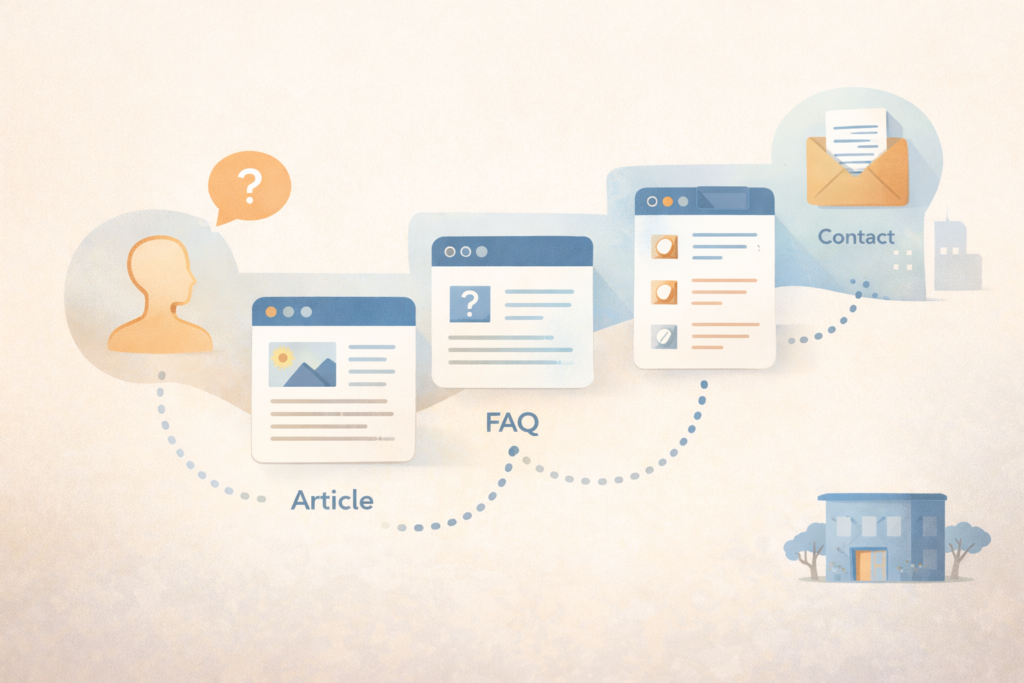
After reading your article, the visitor should know where to go next. That could be a related blog post, a service page, or a contact page.
Mistake 6: Treating social posts and blog posts as separate worlds
A strong educational article can become multiple social posts, email snippets, and sales follow-ups. That is one reason a joined-up content service is often more efficient than ad hoc writing.
How to repurpose educational content without diluting it
Once you create one strong article, you can extend its value.
You can turn customer education content for small business into:
- A short LinkedIn post with one key takeaway
- A carousel explaining the process step by step
- A sales email answering a common objection
- A FAQ section on a service page
- A newsletter edition
- A client onboarding resource
This is where a Fractional Digital Team can help if you want content, SEO, and execution working together rather than in silos.
What a good first month could look like
If you are starting from scratch, keep it simple. Your first month of customer education content for small business could include:
- One article answering the top question buyers ask before they enquire
- One article clarifying your process or timeline
- A refreshed FAQ section on the main service page
- Three to five social posts pulled from the strongest article
- Internal links between the article, service page, and contact page
This creates a much better user journey than publishing broad awareness content with no buying relevance.
How VVRapid can help
VVRapid can help turn repeated buyer questions into useful blog posts, explainers, and supporting social content that match your brand voice and service goals. The focus is not on content for content’s sake. It is on publishing clear pieces that answer real questions, support SEO, and make your business easier to understand. For businesses that need regular publishing support, strategic topic planning, or deeper authority-building articles, this work can sit neatly alongside SEO, website improvements, and wider digital planning.
If you want a practical starting point, review the Socials, Blogs & Article Writing service page or contact VVRapid to map your most valuable buyer questions into content.
FAQ: Customer Education Content for Small Business
What is customer education content for small business?
It is content that helps potential buyers understand your services, process, fit, and likely next steps before they contact you.
Is customer education content just another name for blogging?
Not quite. Blogging is a format. Customer education content is a purpose. It can include blog posts, FAQs, explainers, guides, and service-support content.
How often should a small business publish this type of content?
A steady pace works best. For many small businesses, one to two useful pieces a month is enough to build momentum.
Should this content talk about pricing?
It can, but carefully. You do not have to publish fixed prices. You can explain what affects scope, timelines, or budget ranges where appropriate. Pricing varies by scope and region.
Does customer education content help SEO?
Yes. It often aligns well with real search behaviour because it answers practical questions buyers actually type into search engines. Google’s guidance on helpful content supports content created for people first, not just rankings Google Search Central – Creating helpful, reliable, people-first content.
What should we publish first?
Start with the one question that comes up most often before someone is ready to buy. That is usually the highest-value topic.
To strengthen accuracy and trust in educational content, it also helps to review plain-language guidance from Nielsen Norman Group Nielsen Norman Group – Writing for the Web and structure content around customer questions, not internal assumptions. For search demand and query framing, Google Trends can also be useful for directional research Google Trends.