

When planning website content, many owners eventually ask the same question: FAQ page vs blog post for SEO, which should you publish first? Both formats help search visibility and customer understanding, but they serve different purposes in a content strategy.
Table of Contents
Choosing the right starting point can save time, improve rankings, and make your website more useful for potential customers. A blog post can attract new visitors through search, while an FAQ page can remove friction for people already considering your service.
The key is understanding how search engines and real buyers use these formats differently. Once you see the roles clearly, deciding what to publish first becomes much easier.
FAQ Page vs Blog Post for SEO Explained Simply
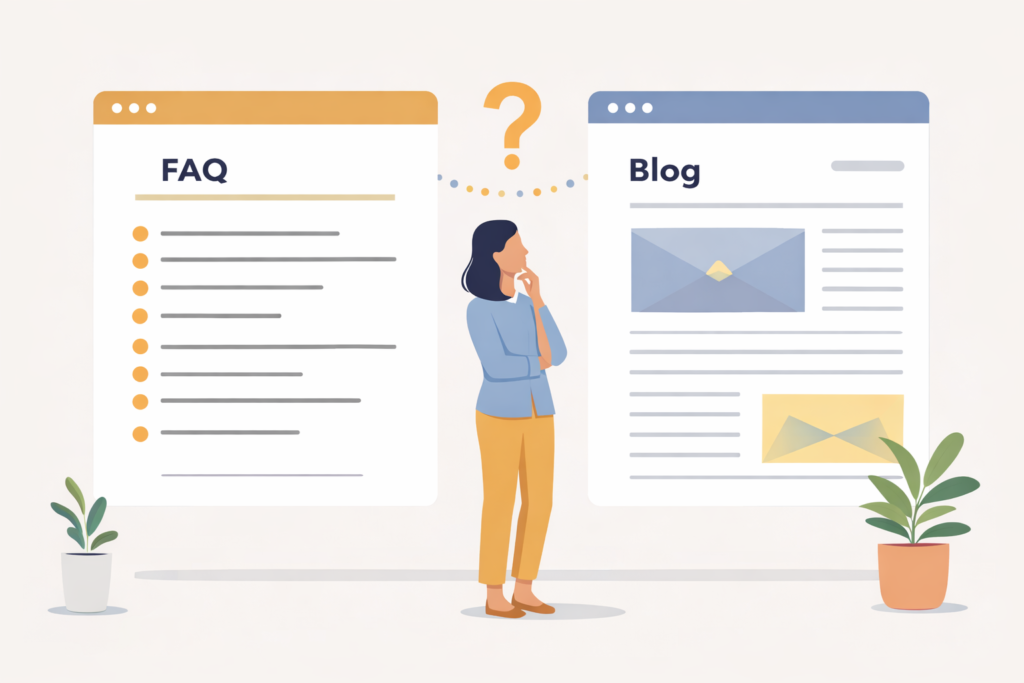
The discussion around FAQ page vs blog post for SEO often appears when small businesses begin planning their website content. In practice, the decision is part of a broader faq vs blog content strategy. Both formats help users and search engines, but they serve different purposes. An FAQ page supports clarity for visitors already considering your service, while blog posts for SEO attract new visitors searching for answers online.
Each format solves a different problem.
FAQ pages
FAQ pages collect short answers to common questions about your business, service, or process.
They work well when visitors already know about your company and want quick clarity.
Examples include:
- pricing questions
- service timelines
- onboarding requirements
- what is included in a service
- who the service is for
FAQ pages are often closely connected to service pages and help remove hesitation before someone contacts you.
Blog posts
Blog posts answer broader questions people search for online.
These questions often come earlier in the buying process.
Examples include:
- how a service works
- comparisons between solutions
- common mistakes in a specific field
- step-by-step guides
Blog posts can attract new visitors through search engines when combined with good Search Engine Optimisation practices.
Both formats matter, but they support different stages of the customer journey.
When an FAQ Page Makes More Sense
Sometimes the FAQ page should come first, especially if your website already gets traffic or enquiries.
An FAQ page is valuable when visitors already arrive on your service pages but still hesitate.
Signs you should publish an FAQ page first
- Prospects ask the same questions repeatedly before buying
- Your service page is strong but still creates confusion
- Clients ask basic questions during discovery calls
- Your contact form receives clarification questions
An FAQ page acts as a conversion support tool rather than a traffic driver.
For example, a web design business might answer questions like:
- How long does a website project take?
- What information do you need from us?
- Do we need to provide images and copy?
- What happens after launch?
These short answers reduce friction for visitors already considering your service.
FAQ pages also work well alongside Website Design & Development improvements, where structure and navigation help users find answers quickly.
When a Blog Post Is the Better Choice
When deciding FAQ page vs blog post for SEO, blog posts usually win if your main goal is increasing website traffic.
When businesses compare a blog post vs FAQ page, the key difference is usually visibility. Blog posts for SEO are designed to target search queries people type into Google before they even know about your company. That makes them especially valuable for attracting new visitors who are researching solutions.
Search engines tend to rank blog content more easily because it targets specific search queries.
For example:
Someone might search:
- “how often should small businesses publish blog content”
- “what does SEO content writing include”
- “how long should a blog post be for SEO”
These are not questions someone asks about a single company. They are industry questions.
A blog post answering these topics can attract visitors who are still researching.
This is why many businesses publish educational articles alongside service pages. Content created through Socials, Blogs & Article Writing can target search demand while also supporting trust.
How Each Format Supports Search Intent
Understanding search intent is the fastest way to decide between the two formats. Understanding how each format fits into a small business SEO content structure makes it easier to decide where a topic belongs.
Search engines aim to match pages to the intent behind a query.
Informational searches
These queries are usually answered best with blog posts.
Examples include:
- how to create a content strategy
- why SEO matters for small businesses
- what makes a good website homepage
Search engines prefer longer, structured explanations for these topics.
Navigational or brand queries
These often fit FAQ sections better.
Examples include:
- how your company works
- whether your service includes a specific feature
- policies or process questions
These questions often come from people who already know your business.
Google itself encourages helpful content that answers user needs clearly rather than trying to manipulate rankings: Google Search Central ↗
That is why aligning content format with intent matters.
A Simple Publishing Order for Small Business Websites
If you are starting with limited content, the best approach is often a balanced one.
Here is a simple publishing order that works well for many service businesses.
Step 1: Build a strong service page
Your service page should explain:
- what you do
- who it is for
- the process
- expected outcomes
This page forms the foundation of your content.
Step 2: Add a focused FAQ section
Include answers to the most common buyer questions.
Even five to eight answers can improve clarity.
Step 3: Publish supporting blog posts
Blog articles can then expand on topics such as:
- process explanations
- comparisons between solutions
- industry mistakes
- educational guides
Each article should link back to the relevant service page.
Step 4: Connect everything with internal links
Internal linking helps both users and search engines understand your site structure.
For example, a blog post about content strategy might link to a service page offering a Digital Strategy Roadmap.
Over time, the goal is to build a balanced small business SEO content structure where service pages, FAQ page SEO, and blog posts for SEO work together. Instead of treating each piece of content separately, a clear faq vs blog content strategy helps your website answer buyer questions while also attracting new search traffic.
Checklist: FAQ Page vs Blog Post for SEO — How to Choose
Use this quick checklist when deciding FAQ page vs blog post for SEO.
Deciding between formats is easier when you treat the decision as part of your overall FAQ page SEO approach rather than viewing each piece of content in isolation.
Choose an FAQ page if:
- the question is specific to your business
- the answer is short and direct
- it helps someone decide whether to contact you
- the topic belongs near a service page
Choose a blog post if:
- the question is widely searched online
- the topic needs explanation or examples
- the article could attract new visitors
- the subject connects to multiple services
Both formats can coexist and support each other.
Common Mistakes When Choosing Between FAQs and Blogs
Publishing only blog posts
Many websites produce educational articles but forget to answer basic buyer questions about their services.
This creates unnecessary friction.
Creating very thin FAQ pages
FAQ pages with only two or three questions rarely help users or SEO.
Aim for substantial but concise answers.
Turning blog posts into long FAQ lists
Blog posts should explain topics clearly. A simple list of short answers rarely performs well for search visibility.

Ignoring internal links
Content pieces should not exist in isolation. Each article should guide readers toward relevant services or deeper resources.
Forgetting the customer journey
Different formats serve different stages. FAQ pages support decisions. Blog posts attract discovery.
How VVRapid Can Help
Understanding FAQ page vs blog post for SEO helps small businesses publish the right content first and avoid wasting time on articles that do not support their website goals.
Planning the right mix of blog posts, FAQs, and service content can make a significant difference to how a website performs. VVRapid helps businesses structure content so it supports both search visibility and real customer decisions. That can include blog topic planning, educational article writing, service page improvements, and SEO alignment so each piece of content has a clear role.
If you want help turning your expertise into clear, helpful content, explore the Socials, Blogs & Article Writing service or get in touch to discuss your website goals.
FAQ: FAQ Page vs Blog Post for SEO
Is an FAQ page good for SEO?
Yes, FAQ pages can support SEO when they answer real user questions clearly and are linked properly from relevant pages.
Should every website have a blog?
Not necessarily, but blogs are one of the most effective ways to publish educational content that attracts search traffic.
Can a blog post replace an FAQ page?
Usually not. Blog posts explain broader topics, while FAQ pages answer specific questions about your services.
How many FAQ questions should a page include?
A useful FAQ page often includes five to fifteen questions, depending on the service complexity.
What type of content ranks best in Google?
Content that is clear, helpful, and aligned with search intent performs best. Resources like Nielsen Norman Group’s research on how users read online support using structured, scannable content: Nielsen Norman Group ↗