

Website Content Writing: How to Turn Service Pages and Blogs Into Clear Buyer Journeys
Website content writing should do more than fill empty pages on your site. Done well, it turns your homepage, service pages, blog posts, FAQs, and calls to action into a clear path that helps the right people understand you, trust you, and take the next step.
Table of Contents
Many small business websites have the same problem. The design may look fine, the services may be good, and the owner may know exactly how to help. But the content feels scattered.
A service page says one thing. A blog says another. The homepage is vague. The FAQ page is thin. The call to action appears too early, too late, or not at all.
That is where better website content writing helps. It gives every page a job.
This guide explains how to connect service page content, blog content, buyer journey content, and SEO content writing so your website becomes easier to follow and more useful for potential customers.
Why Website Content Affects More Than Rankings
Website content writing is often discussed as an SEO task.
That is fair, but incomplete.
Yes, good content helps search engines understand your pages. Google’s own SEO guidance explains that clear, helpful, well-structured pages make it easier for search engines and users to understand your site.: Google Search Central SEO Starter Guide ↗
But rankings are only part of the story.
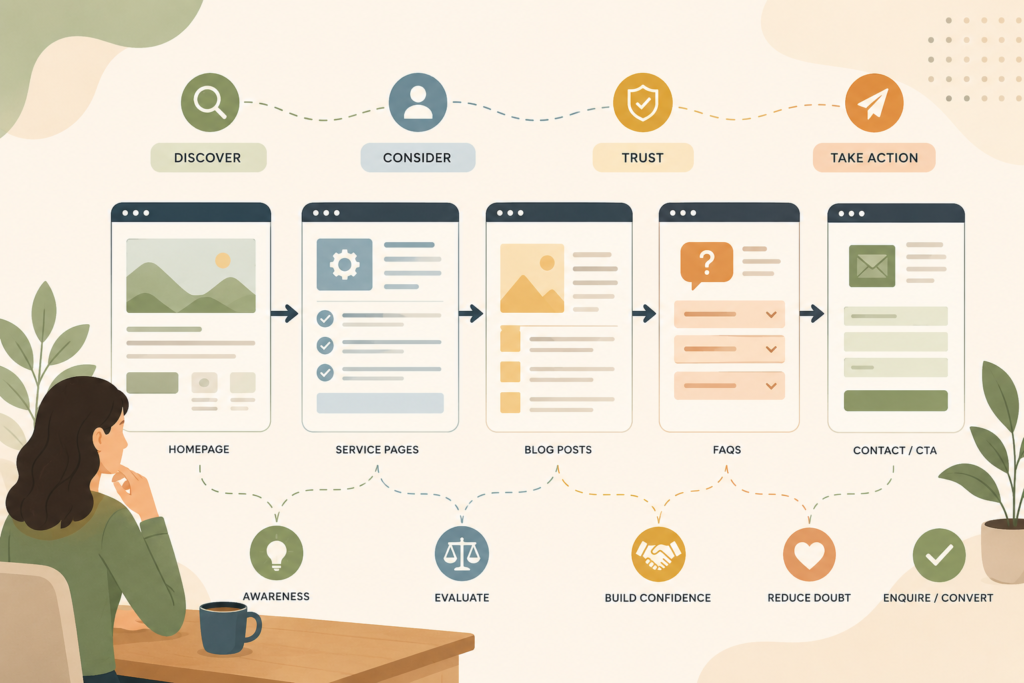
Your website content also affects:
- Whether visitors understand what you offer
- Whether they trust your business
- Whether they feel your service is relevant to them
- Whether they know what to do next
- Whether your sales conversations start warmer
This matters for small business website content because visitors are often comparing several providers at once. They may not contact the first business they see. They contact the one that feels clearest, most relevant, and easiest to trust.
Think: content is not decoration. It is direction.
Service Page Content vs Blog Content
A strong website needs both service page content and blog content, but they do different jobs.
Service Page Content
Service page content explains what you offer.
It should help a visitor answer questions like:
- What does this service include?
- Who is it for?
- What problem does it solve?
- What outcomes can I expect?
- How does the process work?
- Why should I trust this provider?
- What should I do next?
Service pages are usually closer to the buying decision. They need clarity, proof, structure, and practical calls to action.
For example, a website design page should not only say “we build websites.” It should explain what kind of websites, what makes the process useful, what the client needs to prepare, and what happens after launch.
VVRapid’s Website Design & Development page does this by framing websites around speed, usability, mobile-first layouts, clear messaging, and business usefulness.
Blog Content
Blog content answers questions around the service.
It is often useful earlier in the buyer journey, before the person is ready to enquire.
Blog content can explain:
- How to understand a problem
- How to compare options
- What mistakes to avoid
- What a process involves
- How to prepare for a project
- What signs suggest help is needed
A blog post may not convert someone immediately. That is fine.
Good blog content builds context. It helps people become better buyers.
How Website Content Writing Supports the Buyer Journey
Buyer journey content is content written around what a person needs to know before making a decision.
Most small business buyers move through a few simple stages.
Stage 1: Problem Aware
The person knows something is not working.
They may search for topics like:
- Why is my website not getting enquiries?
- Why do visitors leave my service page?
- Do I need a blog for SEO?
- How do I explain my services better?
At this stage, blog content is often useful. The goal is education, not pressure.
Stage 2: Solution Aware
The person understands the problem and starts looking at options.
They may compare:
- Website copywriting vs SEO content writing
- DIY website content vs professional support
- Service page content vs landing page copy
- Blog content vs FAQ content
This is where comparison articles, guides, checklists, and explainers help.
Stage 3: Provider Aware
The person is deciding who to trust.
Now your service pages need to work harder. They should explain your approach, process, fit, next steps, and relevant services.
Internal links matter here.
A blog post about buyer journey content might link naturally to Website Design & Developmentif the reader also needs a clearer site structure.
Stage 4: Decision Ready
The person is almost ready to enquire.
They need reassurance.
This can come from FAQs, process sections, practical expectations, maintenance details, and simple contact options. If the site feels confusing at this stage, the lead may disappear.
Clear website content writing reduces that friction.
The Website Content System Every Small Business Needs
A useful website content system does not need to be complicated.
It needs the right pages doing the right jobs.
Homepage
Your homepage should quickly explain:
- Who you help
- What you help with
- Why it matters
- Where people should go next
It should not try to say everything.
A homepage is a guide, not a storage cupboard.
Service Pages
Each core service should have its own page where possible.
This helps with both user experience and SEO content writing. A focused page is usually easier to understand than a single page listing everything.
Strong service page content should include:
- Clear service name
- Plain-language explanation
- Problems solved
- Who it is for
- What is included
- Process overview
- FAQs
- Internal links to related services
- A practical call to action
Blog Posts
Blog posts should support your service pages.
For example, if you offer SEO, useful blog topics might explain audits, keyword research, content planning, internal linking, or technical SEO basics.
If you offer website design, useful topics might explain content structure, page planning, conversion copywriting, and launch preparation.
Blogs help build the bridge between questions and services.
FAQ Content
FAQ content helps reduce uncertainty.
Some FAQs belong on service pages. Others may become full blog posts when the answer needs more explanation.
The key is to avoid thin, generic answers.
A good FAQ should help the reader make progress.
Contact Page
Your contact page should be simple, clear, and low friction.
It should tell people what to expect after they enquire. This can improve confidence, especially for service businesses where the next step is a conversation, quote, or consultation.
How to Connect Service Pages and Blogs
The strongest small business website content connects pages intentionally.
Here is a simple model.
Start With Your Core Services
List the main services you want to be known for.
For VVRapid, relevant examples include website design, SEO, blog and article writing, hosting, app development, custom plugin development, website maintenance, and digital strategy.
Each service should have a clear page where possible.
Identify Buyer Questions
For each service, list the questions people ask before buying.
For website content writing, questions might include:
- What pages does my website need?
- What should go on a service page?
- How much content is too much?
- Should I write blogs or improve service pages first?
- What is the difference between SEO content and conversion copywriting?
These questions become blog topics, FAQ answers, and service page sections.
Create Blog Posts That Support Pages
A blog post should not float on its own.
It should link to a relevant service page where helpful. For example, a post about website copywriting can link to Socials, Blogs & Article Writing when discussing content support.
A post about site structure can link to Website Design & Development when discussing page layouts, navigation, and user experience.
Add Internal Links From Service Pages Back to Helpful Blogs
Internal links should work both ways.
A service page can link to blog posts that explain common concerns. This helps visitors who are not ready to enquire yet.
It also keeps people moving around your site instead of returning to search results.
The Nielsen Norman Group notes that users often scan pages rather than read every word, which makes clear structure, headings, and navigation important for usability.: Nielsen Norman Group, How Users Read on the Web ↗
Checklist: What Good Website Content Writing Should Include
Use this checklist when reviewing your current site.
Strong website content writing should include:
- □ A clear homepage message
- □ Separate pages for important services
- □ Practical service page content
- □ Blog content that answers buyer questions
- □ Clear calls to action
- □ Internal links between related pages
- □ SEO-friendly headings and metadata
- □ Helpful FAQs on key pages
- □ Consistent tone and terminology
- □ Proof points where available
- □ Simple explanations of your process
- □ Clear next steps on every important page
- □ Image alt text where appropriate
- □ Mobile-friendly page structure
- □ Regular content updates
You do not need everything perfect on day one.
Start by making the path clearer.
Common Website Content Writing Mistakes
Even good businesses can lose leads because their content makes the visitor work too hard.
Mistake 1: Writing From the Business’s Point of View Only
Many service pages start with “we offer” and then list features.
That is not always wrong, but it can feel flat.
Better content starts with the customer’s problem, then connects the service to a clear outcome.
Mistake 2: Treating Blogs and Service Pages as Separate Worlds
Your blog should support your commercial pages.
If your blog answers useful questions but never guides readers to relevant services, it may build trust without creating action.
If your service pages never link to educational content, they may feel too thin for cautious buyers.
Mistake 3: Using Vague Language
Words like “solutions,” “quality,” “innovative,” and “tailored” can be useful, but only when supported by specifics.
Instead of saying “we provide tailored digital solutions,” explain what you actually do, for whom, and how the process works.
Mistake 4: Hiding the Next Step
Every important page should make the next step clear.
That does not mean shouting “book now” every few lines. It means helping the reader understand what to do when they are ready.
Mistake 5: Ignoring Mobile Readers
Many visitors will read your site on a phone.
Long blocks of text, unclear headings, and buried calls to action can make mobile pages harder to use. Keep paragraphs short and sections scannable.
Mistake 6: Forgetting to Maintain Content
Website content is not finished forever.
Services change. Markets shift. Customer questions evolve. Old content should be reviewed, improved, and connected to newer pages.
For ongoing technical and content upkeep, a service like Website Maintenance & Care can help keep the site healthier over time.
Where SEO Fits Into Website Content Writing
SEO content writing should make your content easier to find and easier to understand.
That includes:
- Choosing a clear primary keyword
- Matching the page to search intent
- Using related terms naturally
- Writing useful headings
- Adding internal links
- Writing helpful metadata
- Making the page readable
- Keeping content accurate and current
For broader visibility planning, Search Engine Optimisation can support the technical and strategic side of search.
But SEO should not make your content robotic.
The best content feels clear to people first. Search engines then have a better chance of understanding it too.
A Simple Buyer Journey Content Map
Here is a practical way to plan your content.
Awareness Content
Purpose: help readers understand the problem.
Examples:
- Why your website is not generating leads
- Signs your service pages are unclear
- Common website content mistakes
Consideration Content
Purpose: help readers compare options.
Examples:
- Website copywriting vs SEO content writing
- Service page content vs blog content
- DIY website content vs hiring a content partner
Decision Content
Purpose: help readers choose the right next step.
Examples:
- What to prepare before a website content project
- What a website content writing package should include
- Questions to ask before hiring a website copywriter
Retention Content

Purpose: help existing customers get more value.
Examples:
- How to keep website content updated
- When to refresh old blog posts
- How to expand content as services grow
This type of map turns content structure into a practical growth tool.
How VVRapid Can Help
VVRapid helps small businesses strengthen the digital side of their business through websites, SEO, content, hosting, apps, maintenance, and strategy. The business is based in Cape Town, South Africa, with an additional presence in Horsham, United Kingdom.
For website content writing, VVRapid can help connect your service pages, blog content, SEO structure, and buyer journey so your site feels clearer and more useful.
That may include article writing, service page planning, SEO support, website improvements, or a broader Digital Strategy Roadmaps approach.
The aim is simple: content that helps people understand your business faster.
FAQ: Website Content Writing
What is website content writing?
Website content writing is the planning and writing of content for pages such as homepages, service pages, blog posts, FAQs, about pages, and contact pages. It helps visitors understand your business and take the next step.
How is website content writing different from blog writing?
Website content writing covers the full site, including commercial pages and navigation flow. Blog writing usually focuses on educational or search-led articles that support those pages.
Do service pages or blogs matter more?
Both matter. Service pages usually support conversion, while blogs support education, search visibility, and trust. The best results often come when they work together.
What is buyer journey content?
Buyer journey content is content planned around what potential customers need to know at each stage, from problem awareness to final decision.
Can website content writing improve SEO?
Yes. Clear structure, search-focused topics, internal links, helpful headings, and relevant copy can all support SEO. It works best when combined with technical SEO and a strong site structure.
How often should website content be reviewed?
Important pages should be reviewed at least a few times a year, or whenever services, pricing, positioning, customer questions, or search performance changes.
Final Thoughts
Website content writing is not just about sounding polished.
It is about helping people move.
Your service pages should explain what you do. Your blog content should answer the questions people ask before they trust you. Your internal links should connect the journey. Your calls to action should make the next step feel natural.
When those pieces work together, your website becomes less confusing and more useful.
To improve your content structure, service pages, and blog strategy, explore Socials, Blogs & Article Writing or contact VVRapid to plan a clearer website content path.