

Content marketing for service businesses works best when it helps people understand their problem, trust your expertise, and take the next practical step. It is not just about posting more often. It is about building a simple system that supports leads, trust, and search visibility over time.
Table of Contents
Many service businesses create content because they know they should. A few blog posts here. A handful of social updates there. Maybe a newsletter when things are quiet.
The problem is that random content rarely creates steady results.
A better approach is to give every piece of content a role. Some content attracts new people. Some builds confidence. Some answers sales questions. Some helps existing clients get more value. When those pieces work together, content becomes less of a chore and more of a business asset.
This guide explains a practical framework for content marketing for service businesses, with a focus on leads, trust, SEO content marketing, and a monthly content plan that small teams can actually manage.
What Content Marketing for Service Businesses Really Means
Content marketing for service businesses is the process of creating helpful content that supports how people discover, evaluate, trust, and choose your service.
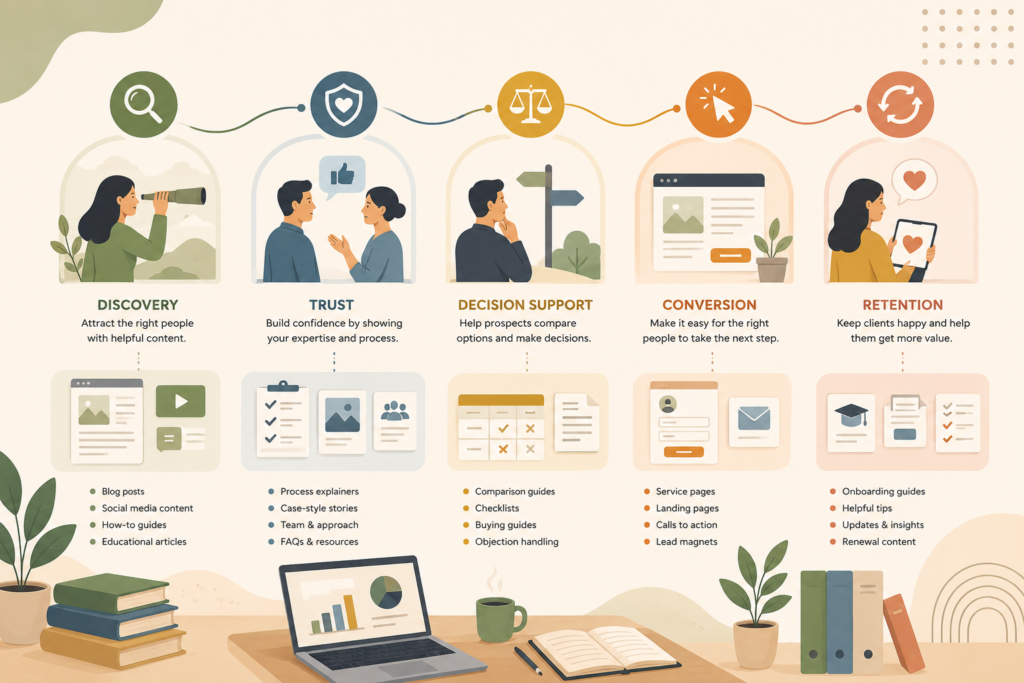
That content can include:
- Blog posts
- Social media posts
- Service pages
- FAQs
- Email newsletters
- Guides and checklists
- Case-style explanations
- Process pages
- Comparison articles
- Educational videos or visuals
For service businesses, content is especially important because people are not buying a product they can hold. They are buying judgement, skill, process, reliability, and trust.
That means your content has to do more than describe what you offer. It should help potential clients feel clearer and more confident.
Think: your content should make the invisible parts of your service easier to understand.
Why Service Businesses Need a Different Content Approach
Service business marketing is different from product marketing.
A product page can show specifications, photos, stock levels, delivery details, and reviews. A service page often has to explain something more complex. The buyer may not fully understand the problem yet. They may be comparing several different types of providers. They may worry about cost, time, quality, or whether they are choosing the wrong solution.
That is where content marketing for service businesses becomes useful.
Good content can:
- Explain common problems in plain language
- Show how your process works
- Help buyers compare options
- Answer objections before a sales call
- Build trust before someone contacts you
- Support search visibility for useful topics
- Give your team helpful links to send prospects
This is not about being everywhere. It is about being useful in the right places.
The Five Content Roles Every Service Business Needs
A simple content framework starts by giving each piece of content a job.
Here are five roles to plan around.
1. Discovery Content
Discovery content helps new people find you.
This is often blog content, SEO content marketing, social posts, or educational resources built around the questions your audience is already asking.
Examples:
- “How do I know if my website needs redesigning?”
- “What should be included in an SEO audit?”
- “How often should a small business publish blog posts?”
- “What does website maintenance include?”
Discovery content is not always sales-heavy. Its job is to be found, be helpful, and introduce your expertise.
2. Trust-Building Content
Trust-building content helps people feel that you understand their problem.
For service businesses, this can include:
- Process explainers
- Behind-the-scenes posts
- Practical checklists
- Common mistakes articles
- Educational guides
- Team or approach pages
- Helpful FAQs
Trust-building content should sound calm and specific. Avoid vague claims like “we deliver world-class solutions” unless you can support them with clear detail.
Specific beats impressive.
3. Decision-Support Content
Decision-support content helps buyers compare options.
This is where commercial investigation content is useful. People may be asking:
- Should I hire a freelancer or agency?
- Do I need SEO or paid ads first?
- Should I improve my website before investing in content?
- What should a monthly content plan include?
- How do I choose a digital partner?
This kind of content can support lead generation content without becoming pushy. It helps people make better decisions.
4. Conversion Content
Conversion content helps someone take the next step.
This includes service pages, landing pages, contact pages, proposal support content, and calls to action.
For example, a blog post can educate the reader, but the related service page should explain what you offer, who it is for, how it works, and what to do next.
Content marketing for service businesses works best when blog and social media content connects naturally to strong service pages.
5. Retention Content
Retention content helps existing clients or customers get more value.
This can include:
- Onboarding guides
- How-to articles
- Maintenance tips
- Update reminders
- Best practice checklists
- Educational emails
Retention content is often overlooked, but it can reduce repeated questions, improve client experience, and support long-term relationships.
How Blogs, Social Posts and Service Pages Should Work Together
Your blog, social media, and service pages should not feel like separate projects.
They should support one another.
Blog Content Builds Depth
Blog content gives you space to explain topics properly. It is useful for search visibility, education, and answering detailed buyer questions.
For example, a blog post about content marketing for service businesses can explain the strategy behind content before linking to a relevant service like Socials, Blogs & Article Writing.
Social Content Builds Visibility and Familiarity
Social posts can make your ideas easier to notice.
A single blog article can become several social posts, such as:
- A short checklist
- A common mistake
- A simple framework
- A myth correction
- A question prompt
- A visual summary
This is where blog and social media content can work together. The blog gives depth. Social gives distribution and repetition.
Service Pages Build Clarity
Service pages help people understand what you actually offer.
A good service page should answer:
- What is the service?
- Who is it for?
- What problems does it solve?
- What is included?
- How does the process work?
- What should the reader do next?
If your content attracts the right people but your service pages are unclear, leads may still drop off. For stronger page structure, Website Design & Development can support the website side of the journey.
A Practical Monthly Content Plan for Small Teams
A monthly content plan does not need to be complicated.
For many small service businesses, a simple rhythm is enough.
Week 1: Publish One Search-Focused Blog Post
Choose a topic linked to a real customer question and a relevant service.
This supports SEO content marketing and creates a useful asset for your website.
Week 2: Repurpose the Blog Into Social Posts
Turn the blog into three to five social posts.
For example:
- One problem-aware post
- One checklist post
- One mistake post
- One short opinion post
- One call to read the full guide
This helps you get more value from the original article.
Week 3: Improve One Existing Page
Update one service page, FAQ section, older blog post, or internal link.
Small improvements compound over time.
Week 4: Review and Plan
Look at what performed, what questions came up in sales conversations, and what content should come next.
A monthly content plan should be flexible. If prospects keep asking the same question, that is often your next article.
Checklist: Content Marketing for Service Businesses
Use this checklist to review your current content.
A practical content system should include:
- □ Clear service pages for your main offers
- □ Blog posts that answer real buyer questions
- □ Social posts that repurpose useful ideas
- □ Internal links between blogs and services
- □ Content for awareness, trust, decision, conversion, and retention
- □ A simple monthly content plan
- □ SEO content marketing basics
- □ Clear calls to action
- □ Helpful FAQs
- □ Consistent tone and terminology
- □ A way to track content performance
- □ Content refreshes for older pages
- □ A clear owner for planning and publishing
You do not need a huge content machine. You need a repeatable system that fits your team.
Common Mistakes That Make Content Feel Random
Content often fails because it lacks structure, not because the business lacks expertise.
Mistake 1: Creating Content Without a Goal
Before creating a post, ask what role it plays.
Is it for discovery, trust, decision support, conversion, or retention?
If you cannot answer that, the topic may need more thought.
Mistake 2: Only Posting When Business Is Quiet
Many service businesses create content when enquiries slow down.
That is understandable, but it creates an uneven pattern. Content marketing for service businesses works better when it is consistent, even if the rhythm is modest.
Mistake 3: Making Every Post Sales-Focused
If every post asks people to buy, the content becomes easy to ignore.
Helpful content earns attention. Commercial content then works better because trust has already started.
A healthy mix is roughly 60 percent helpful education and 40 percent decision support.
Mistake 4: Ignoring Search Intent
A keyword is not just a phrase. It represents a reason someone is searching.
Someone searching “how to improve website enquiries” needs different content from someone searching “website design agency near me”.
Good small business content strategy considers what the reader is trying to do.
Mistake 5: Forgetting Internal Links
Internal links help people move from useful content to relevant services.
They also help search engines understand how your content fits together. If your blog posts never link to service pages, you may be missing simple opportunities.
For wider visibility and structure, Search Engine Optimisation can help connect content with SEO priorities.
Mistake 6: Measuring Only Likes
Social engagement can be useful, but it is not the full picture.
Look at website traffic, search impressions, organic clicks, enquiries, assisted conversions, and the quality of sales conversations too.
The Content Marketing Institute describes content marketing as a strategic approach focused on valuable, relevant, consistent content for a defined audience.: Content Marketing Institute Definition ↗
The word “strategic” matters.
How to Choose Topics for Lead Generation Content
Lead generation content should help the right people move closer to a decision.
Start with your sales conversations.
What questions do prospects ask before they enquire, book, or approve a quote?
Useful topic sources include:
- Common objections
- Repeated email questions
- Service misunderstandings
- Comparison questions
- Pricing concerns
- Preparation questions
- Process questions
- Mistakes people make before hiring help
Then group topics by intent.
Awareness Topics
These help people understand the problem.
Example: “Why your website gets traffic but no enquiries.”
Consideration Topics
These help people compare options.
Example: “SEO vs content marketing: which should a service business prioritise?”
Decision Topics
These help people choose a next step.
Example: “What to include in a monthly content plan for a service business.”
This approach makes content marketing for service businesses more focused and less reactive.
Where SEO Fits Into the Framework
SEO helps people find your content when they are actively searching.
For service businesses, SEO content marketing is especially valuable because many buyers research before they contact anyone.
Your content should include:
- A clear primary keyword
- Related phrases used naturally
- Helpful headings
- Search intent alignment
- Internal links
- Useful answers
- Relevant external sources where appropriate
- Metadata for search results
Google’s SEO Starter Guide explains the importance of helpful content, clear structure, and making pages understandable to search engines.: Google Search Central SEO Starter Guide ↗
SEO should not make your writing stiff. The best content sounds human and useful first.
How to Measure Whether Content Is Working
Content marketing for service businesses takes time, but it should still be measured.
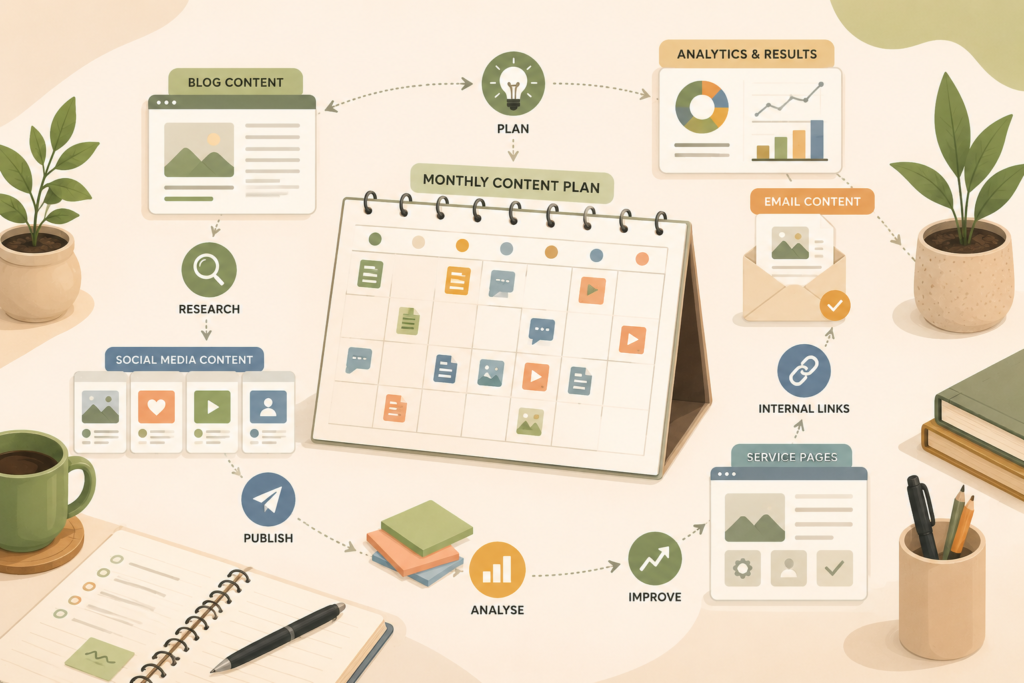
Useful signals include:
- Organic impressions
- Organic clicks
- Ranking improvements
- More visits to service pages
- Newsletter signups
- Enquiries from better-fit prospects
- Prospects mentioning articles on calls
- Social saves and shares
- Reduced repeated questions from clients
Google Search Console can help you understand how pages appear in search and which queries are driving impressions and clicks.: Google Search Console Help ↗
Do not judge every post after one week.
Look for patterns over months. Some content supports direct enquiries. Some supports trust. Some helps your team explain things faster. All of that has value.
A Simple Framework You Can Use This Month
Here is a practical way to start.
Step 1: Choose One Core Service
Pick a service you want more people to understand.
For example: website design, SEO, blog writing, maintenance, hosting, app development, or digital strategy.
Step 2: Write Down Ten Buyer Questions
Use real questions from calls, emails, forms, and social messages.
Step 3: Group the Questions by Journey Stage
Sort them into awareness, consideration, decision, and retention.
Step 4: Choose One Blog Topic
Pick the question that is most useful and most connected to your service.
Step 5: Create Three Social Posts From It
Turn the main points into short, helpful posts.
Step 6: Link It Back to a Service Page
Make sure the article guides readers to the relevant service when it makes sense.
Step 7: Review It Next Month
Check whether the content gained impressions, clicks, engagement, or sales usefulness.
Simple. Repeatable. Manageable.
How VVRapid Can Help
VVRapid helps service businesses turn digital work into clearer systems, including content, SEO, websites, hosting, apps, maintenance, and strategy.
For content marketing for service businesses, support may include blog writing, social content, SEO planning, service page improvements, or a broader content roadmap.
Explore Digital Strategy Roadmaps if you need the plan first, or Fractional Digital Team if you need ongoing digital support.
The aim is practical: clearer content, stronger trust, and a better path from search to enquiry.
FAQ: Content Marketing for Service Businesses
What is content marketing for service businesses?
Content marketing for service businesses is the creation of helpful content that attracts, educates, builds trust, and guides potential clients toward a relevant service.
How is service business marketing different from product marketing?
Service business marketing often needs more education and trust-building because buyers are choosing expertise, process, and reliability rather than a physical product.
What content should a service business create first?
Start with clear service pages, then create blog content that answers common buyer questions. From there, repurpose useful ideas into social posts and email content.
How often should a service business publish content?
A realistic monthly content plan is better than an ambitious plan you cannot maintain. Many small businesses can start with one or two strong blog posts per month plus repurposed social content.
Can content marketing generate leads?
Yes. Lead generation content can attract relevant visitors, answer decision-stage questions, support service pages, and make sales conversations easier.
Does content marketing help SEO?
Yes. SEO content marketing can improve search visibility when content is useful, well-structured, matched to search intent, and connected through internal links.
Final Thoughts
Content marketing for service businesses does not need to be loud, complicated, or constant.
It needs to be clear.
Start with the questions your buyers already have. Build content around discovery, trust, decision support, conversion, and retention. Connect blog and social media content to strong service pages. Review what is working and improve the system month by month.
That is how content becomes more than activity.
It becomes a practical path from visibility to trust to enquiry.
To plan useful blog, article, and social content for your service business, visit Socials, Blogs & Article Writing or contact VVRapid when you are ready to build a clearer monthly content plan.