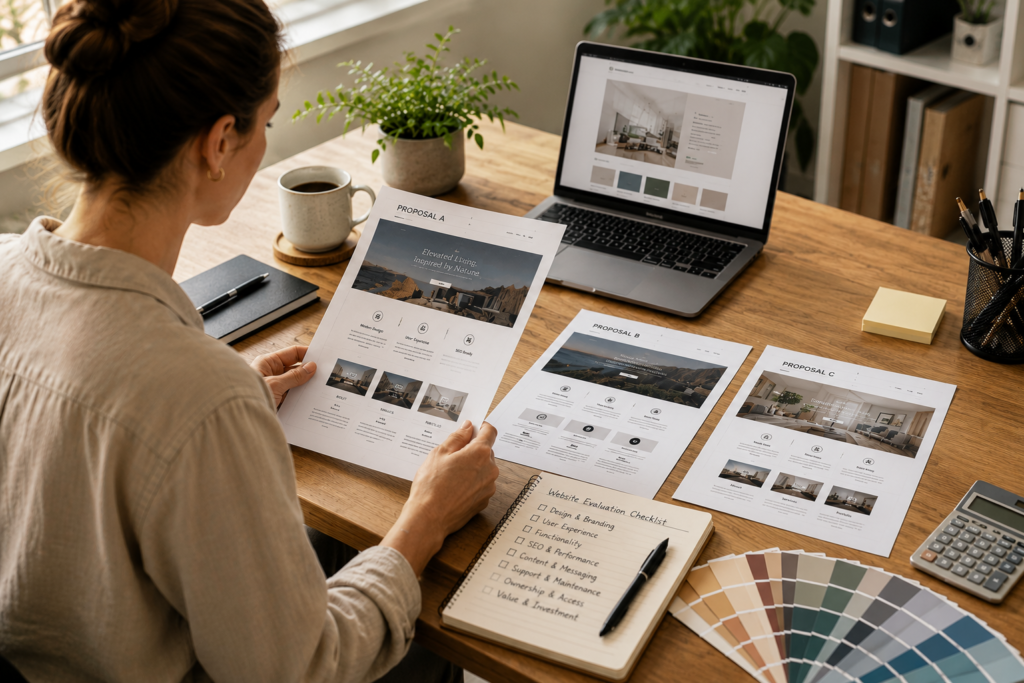
Knowing how to choose a website designer can save your small business from an expensive project that looks polished but fails to generate enquiries, support customers, or grow with you.
Table of Contents
The right website partner should understand more than colours and page layouts. They should be able to translate your business goals into a clear structure, usable pages, reliable technology, and a realistic development process.
The challenge is that website proposals often look similar on the surface. One may come from a freelancer, another from a website design company, and another from a broader digital team. Each may promise a professional result, but the scope, ownership terms, technical quality, and post-launch support can differ significantly.
This guide explains how to compare those options carefully, ask better questions, and select a professional web designer based on business fit rather than presentation alone.
How to Choose a Website Designer Based on Business Goals
Before reviewing portfolios or requesting prices, define what the website must accomplish.
A brochure-style website may need to explain your services and make your business look credible. A lead generation website must guide visitors towards enquiries. An online store needs dependable product management, payments, shipping rules, and checkout functionality.
Your goals affect the type of small business website designer you need.

Start by answering:
- What is the website’s primary job?
- Who is the intended customer?
- What should a visitor do next?
- Which products or services matter most?
- What business systems must the website connect to?
- Who will manage the website after launch?
- How will you measure whether it is working?
A website project becomes easier to compare when every provider is responding to the same business requirements.
For help defining the website itself before approaching providers, use VVRapid’s practical website design and development brief.
Decide What Type of Website Development Partner You Need
There is no universally best hiring model. The right choice depends on your scope, internal capacity, budget, and need for ongoing support.
Freelance website designer
A freelancer may be suitable for a focused project with a limited number of pages and straightforward functionality.
Advantages can include direct communication, flexibility, and a simpler working relationship. The main risk is dependency on one person. Ask what happens if they become unavailable, how support requests are handled, and whether specialist work is outsourced.
Website design company
A website design company may offer access to design, development, project management, content, and SEO skills under one roof.
This can suit a business that needs several capabilities coordinated throughout the project. Confirm which team members will actually work on your website, rather than assuming every skill shown on the company website is included in your package.
Fractional or ongoing digital team
A fractional digital team may be appropriate when the website forms part of a wider growth plan involving campaigns, SEO, content, integrations, analytics, and continuous improvement.
This model is useful when your business needs more than a once-off build but is not ready to employ a complete internal team.
You can review how this model works on VVRapid’s Fractional Digital Team page.
Specialist website developer
Some projects require a specialist rather than a general website designer.
Examples include:
- Complex WooCommerce functionality
- Membership systems
- Customer portals
- Custom calculators
- API integrations
- Multilingual platforms
- Bespoke WordPress plugins
- Advanced booking workflows
When comparing providers, check whether the required functionality is part of their normal work or something they are attempting for the first time.
Review Portfolios for Relevance, Not Just Appearance
A portfolio is useful, but attractive screenshots do not prove that a website is easy to use, fast, maintainable, or commercially effective.
Open several live websites where possible. Review them on both desktop and mobile.
Look for:
- Clear navigation
- Readable text
- Logical page hierarchy
- Obvious next steps
- Consistent design
- Fast page loading
- Working forms
- Accessible colour contrast
- Useful mobile layouts
- Credible trust signals
A professional web designer should also be able to explain the reasoning behind the work.
Ask what problem each project needed to solve, what constraints were involved, and which decisions were made because of the client’s audience or business model.
A strong answer will focus on users, goals, content, functionality, and trade-offs. A weak answer will focus only on visual style.
Think: you are not buying a gallery image. You are buying a working business asset.
Ask Who Will Actually Complete the Work
When learning how to choose a website designer, one of the most useful questions is also one of the simplest:
“Who will be doing the work?”
The person leading the sales call may not be the designer, developer, copywriter, or project manager assigned to your project.
Ask for clarity on:
- Who manages the project
- Who designs the page layouts
- Who develops the website
- Who uploads or writes the content
- Who handles technical SEO
- Who performs quality assurance
- Who communicates with you
- Which tasks are outsourced
Outsourcing is not automatically a problem. Many capable teams use trusted specialists. The concern is whether responsibilities are clear and whether the provider remains accountable for the final result.
You should not have to coordinate several unnamed suppliers yourself.
Compare Website Proposals Line by Line
A lower quote may simply include less work.
Before choosing a website development partner, compare proposals using the same categories.
Scope
Confirm the number and type of pages included.
A five-page website can mean five unique designs, five pages using one reusable template, or a homepage plus four lightly populated pages. These are not the same deliverable.
Content
Check whether the proposal includes:
- Copywriting
- Copy editing
- Content migration
- Image sourcing
- Image optimisation
- Product uploads
- Blog migration
- Legal page setup
Content is often excluded or treated as the client’s responsibility. That is acceptable when stated clearly.
For professional help with service pages, articles, and supporting website copy, see VVRapid’s Socials, Blogs & Article Writing Services.
Functionality
List each required feature and confirm whether it is included.
Examples include contact forms, WhatsApp buttons, booking systems, payment gateways, newsletters, CRM integrations, analytics, search, customer accounts, and multilingual functionality.
Revisions
“Unlimited revisions” can sound reassuring, but the definition matters.
Ask whether revisions apply to design concepts, page content, development work, or only minor changes within an approved layout. Also ask how feedback must be submitted and when a change becomes new scope.
Testing and launch
A complete proposal should explain how the website will be tested before launch.
Testing may include:
- Mobile and desktop layouts
- Forms and notifications
- Links and buttons
- Browser compatibility
- Basic accessibility
- Checkout or booking flows
- Page speed
- Redirects
- Analytics
- Search engine visibility settings
Support after launch
Confirm whether the provider includes a warranty period, training, maintenance, updates, backups, security monitoring, or ongoing support.
Do not assume website maintenance is included in the original build.
VVRapid’s Website Maintenance & Care service explains the type of ongoing support a business may need after launch.
Ask the Right Questions Before You Hire a Website Designer
A good website proposal checklist should include questions about business thinking, technical delivery, and ownership.
Ask each shortlisted provider:
- How will you learn about our business and customers?
- What is included and excluded from the quote?
- Who will manage and complete the work?
- Which platform and page builder will you use?
- Can we update the website ourselves?
- How do you approach mobile usability?
- What SEO foundations are included?
- How do you test accessibility?
- How do you handle security, backups, and software updates?
- Who owns the website, content, domain, and accounts?
- Which paid licences must we renew?
- What happens if the project scope changes?
- How is feedback and approval managed?
- What support is available after launch?
- How will the website be handed over?
The answers should be understandable without technical translation.
A provider who explains limitations clearly is often more reliable than one who agrees to every request immediately.
Check SEO, Accessibility, and Performance Knowledge
You do not need to become a technical expert, but your website designer should understand the fundamentals that influence usability and visibility.
Google advises building websites for users while making content easy for search engines to understand. Its developer guidance covers crawlable pages, descriptive content, metadata, links, and other search foundations.: Google Search Central SEO Starter Guide ↗
Ask whether the project includes:
- Search-friendly page structures
- Editable page titles and descriptions
- Clean heading hierarchy
- Image ALT text
- XML sitemap setup
- Redirect planning for a redesign
- Analytics and Search Console setup
- Indexing checks before and after launch
For deeper organic search support, review VVRapid’s Search Engine Optimisation service.
Accessibility should also be considered during design and development, not added as a final plugin. The W3C explains that accessible websites allow people with disabilities to perceive, understand, navigate, and interact with web content.: W3C Web Accessibility Initiative ↗
Ask how the provider handles keyboard navigation, colour contrast, form labels, heading structure, link clarity, image alternatives, and readable mobile layouts.
For WordPress projects, hosting requirements and HTTPS should also be discussed. WordPress publishes its current technical requirements and recommends a suitable server environment for stable operation.: WordPress Requirements ↗
Confirm Ownership Before the Project Starts
Ownership problems often surface only when a business wants to move providers.
Before you hire a website designer, confirm who will own and control:
- The domain name
- Hosting account
- WordPress administrator account
- Website files
- Database
- Written content
- Images and design assets
- Analytics accounts
- Search Console account
- Email marketing account
- Premium themes and plugins
- Custom code
- Source design files
Ideally, important accounts should be created in the business’s name using a company-controlled email address.
Your provider can receive appropriate access without becoming the sole owner of your digital property.
Also ask whether any theme, plugin, font, stock image, or third-party tool is licensed only through the provider. Find out what must be purchased or renewed if the working relationship ends.
Evaluate Communication and Project Management
Technical ability matters, but communication problems can derail a capable build.
During early discussions, note whether the provider:
- Responds clearly
- Asks useful questions
- Explains decisions
- Documents agreements
- Identifies risks
- Sets realistic expectations
- Distinguishes requirements from preferences
- Confirms who must approve work
- Provides a clear feedback process
You should also understand the expected project rhythm.
Will there be weekly meetings? Will progress be shown in stages? Are designs approved before development? Where will files and feedback be stored? How quickly must your business respond?
A reliable process reduces confusion and protects both sides.
Consider Local and International Working Practicalities
A South African small business may hire locally or work with an international website design company.
Neither option is automatically better. Evaluate the practical implications.
Consider:
- Working hours and time-zone overlap
- Payment currency and exchange-rate changes
- VAT or tax documentation
- Communication channels
- Contract jurisdiction
- Hosting location
- Customer data requirements
- Local payment gateways
- South African audience expectations
- POPIA-related privacy responsibilities
For businesses serving the UAE, UK, EU, Australia, or New Zealand, local currencies, privacy rules, spelling preferences, payment options, and customer expectations may also affect the build.
Ask the provider how regional needs will be identified and implemented.
Do not assume that a technically functional website is automatically suitable for every market.
Website Designer Selection Checklist

Use this checklist before making your final decision:
- □ The provider understands the website’s business goal
- □ The proposal defines pages and deliverables clearly
- □ Content responsibilities are assigned
- □ Required functionality is listed
- □ The portfolio includes relevant live work
- □ The provider explains design decisions
- □ The project team is identified
- □ Mobile usability is included
- □ Basic SEO foundations are included
- □ Accessibility is considered
- □ Testing and launch responsibilities are clear
- □ Website and account ownership are documented
- □ Paid licence renewals are disclosed
- □ Revision limits are understandable
- □ Change requests have a defined process
- □ Post-launch support is explained
- □ Communication feels clear and dependable
- □ The contract reflects the proposal
- □ The final choice is based on fit, not price alone
Common Mistakes When Choosing a Website Designer
Choosing the cheapest quote without comparing scope
A cheap quote may exclude content, migration, SEO setup, testing, licences, training, or support.
Compare what will actually be delivered.
Judging only by visual style
A stylish portfolio does not prove that the websites are clear, fast, accessible, maintainable, or commercially useful.
Review live examples and ask about outcomes.
Starting without a clear decision maker
Conflicting feedback from several stakeholders causes delays and inconsistent design decisions.
Assign one person to consolidate and approve feedback.
Ignoring ownership and access
Your business should not discover after launch that the domain, hosting, analytics, or premium licences are controlled entirely by the provider.
Document access and ownership before work begins.
Assuming SEO is automatically included
Some providers use “SEO-friendly” to mean little more than installing a plugin.
Ask for a specific list of included SEO foundations.
Skipping post-launch planning
A website needs software updates, backups, security checks, content changes, and periodic improvement.
Decide who will own those tasks before launch.
Hiring a provider who never challenges the brief
A capable professional web designer should identify unclear requirements, conflicting priorities, and unnecessary features.
Agreement is not the same as expertise.
How VVRapid Can Help
VVRapid designs and develops fast, modern websites for local businesses, online stores, blogs, and portfolio-led companies. Projects can include structure, mobile-first layouts, integrations, launch support, and practical technical foundations.
The aim is to build a website that suits the business rather than forcing every client into the same template.
You can review the Website Design & Development service or contact VVRapid for any assistance or advice.
For broader ongoing support across development, content, SEO, and digital planning, VVRapid can also work as an extended digital partner.
FAQ: How to Choose a Website Designer
How do I choose a good website designer?
Choose a website designer who understands your business goals, defines the project scope clearly, shows relevant live work, explains their process, and documents ownership and support arrangements.
What should I look for in a small business website designer?
Look for clear communication, relevant experience, mobile-first thinking, practical SEO knowledge, reliable development standards, transparent pricing, and a website handover process your business can understand.
Should I hire a freelancer or a website design company?
A freelancer can suit a focused project with straightforward requirements. A website design company or fractional team may be better when you need coordinated design, development, content, SEO, integrations, or ongoing support.
How many website quotes should I get?
There is no fixed number, but two or three well-matched proposals are usually more useful than collecting many loosely comparable quotes. Give each provider the same requirements so you can compare scope properly.
What questions should I ask a web designer?
Ask about scope, team responsibilities, platform choice, mobile design, SEO, accessibility, testing, ownership, licences, revisions, timelines, handover, and post-launch support.
Should I choose a website designer based on price?
Price matters, but it should be considered alongside scope, experience, technical quality, communication, ownership terms, and ongoing support. The lowest initial quote may not offer the lowest total cost.
Make the Decision on Evidence
Learning how to choose a website designer is largely about replacing assumptions with documented answers.
Define what the website must do. Compare equivalent scopes. Review live work. Ask who owns the accounts and assets. Understand what happens after launch.
The best website development partner is not necessarily the cheapest, the largest, or the one with the most dramatic portfolio.
It is the provider whose skills, process, communication, and deliverables fit your business.
Review VVRapid’s Website Design & Development service or contact the team to discuss the type of website your business needs.