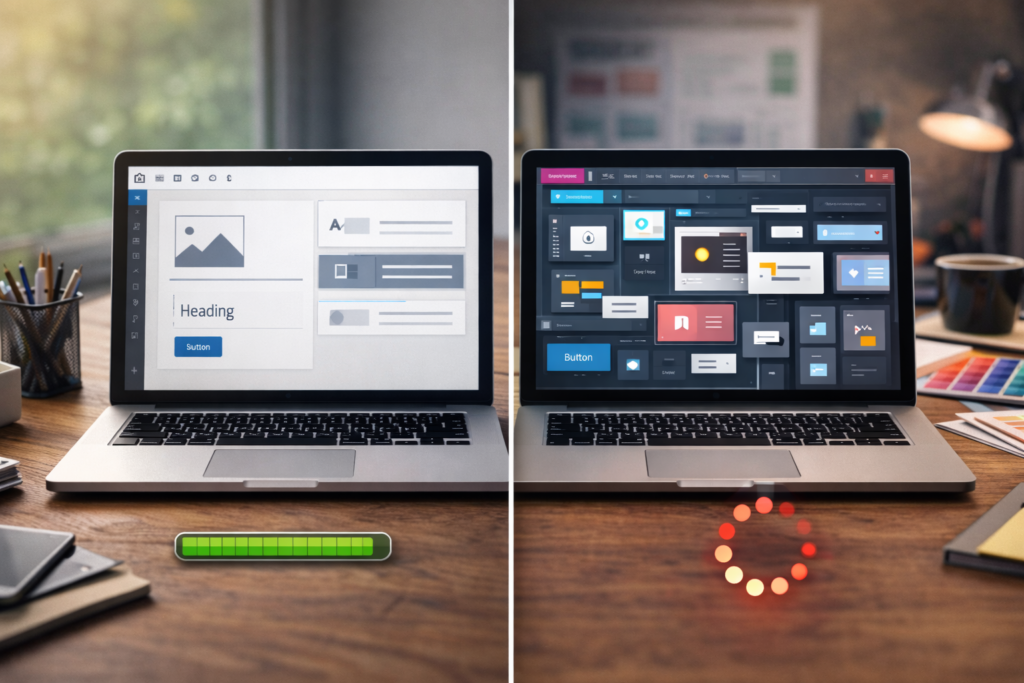

A custom website vs template website decision usually comes down to one thing: are you buying speed for today, or flexibility for the next few years? Many small business owners do not need a fully custom build on day one, but they also do not want to outgrow a template six months after launch.
Table of Contents
The good news is that a custom website vs template website choice does not need to feel technical or overwhelming. If you understand your goals, budget, content, and growth plans, the right option becomes much clearer.
A template website can be a smart move when you need to launch quickly, keep costs controlled, and publish a simple site with clear pages. A custom website can be the better choice when your business has more complex needs, a stronger brand, or a website that needs to support growth, SEO, and conversions in a more deliberate way.
For businesses comparing the practical route, start by reviewing Website Design & Development and then align that with your visibility goals through Search Engine Optimisation.
What a Template Website Actually Means
A template website uses an existing layout or theme as the foundation of the site. Instead of designing every page from scratch, the developer or business owner customises the structure, colours, images, copy, and some layout elements.
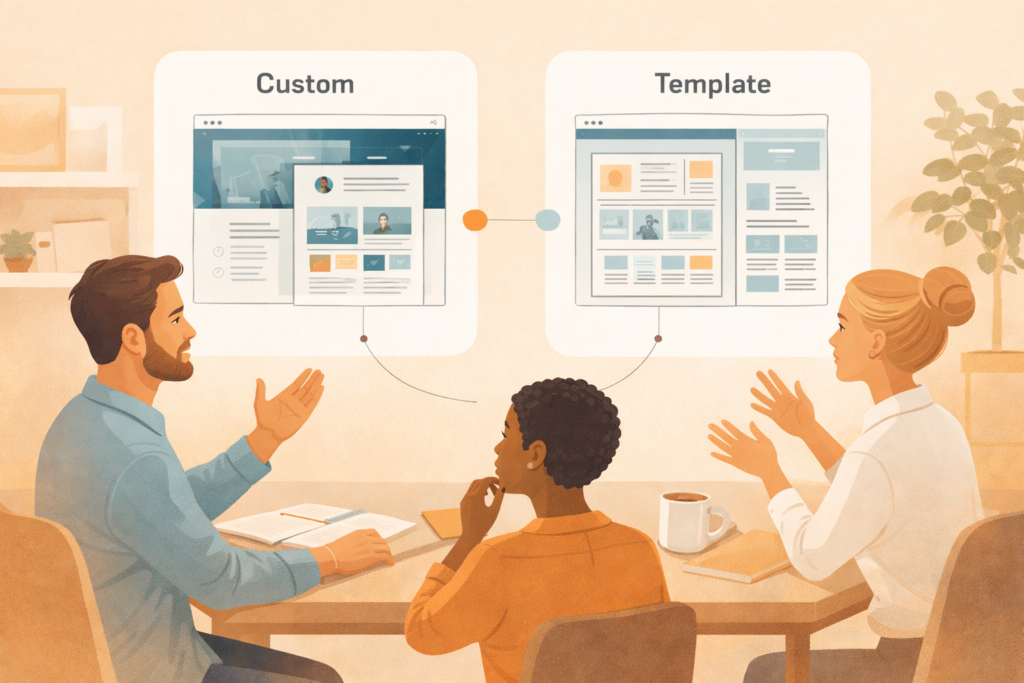
This is why template sites are popular with small businesses. They can be:
- Faster to launch
- More affordable upfront
- Easier to scope
- Good enough for brochure-style websites
- Useful for early-stage businesses testing their offer
A template website is often a good fit when you need:
- A simple home page
- Service pages
- An about page
- A contact page
- A blog or basic content section
- A lightweight online presence without advanced functionality
That does not make a template “bad.” In many cases, a template is the sensible choice.
What a Custom Website Actually Means
A custom website is designed and built around your specific business needs. That does not always mean every line of code is written from zero. It usually means the structure, layout, user journey, and functionality are tailored to your goals instead of squeezed into a pre-made pattern.
A custom website is often the stronger option when:
- Your services need a more strategic sales journey
- You have unique content or page requirements
- You want a more distinct brand experience
- You need custom integrations or functionality
- You expect to scale the website over time
- SEO structure and performance matter from the start
In a custom website vs template website discussion, the biggest difference is not just design. It is how well the website fits the business.
Custom Website vs Template Website on Cost
This is usually the first question, and fair enough.
Template websites tend to cost less upfront because:
- Design time is reduced
- Development time is shorter
- Scope is easier to control
- Fewer bespoke decisions are needed
Custom websites tend to cost more because:
- Strategy takes longer
- Page layouts are more tailored
- UX decisions are more deliberate
- Extra testing and revisions are often involved
- Complex functionality may need custom work
But upfront cost is only part of the story.
A template can become expensive later if:
- You keep patching around its limitations
- You add too many plugins to force features
- Your pages become inconsistent
- Mobile usability suffers
- You need a redesign sooner than expected
Think: cheap to launch is not always cheap to own.
If budget clarity is your main concern, this is where Digital Strategy Roadmaps can help shape scope before you build.
Custom Website vs Template Website on Speed to Launch
If you need a website live quickly, templates usually win.
A template website can often move faster because:
- The visual system is already there
- Fewer design decisions need approval
- Developers can work within a known structure
- Content can be placed more quickly
A custom website usually takes longer because:
- Sitemap and wireframes may need more work
- The layout needs to be refined around real goals
- Design rounds are more involved
- Functionality may need more testing
That said, many “fast” template projects still get delayed by content, unclear requirements, and late decisions. The build method is only one part of the timeline.
Custom Website vs Template Website on Branding
This is where many businesses misjudge the decision.
A template can look polished, but if it resembles dozens of similar websites in your niche, it may not help your brand stand out. That is especially true in crowded service sectors where trust, clarity, and perceived professionalism matter.
A custom website gives you more control over:
- Layout hierarchy
- Calls to action
- Brand personality
- Content presentation
- Trust-building page flow
If your business relies on credibility, premium positioning, or a clear point of difference, a custom website often gives you more room to express that properly.
Custom Website vs Template Website on SEO and Performance
A custom website vs template website comparison should always include SEO and speed, not just visuals.
Template websites can perform well when they are:
- Lightweight
- Properly configured
- Built on a solid theme
- Not overloaded with unnecessary plugins
- Structured clearly for search and users
Custom websites can perform even better when SEO and UX are planned together from the start. That includes:
- Cleaner page structure
- Better internal linking paths
- Stronger content hierarchy
- More intentional conversion pages
- Better control over code, assets, and templates
In practice, the best SEO result usually comes from the site that is easiest to maintain, easiest to expand, and easiest for visitors to understand.
For site speed, hosting quality matters too. A well-built site performs better when paired with LiteSpeed WebServer Hosting.
Useful reference points for technical quality and search guidance:
Custom Website vs Template Website on Flexibility
This is often the deciding factor for growth-stage businesses.
A template works well when your structure is stable. It works less well when your business keeps evolving.
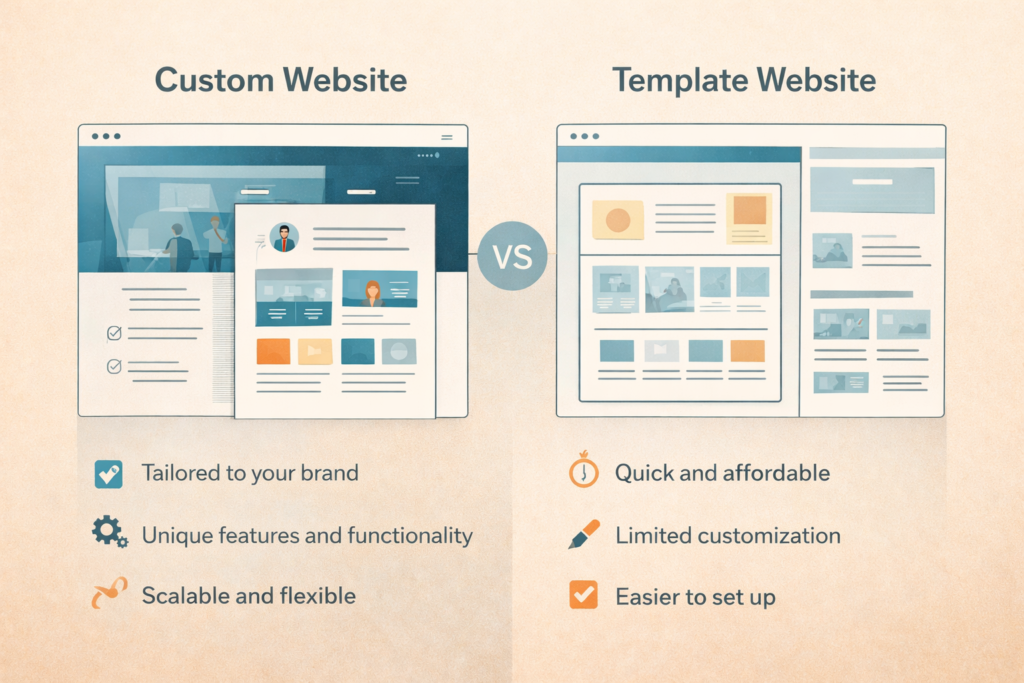
You may outgrow a template faster if you need:
- New service sections
- Landing pages for campaigns
- Multi-step lead flows
- Member areas
- Quote tools
- Location pages
- Advanced filtering
- More control over layouts
A custom website usually handles change better because it is built with your future use cases in mind.
That does not mean every small business needs a custom build immediately. It means you should be honest about how likely your website is to evolve.
When a Template Website Is the Better Choice
Choose a template website when:
- You are launching a new business
- Your offer is still simple
- You need a professional site quickly
- Your budget is limited
- You only need core pages
- You can live with some design constraints
- You want to validate demand before investing more
For many small businesses, this is a smart first step.
When a Custom Website Is the Better Choice
Choose a custom website when:
- Your site is central to lead generation
- Your brand needs stronger differentiation
- You need more than standard pages
- Your customer journey needs more strategy
- You want better long-term scalability
- You expect ongoing SEO and content growth
- You are tired of working around limitations
A custom website is usually not about ego. It is about fit.
Checklist: How to Decide Between a Custom Website and a Template Website
Use this checklist before requesting quotes:
- □ Define the main job of the website
- □ List the pages you need now
- □ List the features you may need within 12 months
- □ Decide whether speed or flexibility matters more
- □ Review whether your brand needs to look distinct
- □ Check who will update the website after launch
- □ Consider how important SEO will be to growth
- □ Identify whether integrations are required
- □ Confirm whether you need e-commerce now or later
- □ Set a realistic budget range
- □ Gather your content before the project starts
- □ Ask how easy it will be to expand the site later
If your answers are simple and stable, a template may be enough. If your answers are layered, evolving, or strategic, custom usually makes more sense.
Common Mistakes
Choosing custom too early
Some businesses invest in a custom website before they have clear messaging, validated offers, or enough content. That can lead to expensive indecision.
Choosing a template for the wrong reason
A template is not always cheaper in the long run. If it creates friction, redesign costs can arrive sooner than expected.
Focusing only on appearance
A beautiful website that confuses visitors still underperforms. Clarity beats decoration.
Ignoring content readiness
Even the best build struggles when the copy, images, and approvals are missing.
Forgetting post-launch upkeep
Websites need updates, checks, backups, and ongoing support. This matters whether the site is custom or template-based. See Website Maintenance & Care.
Not asking how scalable the site is
Ask what happens when you need new pages, new functionality, or stronger SEO later.
A Practical Way to Make the Decision
If you are unsure about custom website vs template website, do not start with “Do I want custom?”
Start with these questions instead:
- What does the website need to do this year?
- What is likely to change next year?
- How important is brand differentiation?
- How important is organic search growth?
- Will a standard structure genuinely fit the business?
This usually makes the custom website vs template website decision much easier.
How VVRapid Can Help
VVRapid offers Website Design & Development for businesses that need anything from lean brochure sites to more complete, growth-ready websites. The service page highlights builds for local businesses, online stores, blogs, and portfolios, with related support across SEO, hosting, strategy, and maintenance. That makes this topic a natural fit for buyers who are deciding not just what looks good, but what will work for their business over time.
A helpful starting point is Website Design & Development. If your priority is search visibility after launch, pair that with Search Engine Optimisation.
FAQ
Is a template website bad for SEO?
No. A template website can rank well if it is fast, well-structured, and supported by good content and technical basics.
Is a custom website always expensive?
Not always, but it usually requires more planning and tailored work. Cost depends on scope, complexity, and region.
Can a template website be upgraded later?
Sometimes, yes. But there is a limit to how much you can stretch a template before rebuilding becomes the cleaner option.
Which option is better for a service business?
It depends on the complexity of the offer and how much trust-building the website needs to do. Simpler service businesses may do well with a template. More competitive or premium services often benefit from custom.
What matters more: design or usability?
Usability. Strong design should support clarity, trust, and action.
Next Step
Choosing between a custom website vs template website build is easier when the decision is tied to business goals, not just aesthetics. To explore the right fit, visitWebsite Design & Development or contact VVRapid for a practical discussion.