

SEO lead quality matters because more traffic does not always mean more business. A website can attract hundreds or thousands of visitors from Google and still generate very few serious enquiries, bookings, calls, or quote requests.
Table of Contents
That is frustrating for small business owners. You see the traffic graph moving, but your inbox stays quiet. Or worse, you get enquiries from people who are not the right fit, not in your service area, not ready to buy, or only looking for the cheapest option.
Good SEO is not only about rankings. It is about attracting the right people, matching their search intent, answering their questions clearly, and making the next step easy.
If your business wants search visibility that supports real enquiries, VVRapid’s Search Engine Optimisation service can help connect SEO work to the pages, content, and tracking that matter.
Why SEO Lead Quality Matters More Than Traffic Alone
A traffic report can look impressive and still hide a weak commercial result.
For example, a blog post might attract many visitors who want free advice, but none of them need your service. A broad keyword might bring traffic from the wrong region. A page might rank for a term with unclear intent. Or your content may answer a question so completely that visitors leave without knowing you can help.
That is why SEO lead quality deserves attention.
The goal is not simply to increase organic sessions. The goal is to attract qualified organic traffic from people who are more likely to become useful enquiries.
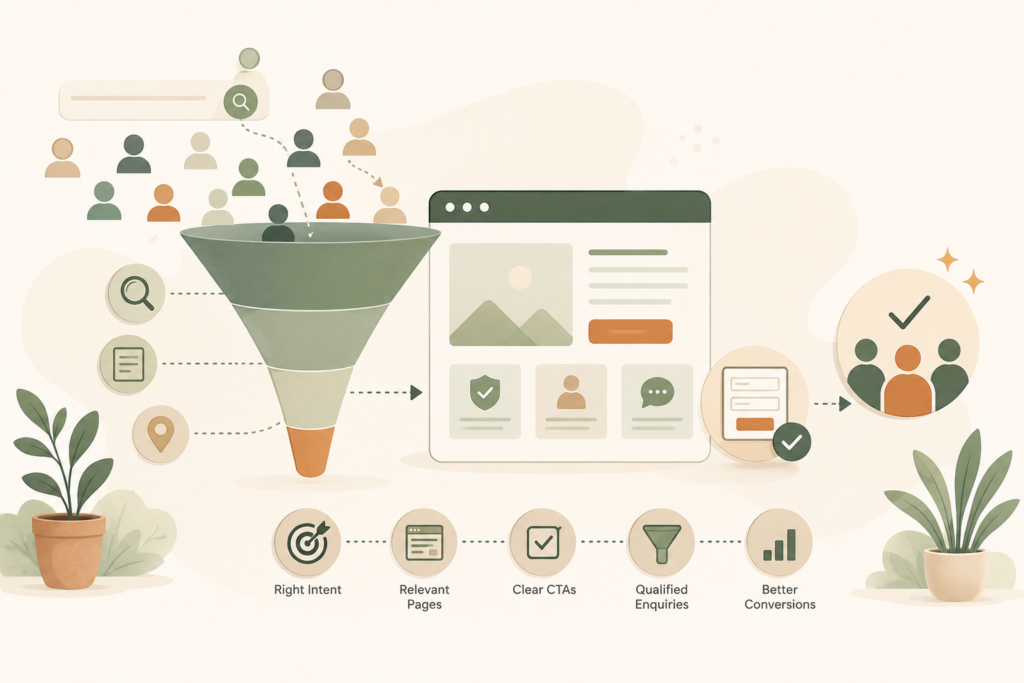
For a small business, this can mean:
- Fewer irrelevant calls
- Better-fit quote requests
- More local or regional enquiries
- More informed prospects
- Shorter sales conversations
- Better conversion rates from existing traffic
This is where SEO and conversion strategy overlap. A strong SEO conversion strategy looks at what people search, why they search it, which page they land on, and what they do next.
What SEO Lead Quality Actually Means
SEO lead quality is the measure of how useful your organic visitors are to your business.
A high-quality SEO lead is not just someone who found you on Google. It is someone who matches your ideal customer profile and has a realistic reason to contact you.
That may include someone who:
- Needs one of your core services
- Fits your location or delivery model
- Has the right budget or business size
- Understands the problem you solve
- Is comparing options seriously
- Is ready to book, enquire, call, or request a quote
Low-quality SEO leads may still be real people. They are just not strong business opportunities.
They might be students doing research, people outside your service area, DIY readers, bargain hunters, job seekers, suppliers, or visitors looking for something adjacent to what you offer.
The purpose of SEO lead quality work is to reduce the gap between “people visiting the website” and “people your business can actually help.”
Search Intent Is the Starting Point
Search intent is one of the biggest drivers of SEO lead quality.
Search intent means the reason behind a query. Someone searching “what is SEO” is in a different mindset from someone searching “SEO services for small business” or “technical SEO agency for WordPress site.”
The keyword may be related to your business, but the intent can be completely different.
Informational intent
These searches are usually research-based.
Examples:
- What is local SEO?
- How does Google Search Console work?
- Why is my website not ranking?
- What is on-page SEO?
Informational content is useful because it builds trust and brings people into your ecosystem. But not every informational visitor will become a lead.
Commercial investigation intent
These searches show that the visitor is comparing options.
Examples:
- Best SEO services for small business
- SEO retainer vs SEO project
- SEO agency vs freelancer
- Website SEO audit services
This traffic often has stronger enquiry potential because the reader is already thinking about solutions.
Transactional intent
These searches suggest the visitor may be ready to act.
Examples:
- Hire SEO consultant
- Request SEO audit
- SEO services near me
- Website optimisation company
Transactional searches can produce strong organic leads, but the pages must be clear, credible, and easy to act on.
A good SEO lead quality strategy does not ignore informational content. It simply knows what each page is meant to do.
Why Service Pages Often Matter More Than Blog Traffic
Blog traffic can be useful, but service pages usually carry the strongest commercial weight.
Your service pages explain what you do, who you help, and why someone should contact you. They are the pages most likely to turn qualified organic traffic into enquiries.
This is why service page SEO matters so much.
A strong service page should answer practical buyer questions:
- What exactly is included?
- Who is this service for?
- What problem does it solve?
- How does the process work?
- What outcomes can a client reasonably expect?
- What makes your approach credible?
- What should the visitor do next?
If your service page is vague, thin, slow, or hard to navigate, your SEO lead quality will suffer.
You may be attracting the right visitors, but losing them at the page level.
If your website needs clearer structure, stronger service pages, or better conversion flow, VVRapid’s Website Design & Development service can support the website side of your SEO conversion strategy.
Signs Your SEO Is Attracting the Wrong Visitors
Poor SEO lead quality is not always obvious at first. You may need to look beyond traffic totals.
Here are common signs:
- Organic traffic is increasing, but enquiries are flat.
- Visitors spend time on blog posts but do not visit service pages.
- You receive enquiries for services you do not offer.
- Leads are mostly outside your service area.
- People ask for prices far below your target market.
- Visitors land on pages that do not match your main offers.
- Your top-ranking keywords are mostly educational, not buyer-focused.
- Contact forms are submitted by suppliers, job seekers, or irrelevant prospects.
- Your sales team says “these leads are not a fit.”
One or two of these signs may not be a problem. But if they keep appearing, your SEO strategy may be attracting visibility without enough qualification.
That is when SEO lead quality needs to become part of the plan.
How to Improve SEO Lead Quality
Improving SEO lead quality does not mean removing all top-of-funnel content. It means creating clearer pathways from search to enquiry.
1. Map keywords to buyer intent
Start by grouping your keywords based on intent.
Use simple categories:
- Learning
- Comparing
- Problem-aware
- Service-aware
- Ready to enquire
Then map each group to the right page type.
Blog posts usually suit learning and problem-aware searches. Service pages suit service-aware and ready-to-enquire searches. Comparison guides can support commercial investigation.
This helps you avoid sending buyer-intent traffic to a weak blog post or forcing early-stage readers onto a sales-heavy page.
2. Strengthen your main service pages
For most small businesses, better service page SEO is one of the fastest ways to improve lead quality.
Review each main service page and ask:
- Is the offer clear in the first screen?
- Does the page describe who the service is for?
- Does it answer common buyer objections?
- Does it explain the process?
- Does it include internal links to supporting content?
- Does it make the next step obvious?
A lead generation website needs pages that help visitors decide, not just pages that exist for rankings.
3. Use qualifying language naturally
You can improve SEO lead quality by being clear about fit.
This does not mean sounding exclusive or cold. It means helping visitors understand whether your service is right for them.
Examples:
- “Best for small businesses that need ongoing support”
- “Useful if your website already has traffic but few enquiries”
- “Designed for service businesses that rely on quote requests”
- “Ideal when your team needs a practical plan, not just a report”
Clear positioning filters out poor-fit enquiries and reassures better-fit visitors.
4. Add internal links that guide the journey
Internal links should not be random. They should guide visitors from learning to deciding.
For example, a blog post about improving enquiries can link to SEO, website design, article writing, and digital strategy pages where relevant.
If content is central to your SEO plan, VVRapid’s Socials, Blog & Article Writing Services can help create helpful articles that support real buyer journeys instead of chasing traffic for its own sake.
Internal links help search engines understand your site. They also help people find the next useful page.
5. Improve calls to action
A good call to action should match the visitor’s stage.
Someone reading an early-stage guide may not be ready for a sales call. They may prefer to read a related service page, checklist, or comparison guide.
Someone on a service page may be ready to contact you.
Useful calls to action include:
- View the service page
- Request a quote
- Book a consultation
- Contact the team
- Read the related guide
- Compare service options
- Ask for a website review
Better CTAs improve SEO lead quality because they reduce friction between interest and action.
Track Enquiries, Not Just Rankings
You cannot improve SEO lead quality properly without enquiry tracking.
Rankings are helpful. Traffic is helpful. But neither tells the full story.

A better measurement setup looks at:
- Organic form submissions
- Phone calls from organic visitors
- Quote requests
- Booking form completions
- Newsletter signups, if relevant
- Service page visits from blog content
- Conversion rate by landing page
- Lead quality by source
Google Search Console can show which queries and pages bring impressions and clicks. Google Analytics can help show what visitors do after they land on your website.
Useful external resources include Google Search Console Help ↗ and Google Analytics Help ↗.
The key is connecting SEO data to business outcomes.
A page that gets 50 visits and 5 good enquiries may be more valuable than a page that gets 2,000 visits and no leads.
Turn Blog Visitors Into Better Enquiries
Blog content can absolutely support SEO lead quality when it is planned well.
The problem is not blogging. The problem is publishing content with no connection to buyer intent, service pages, or enquiry paths.
A strong blog strategy should include:
- Problem-solving articles for early-stage readers
- Comparison articles for decision-stage readers
- Service-supporting guides
- Local or industry-specific content where relevant
- Internal links to commercial pages
- Clear CTAs that match the reader’s stage
For example, an article about “why your website traffic is not converting” could naturally link to SEO, website design, conversion improvements, and digital strategy.
A content plan should not only ask, “Can we rank for this?”
It should also ask, “Will the right reader know what to do next?”
That question is central to SEO lead quality.
SEO Lead Quality Checklist
Use this checklist to review your current SEO traffic:
- □ Your main service pages clearly explain what you offer.
- □ Each key page targets a clear search intent.
- □ Blog posts link naturally to relevant service pages.
- □ Your CTAs match the visitor’s stage of awareness.
- □ Your highest-traffic pages are reviewed for enquiry potential.
- □ Your top keywords attract the right audience and region.
- □ Contact forms ask enough to qualify the enquiry.
- □ Organic enquiries are tracked in analytics.
- □ Sales or admin teams give feedback on lead quality.
- □ Outdated pages are refreshed to match current services.
- □ Thin content is improved, merged, or removed where needed.
- □ Your SEO reporting includes enquiries, not only rankings.
A good SEO lead quality review should make your website more useful for visitors and more productive for your business.
Common Mistakes That Lower SEO Lead Quality
Mistake 1: Chasing high-volume keywords only
High-volume keywords can look attractive, but they are not always valuable.
A broad keyword may bring visitors who are too early in the journey or not looking for your specific service. Lower-volume buyer-intent keywords often produce better enquiries.
Mistake 2: Publishing helpful content with no next step
Helpful content is good. Helpful content with no pathway is a missed opportunity.
Every useful article should offer a natural next step, whether that is a related guide, service page, checklist, or contact option.
Mistake 3: Sending visitors to weak service pages
You can have strong SEO content and still lose leads if your service pages are unclear.
Service pages need structure, proof, process, answers, and conversion-focused design.
Mistake 4: Not filtering poor-fit enquiries
If your copy is too vague, visitors may assume you do everything for everyone.
Clear service descriptions, location cues, audience fit, and process notes can reduce irrelevant enquiries.
Mistake 5: Reporting only on rankings
Rankings matter, but they should not be the only measure.
If SEO reports do not include organic leads, enquiry tracking, conversions, and service page performance, they may miss the business impact.
How Website Experience Affects SEO Lead Quality
A visitor can arrive with strong intent and still leave if the website experience is poor.
Common issues include:
- Slow page load times
- Confusing navigation
- Hidden contact details
- Weak mobile layouts
- Overly long forms
- Unclear service descriptions
- Distracting popups
- Pages that look outdated or untrustworthy
This is why SEO and website maintenance often overlap.
A technically healthy, easy-to-use website gives qualified visitors fewer reasons to leave. For ongoing technical support, VVRapid’s Website Maintenance & Care service can help keep the site stable while SEO improvements continue.
For speed and hosting support, VVRapid’s LiteSpeed WebServer Hosting can also support a stronger technical base.
How VVRapid Can Help
VVRapid helps small businesses connect SEO visibility with better enquiry quality.
That can include keyword intent review, service page SEO, content planning, internal links, analytics checks, and practical recommendations for improving the website journey.
The goal is not traffic for the sake of traffic. It is qualified organic traffic that supports real business conversations.
For broader planning across SEO, content, website improvements, and lead generation, VVRapid’s Digital Strategy Roadmaps can help clarify what to fix first.
FAQ: SEO Lead Quality
What is SEO lead quality?
SEO lead quality refers to how useful your organic search visitors are as potential customers. High-quality SEO leads match your services, location, budget, timing, and enquiry goals.
Why is my SEO traffic not turning into enquiries?
Your traffic may be coming from low-intent keywords, poor-fit regions, informational blog posts, or pages that do not make the next step clear. Weak service pages and poor enquiry tracking can also hide the real issue.
How can I attract better organic leads?
Focus on search intent, improve service page SEO, write content around buyer questions, add natural internal links, use clearer qualifying language, and track enquiries from organic search.
Are blog posts good for lead generation?
Yes, but only when they support the buyer journey. Blog posts should answer useful questions, link to relevant service pages, and guide readers toward a sensible next step.
What should I track to measure SEO lead quality?
Track organic form submissions, calls, quote requests, booking actions, service page visits, conversion rates by landing page, and feedback from your sales or admin team.
To improve your search visibility and attract better-fit enquiries, view VVRapid’s Search Engine Optimisation service page or contact the team for a practical recommendation.