

Social media content pillars give small businesses a practical way to decide what to post without starting from a blank page every week. Instead of chasing random trends or publishing disconnected promotions, you choose a small group of themes that reflect what your audience needs and what your business knows well.
Table of Contents
A good set of social media content pillars makes planning faster, strengthens your brand message, and helps followers understand why they should keep paying attention. It does not limit creativity. It gives your creativity useful boundaries.
For most small businesses, three to five pillars are enough. Each pillar should support a customer need, business objective, or area of genuine expertise.
What are social media content pillars?
Social media content pillars are the main themes your business talks about repeatedly across its social channels.
Each pillar acts like a category. Individual posts sit underneath it.
For example, an accounting firm could use:
- practical financial education
- tax deadlines and preparation
- common bookkeeping mistakes
- business growth decisions
- behind-the-scenes expertise
A fitness studio might choose:
- movement education
- member motivation
- recovery and wellbeing
- trainer knowledge
- class information
These brand content themes make it easier to create consistent social media content because the business no longer has to invent a completely new direction for every post.
Your pillars should be broad enough to produce many ideas but focused enough to feel connected to your services and audience.
Why random posting becomes difficult to sustain
Many businesses start social media without a clear structure. They post a promotion, then a quote, then a staff photo, then nothing for two weeks.
The problem is not always a lack of ideas. It is the lack of a decision-making system.
Without social media content pillars, every post requires several decisions:
- What should we talk about?
- Is this relevant to our audience?
- Does it support the business?
- Have we posted something similar recently?
- Which format should we use?
- Is this educational or promotional?
That repeated decision-making creates friction.
Content pillars for small business reduce the number of choices. Instead of asking what to post, you ask which pillar needs attention and what useful question you can answer within it.
This makes social media planning more manageable, especially when the owner is also responsible for sales, operations, customer service, and delivery.
Meta’s small business guidance recommends defining an audience, planning content in advance, engaging with followers, and adjusting based on results. A pillar system gives those activities a practical structure.: Meta for Business, Social Media Marketing for Small Businesses ↗
What makes a useful content pillar?
A useful pillar sits at the intersection of three things:
- What your audience wants to understand
- What your business can discuss credibly
- What supports your wider marketing goals
A topic may be popular, but that does not automatically make it a good pillar.
For example, a local architect could post generic home décor inspiration because the subject attracts attention. However, a stronger pillar might focus on planning functional spaces, understanding approval processes, or avoiding renovation mistakes.
Those subjects are closer to the architect’s expertise and the client’s buying journey.
Strong social media content pillars should pass four tests.
They are relevant to the audience
The pillar should address a question, concern, goal, or interest your ideal customer already has.
They connect to your expertise
You should be able to add real perspective, examples, or practical advice. A pillar becomes difficult to sustain when the business has nothing distinctive to contribute.
They support a business goal
Some pillars may build awareness. Others may educate potential buyers, develop trust, reduce objections, or explain services.
They can produce many post ideas
A useful pillar is not one post. It is a theme that can generate tips, questions, examples, videos, checklists, stories, and discussions over time.
How to choose your social media content pillars
Use the following process to build a practical set of pillars.
Step 1: Start with customer questions
List the questions people ask before they buy.
Look through:
- sales emails
- WhatsApp conversations
- enquiry forms
- consultation notes
- comments and direct messages
- customer support requests
- search queries
- questions staff answer repeatedly
These questions reveal what your audience wants to know.
A website developer may repeatedly hear:
- How long does a website take?
- What content do I need?
- Why is my website slow?
- Should I use a template?
- What happens after launch?
These could lead to pillars around planning, content preparation, performance, design decisions, and website care.
This approach keeps social media content pillars grounded in real customer needs rather than assumptions.
Step 2: Map your areas of expertise
Write down the topics your business is genuinely qualified to discuss.
Do not only list your services. Include the knowledge surrounding those services.
A digital business may offer SEO, but its expertise could include:
- search intent
- website structure
- keyword research
- local visibility
- content quality
- technical performance
- measurement
These areas can become useful content categories without turning every post into a sales message.
Google recommends producing helpful, reliable, people-first content that benefits the intended audience. The same principle works well for social media. Start with usefulness, then connect the topic naturally to the business.: Google Search Central, Creating Helpful, Reliable, People-First Content ↗
Step 3: Identify your business objectives
Decide what your content needs to achieve.
Common objectives include:
- increasing awareness
- showing expertise
- educating prospective customers
- answering objections
- building trust
- generating website visits
- supporting enquiries
- keeping existing customers informed
Each pillar should support at least one objective.
For example, a “common mistakes” pillar may educate prospects and demonstrate expertise. A “how we work” pillar may build trust and reduce uncertainty. A “customer questions” pillar may support both engagement and sales.
A broader Digital Strategy Roadmap can help connect these social media goals to the rest of your marketing.
Step 4: Group similar ideas together
Once you have gathered customer questions, expertise areas, and business goals, group related ideas.
You may notice that several topics fit under a wider theme.
For example:
- pricing questions
- what is included
- how long delivery takes
- what clients need to provide
These could sit under one pillar called “Working with us.”
Try to name each pillar clearly. Internal names do not need to sound clever. They need to help the team understand what belongs in each category.
Step 5: Choose three to five pillars
Too many pillars can recreate the same problem you are trying to solve.
For most small businesses, three to five social media content pillars provide enough variety without making the system difficult to manage.
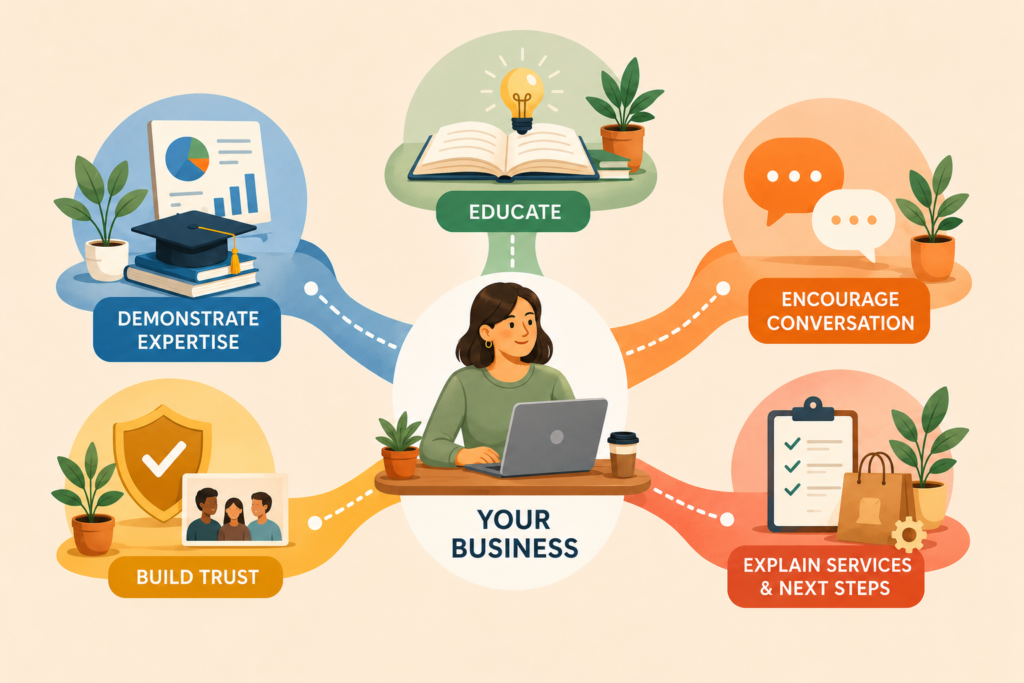
A practical five-pillar framework could include:
- Customer education
- Expert perspective
- Process and people
- Customer problems and solutions
- Services and next steps
You can change the labels to fit your business.
Step 6: Test each pillar for depth
Before finalising a pillar, try to write ten post ideas for it.
A strong pillar should produce ideas such as:
- quick tips
- frequently asked questions
- myths
- mistakes
- short tutorials
- checklists
- examples
- opinions
- mini case scenarios
- behind-the-scenes explanations
When a theme cannot support ten useful ideas, it may be too narrow.
When it produces hundreds of unrelated ideas, it may be too broad.
A simple social media content pillar framework
The following framework works particularly well for service businesses.
Pillar 1: Educate
Use this pillar to help people understand a problem or make a better decision.
Possible formats:
- how-to posts
- definitions
- checklists
- beginner guides
- myths and facts
- common questions
Educational posts are valuable because they demonstrate knowledge without requiring a hard sell.
Pillar 2: Build trust
Show people how your business thinks and works.
Possible formats:
- team introductions
- process explanations
- quality standards
- lessons learned
- behind-the-scenes posts
- values in practice
Trust-building content should be specific. Generic claims such as “we care about quality” are less useful than showing what your quality process actually involves.
Pillar 3: Demonstrate expertise
Share a clear perspective on your field.
Possible formats:
- professional opinions
- industry observations
- decision frameworks
- detailed explanations
- trend commentary
- responses to common misconceptions
LinkedIn advises businesses to select content types that support their wider strategy and help educate, engage, or convert potential customers.: LinkedIn Marketing Solutions, B2B Content Types ↗
Pillar 4: Encourage conversation
Social media should not only broadcast information.
Use questions that are relevant and easy to answer:
- Which part of this process causes the most frustration?
- What have you tried already?
- Which option would suit your business?
- What would make this decision easier?
- What question should we answer next?
Conversation posts can also provide ideas for future brand content themes.
Pillar 5: Explain services
Commercial content still has a place.
The goal is to explain rather than pressure.
Useful service posts may cover:
- who the service is for
- what is included
- when it may be useful
- how the process works
- what clients need to prepare
- how different options compare
A balanced content mix can support awareness, trust, and buying decisions.
For businesses that need help turning pillars into finished posts and articles, Socials, Blogs & Article Writing provides structured content support.
Social media content pillars for different businesses
Here are a few examples.
Professional services firm
- client education
- industry updates
- common risks
- working process
- service explanations
Restaurant or café
- menu and ingredients
- people behind the business
- local community
- food education
- customer experience
Construction company
- project planning
- materials and methods
- site progress
- common building mistakes
- maintenance advice
Online retailer
- product education
- product comparisons
- customer use cases
- care instructions
- brand story
Health or wellness practice
- general education
- prevention and healthy habits
- treatment or service explanations
- practitioner expertise
- patient preparation
Health-related businesses should ensure posts are accurate, appropriately qualified, and suitable for their local professional requirements.
How to balance your content pillars
Your pillars do not need equal attention every week.
A simple monthly split might be:
- 35% educational content
- 25% expertise and opinion
- 20% trust and process
- 10% conversation
- 10% service information
These percentages are illustrative. The right balance depends on the audience, platform, goals, and sales cycle.
A new business may need more awareness and education. An established business may benefit from stronger expert commentary. A company launching a new service may temporarily publish more explanatory content.
Consistency matters more than a perfect formula.
Social media content pillar checklist
Use this checklist before approving your pillars:
- □ Does each pillar address a real audience interest or concern?
- □ Can the business contribute credible expertise?
- □ Does each pillar support a marketing objective?
- □ Can each pillar produce at least ten post ideas?
- □ Are the pillars clearly different from one another?
- □ Is there a balance between education and promotion?
- □ Can the themes work in several content formats?
- □ Do the pillars match the platforms you use?
- □ Can your team maintain them consistently?
- □ Is there room to adjust based on performance?
Common mistakes when choosing social media content pillars
Making every pillar promotional
A list such as products, offers, testimonials, and company news is centred almost entirely on the business.
Include themes that help the audience before asking them to buy.
Choosing topics only because they are popular
Trending subjects may create temporary attention, but they should still connect to your audience and expertise.
Creating too many pillars
Ten or twelve categories can make social media planning harder. Start with a smaller, clearer set.
Making pillars too narrow
A pillar called “Tuesday product tips” may run out of ideas quickly. “Product education” gives you more room.
Confusing pillars with formats
Video is a format, not usually a pillar. Carousels, polls, reels, articles, and photos are ways to present a theme.
Never reviewing performance
Your first set of social media content pillars is a starting point. Review which themes generate useful engagement, website visits, saves, enquiries, or customer conversations.
Meta recommends measuring outcomes and adjusting a social media strategy based on performance.: Meta for Business, Build a Social Media Marketing Strategy ↗
How to turn pillars into a monthly content plan
Once your pillars are clear, assign each planned post to one.
A simple weekly pattern could be:
- Monday: educational tip
- Wednesday: expert perspective
- Friday: process, people, or customer question
The following week could include:
- a common mistake
- a conversation prompt
- a service explainer
You do not need to use every pillar every week. Aim for balance across the month.

A content calendar can then track:
- pillar
- topic
- format
- platform
- owner
- status
- publication date
- CTA
- performance
This is where social media content pillars become operational. They stop being a strategy document and start guiding real posts.
FAQ
How many social media content pillars should a small business have?
Most small businesses can work effectively with three to five social media content pillars. This gives enough variety without creating an overly complicated planning system.
How often should content pillars change?
Review them every three to six months, or when your audience, services, priorities, or platform strategy changes. You do not need to replace pillars that continue to perform well.
Are content pillars the same as content formats?
No. A pillar is the subject or theme. A format is how the idea is presented, such as a video, carousel, article, photograph, or poll.
Should one pillar focus on selling?
No. A pillar is the subject or theme. A format is how the idea is presented, such as a video, carousel, article, photograph, or poll.
Can the same post fit more than one pillar?
Yes, but assign one primary pillar for planning and measurement. This helps keep your reporting clear.
Do social media content pillars improve consistency?
They can. Pillars give your team a repeatable structure, reduce decision fatigue, and make it easier to plan consistent social media content in advance.
How VVRapid can help
VVRapid helps small businesses turn strategy into practical content. This can include identifying useful brand content themes, developing a manageable content plan, writing social media captions, producing articles, and connecting content with SEO and wider digital goals. The focus is on clear, useful communication that your business can maintain consistently.
Explore Socials, Blogs & Article Writing to see how VVRapid can support your social media content pillars and monthly publishing workflow.