
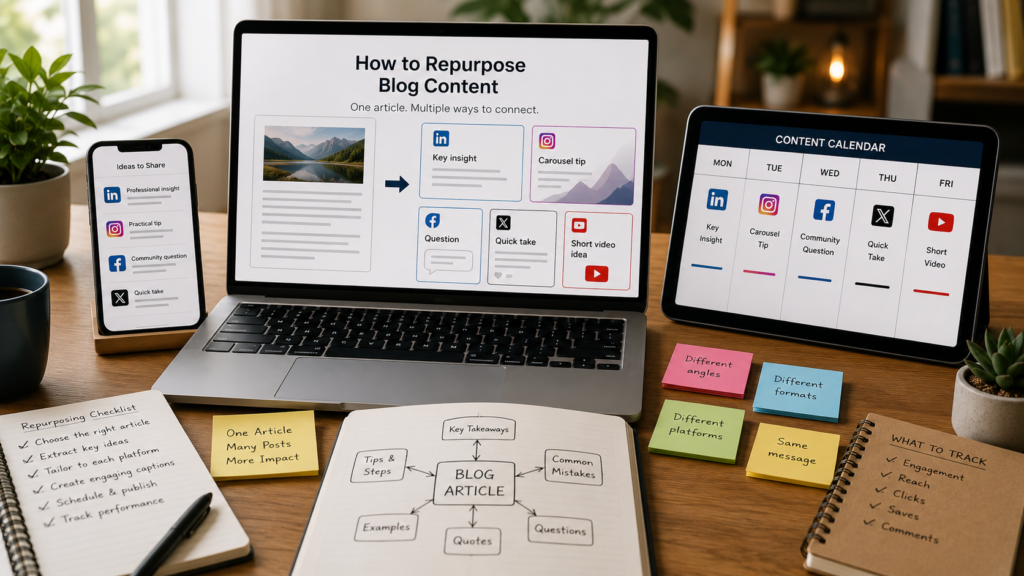
Blog content repurposing helps small businesses get more value from every article they publish. Done well, blog content repurposing turns one useful post into several social updates that feel fresh, platform-appropriate, and helpful instead of repetitive.
Table of Contents
If you already invest time in writing articles, you should not have to start from zero every time you need social content. One strong article can support a week or even a month of social media captions, short tips, opinion posts, carousels, and conversation starters.
That does not mean copying a paragraph from your blog and pasting it everywhere. Good social media content repurposing is about reshaping the idea, not duplicating the wording. The goal is to turn blogs into social posts that match how people use each platform.
If you need a consistent flow of original articles to repurpose, that is where Socials, Blogs & Article Writing can support the process.
What blog content repurposing actually means
Blog content repurposing means taking the substance of an article and adapting it into multiple content formats for social platforms. The key word is adapting.
A blog post is usually built for depth. It explains a topic clearly, answers questions, and often supports search intent. Social posts are different. They need a sharper angle, faster delivery, and a single takeaway.
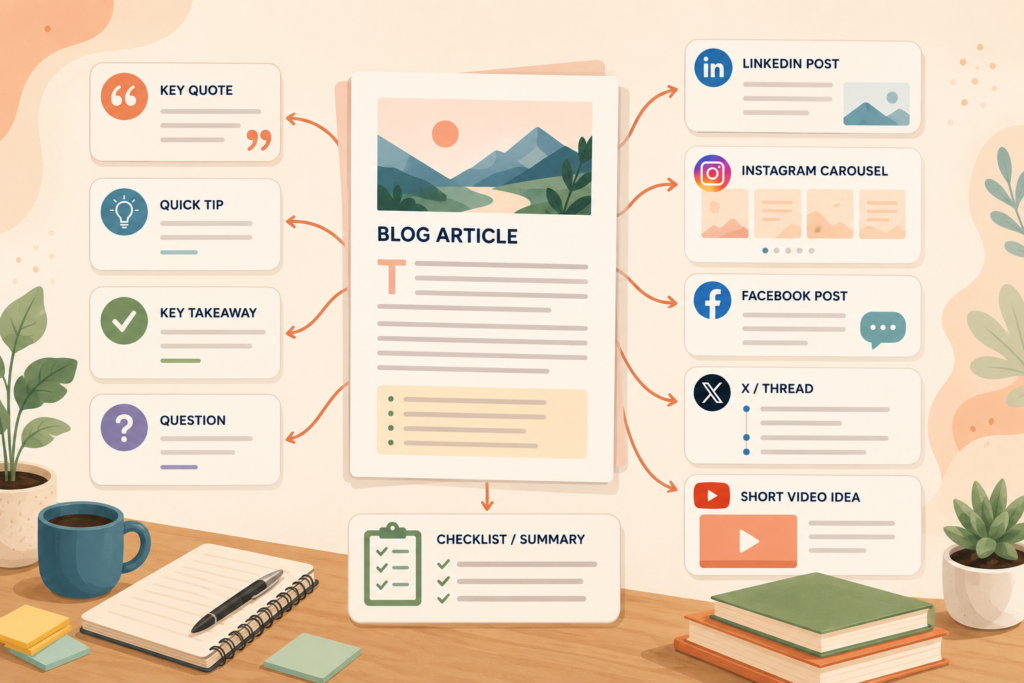
So instead of treating your article as one finished asset, treat it as a source document full of reusable parts:
- key insights
- definitions
- myths and mistakes
- short examples
- checklists
- steps
- quotes
- questions
- stats or references
- calls to reflection
This is why blog content repurposing works so well. One article can become several types of evergreen content without weakening your brand voice.
Why blog content repurposing works for small businesses
Small business marketing often breaks down because content creation takes too much time. Writing a blog post already requires research, structure, editing, and approval. Then social media still needs attention.
Blog content repurposing reduces that pressure.
It helps you:
- extend the life of each article
- stay visible on social media more consistently
- reinforce the same message in different formats
- support SEO and social media together
- build a clearer content workflow
- create a more sustainable content repurposing strategy
It also improves message consistency. When your blog, website, and social media all reflect the same core ideas, your marketing starts to feel more intentional. That is especially helpful for service businesses that need trust before a prospect makes contact.
Google also continues to reward helpful, people-first content, which makes high-quality source articles even more valuable over time Google Search Central, Creating helpful, reliable, people-first content ↗.
If you want the search side of that system to work harder, blog content repurposing pairs naturally with Search Engine Optimisation.
A simple blog content repurposing workflow
The easiest way to handle blog content repurposing is to follow the same repeatable process every time.
1) Start with the right article
Not every post deserves the same level of repurposing. Start with articles that already have one or more of these qualities:
- they answer a common client question
- they explain a recurring pain point
- they support a core service
- they stay useful for months, not just days
- they contain clear steps, tips, or frameworks
Evergreen content is ideal because you can keep reusing the ideas. A timely announcement may only support a few posts, but a practical article can fuel social media for much longer.
Think: if the article solves a real problem, it probably contains several social post angles already.
2) Pull out reusable content assets
Before writing any social posts, break the article into smaller assets.
For example, one article might contain:
- one big idea
- three myths
- five mistakes
- seven tips
- two examples
- one checklist
- one short conclusion
That gives you a strong starting point for blog content repurposing. You are no longer staring at a blank page. You are selecting from content that already exists.
A simple extraction sheet can help. Use columns like:
- source article title
- post angle
- platform
- hook
- key point
- CTA
- publish date
This type of content workflow makes repurpose blog posts much faster, especially when more than one person is involved.
3) Match each idea to the right platform
This is where many businesses go wrong. They assume every idea should appear the same way everywhere.
A better approach is to match the content to platform behaviour.
Here is a simple guide:
LinkedIn
Best for perspective, lessons, short frameworks, industry observations, and opinion-led content. If your blog explains a process, turn that into a concise professional insight.: LinkedIn Marketing Blog, Content Marketing ↗
Instagram
Best for visual tips, short educational sequences, carousels, and punchy social media captions. Pull out a checklist, common mistake, or mini how-to.: Instagram for Creators ↗
Facebook
Best for community-friendly explanations, local relevance, conversational prompts, and educational snippets with context.
X or Threads
Best for short takes, tip threads, bold observations, and question-led engagement.
A single article on blog content repurposing might become:
- a LinkedIn post about why copy-paste social content fails
- an Instagram carousel on five ways to turn blogs into social posts
- a Facebook post asking which type of content audiences save most
- a short thread listing common repurposing mistakes
That is social media content repurposing done properly. Same source, different execution.
4) Rewrite the format, not just the length
This is the step that stops repetition.
Do not simply shorten the article. Rewrite it around a new angle.
For example, if your article says:
“Businesses should extract smaller content assets from every article, including tips, mistakes, examples and questions.”
You could repurpose that in several ways:
- Tip post: One simple way to repurpose blog posts is to pull out the tips section and turn each tip into a single post.
- Question post: Are you treating each article like one asset, or like ten smaller assets?
- Mistake post: A common social media mistake is publishing one blog link and assuming the job is done.
- Checklist post: Before you publish a blog, identify the five social posts you will create from it.
Same concept. Different framing.
This is what makes blog content repurposing feel useful rather than repetitive.
5) Build a simple posting sequence
A helpful article can support several posts over time. You do not need to publish them all in one week.
A practical sequence could look like this:
- Day 1: publish the article
- Day 2: share the main idea on LinkedIn
- Day 4: post one practical tip on Instagram
- Day 6: share a common mistake on Facebook
- Week 2: post a checklist or mini summary
- Week 3: revisit the article with a new angle or audience question
Spacing matters. Good blog content repurposing creates repetition of message, not repetition of wording.
If your business publishes regularly, planning this in advance is much easier with a wider roadmap. That is where Digital Strategy Roadmaps can help connect content, timing, and channel priorities.
6) Track what gets attention
Repurposing should improve results, not just increase output.
Watch for:
- saves
- shares
- comments
- click-throughs
- profile visits
- time on page
- assisted leads or enquiries
This helps you refine your content repurposing strategy. You may find that checklists outperform quote posts, or that behind-the-scenes commentary gets stronger engagement than direct link shares.
Over time, blog content repurposing should tell you more about your audience, not less.
7) Save everything in a reusable library
The best repurposing systems keep getting better.

Every time you publish a new article, save:
- ready-to-use hooks
- short captions
- alternative CTAs
- image ideas
- carousels or post concepts
- comments and audience questions
This becomes your own content bank. It makes future blog content repurposing faster and helps your team maintain consistency.
For growing businesses, this matters because the challenge is usually not ideas. It is capacity. If content creation is becoming hard to maintain, Fractional Digital Team can support execution without the need to build a full in-house department.
Blog content repurposing checklist
Use this checklist before you start:
- □ Choose an article with strong evergreen value
- □ Identify the main theme and subtopics
- □ Pull out tips, mistakes, examples, and questions
- □ Match each idea to a specific platform
- □ Rewrite the hook for each post
- □ Change the format, not just the word count
- □ Write platform-specific social media captions
- □ Space out the publishing sequence
- □ Track engagement and click-throughs
- □ Save high-performing angles for reuse
If you follow this checklist consistently, blog content repurposing becomes part of a reliable content workflow instead of an occasional scramble.
Common mistakes that make repurposed content feel repetitive
Copying the same sentence everywhere
This is the biggest issue. If every platform gets the same words, people notice quickly. Repurpose the idea, not the paragraph.
Sharing only the blog link
A link alone is rarely enough. Give people a reason to care before asking them to click.
Using the same tone on every platform
Professional, visual, conversational, and fast-moving spaces all need slightly different treatment.
Repurposing weak source content
If the original article is thin, blog content repurposing will not rescue it. Start with something genuinely useful.
Ignoring audience questions
Comments, replies, and objections are some of the best inputs for future social posts.
Posting everything at once
Good repurposing stretches value across time. It should support consistency, not create a short burst and then silence.
How to measure whether blog content repurposing is working
A good repurposing system should improve both efficiency and performance.
Look for signs like:
- less time spent creating social content from scratch
- more consistent posting
- higher engagement on educational posts
- better traffic from social media to blog pages
- stronger alignment between SEO content writing and social messaging
- more evidence that audiences understand your services
This is where repurpose blog posts becomes more than a time-saving tactic. It becomes a system for reinforcing expertise and increasing visibility across channels.
FAQ
What is blog content repurposing?
Blog content repurposing is the process of adapting one article into several smaller content pieces for social media, email, or other formats. The goal is to reuse the core idea while changing the angle and format.
How many social posts can one blog support?
It depends on the depth of the article, but one useful post can often produce five to ten social ideas. Evergreen content usually gives you the most flexibility.
Does blog content repurposing help SEO?
Indirectly, yes. Blog content repurposing can increase traffic to your articles, reinforce your core topics, and help more people discover content that already supports your search strategy.
Should I post the same blog on every platform?
No. You can share the same core message, but the execution should change. Social media content repurposing works best when each platform gets a version suited to how people use it.
What if I do not have time to do this every week?
Create a repeatable content workflow, or outsource the planning and writing. Many businesses can maintain consistency more easily with monthly support.
How VVRapid can help
VVRapid can help you build a practical content system that connects blog writing and social publishing. That may include topic planning, article writing, repurposing workflows, SEO alignment, and a realistic monthly content rhythm. The aim is not more noise. It is clearer messaging, more useful content, and a process your business can actually maintain.
If you want a calmer, more structured way to handle blog content repurposing, view Socials, Blogs & Article Writing or contact VVRapid.