
If you are planning a new business website, how many website pages do I need is one of the first questions worth answering. The right number is not determined by what looks impressive. It depends on what customers need to understand, what you want the website to achieve, and how much useful content your business can genuinely support.
Table of Contents
Some small businesses can launch with a compact website and expand later. Others need separate pages for services, locations, products, resources, or important customer questions from the start.
The goal is not to create the most pages.
The goal is to give every important topic, service, and customer journey enough room to do its job.
If you are already planning the build itself, VVRapid’s Website Design & Development service provides a useful starting point for comparing different website sizes and capabilities.
How Many Website Pages Do I Need for a Small Business?
When asking how many website pages do I need, start with business requirements rather than an arbitrary number.
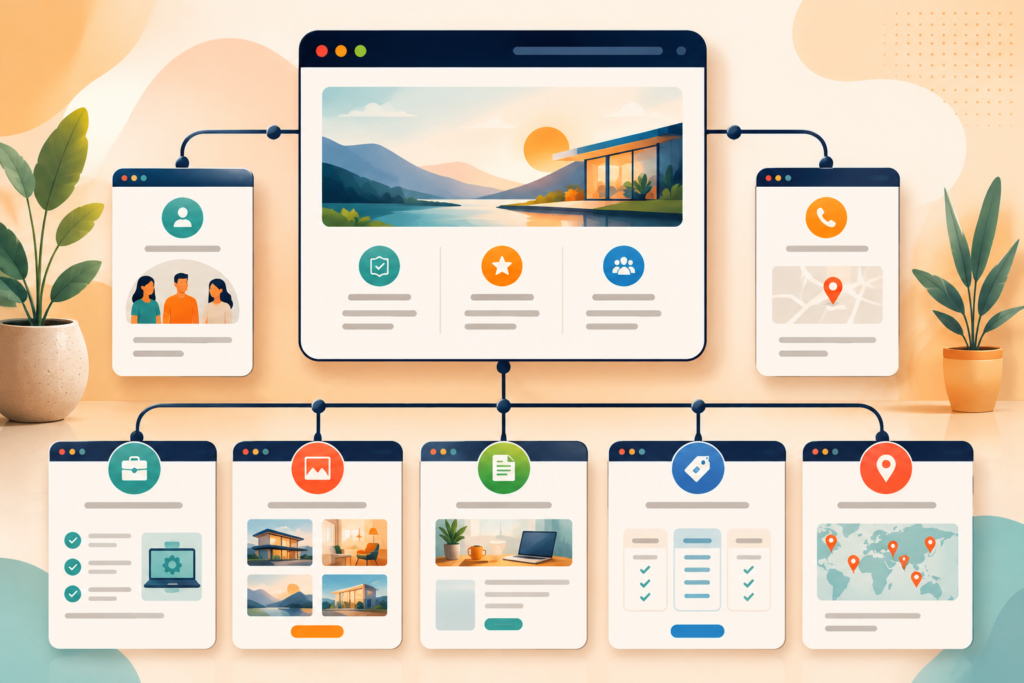
A typical small business website might contain:
- Home
- About
- Services
- Contact
- Individual service pages
- FAQ
- Pricing or packages
- Portfolio or projects
- Blog or resources
- Location or service area pages
- Ecommerce pages where relevant
That does not mean every business needs all of them.
A consultant offering one focused service may need far fewer pages than a company offering ten services across several cities. An ecommerce company will have a very different business website structure from a local accountant or trades business.
Your ideal website page count should reflect the amount of information customers need before they can confidently take the next step.
Start With What the Website Must Achieve
Before counting pages, define the website’s job.
Ask yourself:
- Do we mainly need enquiries?
- Do customers need to book appointments?
- Are we selling products?
- Do prospects need to compare several services?
- Do we need to generate leads through search?
- Do customers need detailed technical information before contacting us?
- Are we targeting multiple locations?
- Will the website support ongoing content marketing?
These answers change the website page structure.
If your goal is simply to establish credibility and give existing referrals somewhere professional to learn about you, a lean site may be enough.
If your goal is to attract new customers from Google, explain several offers, build trust, answer objections, and generate qualified leads, you will usually need more depth.
Google’s SEO guidance encourages site owners to organise content in a way that is useful and understandable for visitors rather than building pages purely for search engines.: Google SEO Starter Guide ↗
Use Your Services to Calculate Website Page Count
One of the easiest ways to answer how many website pages do I need is to look at your services.
Suppose you run a business offering:
- Website design
- SEO
- Content writing
- Website maintenance
You could technically put all four services on one page.
But should you?
That depends on how different those services are and how much information customers need about each one.
A separate service page becomes useful when a service has its own:
- audience
- problems
- benefits
- process
- FAQs
- examples
- search intent
- call to action
This is particularly important for a service business website.
If someone searches specifically for SEO services, they may benefit from landing on a page entirely focused on SEO rather than scrolling through an all-purpose services page.
VVRapid follows this approach by separating areas such as Website Design & Development and Search Engine Optimisation into dedicated service pages.
That structure gives each major service room to be explained properly.
Not Every Service Needs Its Own Page
More pages do not automatically mean better SEO or better user experience.
If you have several tiny variations of essentially the same service, creating separate thin pages can make the website repetitive.
For example, a gardening company might offer:
- weekly garden care
- fortnightly garden care
- monthly garden care
Those probably do not require three substantial service pages.
They may belong on one strong garden maintenance page.
Think about whether each page can provide genuinely distinct value.
If the content would mostly repeat another page with a few words changed, combining the subjects is usually cleaner.
That is a better approach to small business website pages than setting a page-count target first and trying to fill it.
Consider Search Intent Before Combining Topics
SEO is another reason the answer to how many website pages do I need varies from one business to another.
Different customer searches sometimes deserve different destinations.
Imagine a company provides both:
- website design
- website maintenance
Someone searching for a new website has a different problem from someone whose existing WordPress site needs updates, backups, or technical care.
A dedicated Website Maintenance & Care page can therefore make sense alongside a website design page.
This is not about creating pages for every keyword variation.
It is about matching genuinely different customer needs with useful content.
Google’s Search Essentials provide broader guidance on creating sites that can be understood and discovered through search.: Google Search Essentials ↗
Location Can Increase the Number of Pages You Need
Location is another factor when deciding how many website pages do I need.
A business serving one town may only need its service area explained on its contact or service pages.
A company operating across several meaningful markets may benefit from dedicated location content.
For example:
- Johannesburg accounting services
- Cape Town accounting services
- Durban accounting services
But location pages should only exist when they provide useful local information.
Changing the city name while keeping everything else identical creates weak content and a poor experience.
A useful location page might include:
- services available in that area
- geographic coverage
- relevant contact information
- local processes
- delivery or response details
- region-specific FAQs
- genuine local considerations
South African businesses may also need to consider whether they serve nationally, locally, or internationally. The same principle applies to businesses targeting the UK, UAE, Australia, New Zealand, or European markets.
Customer Questions Can Reveal Missing Pages
Your customers can often tell you more about the ideal website page count than a generic website checklist.
Look at the questions people repeatedly ask before buying.
Do they ask:
- How does your process work?
- What does the service include?
- What does it cost?
- Who is it suitable for?
- Can I see examples?
- How long does it take?
- What happens after purchase?
- Do you work in my area?
Some answers belong inside service pages.
Others may justify dedicated pages such as:
- Pricing
- Process
- FAQ
- Portfolio
- Case studies
- Delivery information
When several prospects repeatedly need the same information, giving that subject a clear destination can reduce friction.
It can also make navigation easier because visitors do not have to hunt through unrelated content.
When Does a Blog Add More Pages?
A blog changes the answer to how many website pages do I need because your website can grow well beyond its original core pages.
That is useful when content supports a real marketing strategy.
A service business might publish articles answering specific questions customers search for before buying.
Those articles can then point readers toward relevant service pages.
For example, a website planning guide can naturally link to Website Design & Development, while an article about organic visibility can support Search Engine Optimisation.
VVRapid’s Socials, Blog & Article Writing service is relevant when a business wants to build that content layer consistently.
A blog should not exist simply because websites are “supposed” to have one.
It needs a purpose.
A Practical Small Business Website Page Framework
If you are still wondering how many website pages do I need, use this framework.
Lean website
Suitable for a straightforward business with one primary offer and limited content.
Possible structure:
- Home
- Services or About
- Contact
Growing service website
Suitable for businesses offering several distinct services.
Possible structure:
- Home
- About
- Services overview
- Service page 1
- Service page 2
- Service page 3
- Contact
- FAQ
Search-focused service website
Suitable for businesses investing more seriously in organic visibility.
Possible structure:
- Home
- About
- Services overview
- Individual service pages
- Contact
- FAQ
- Resources or blog
- Relevant location pages
- Supporting educational content
Ecommerce website
The number of pages can increase quickly because you may need:
- Home
- About
- Shop
- Product categories
- Product pages
- Contact
- FAQ
- Shipping information
- Returns information
- Privacy and legal pages
- Blog or buying guides
The correct website size for small business therefore depends much more on business complexity than company size.
A company with three employees and eight specialist services may need more website content than a 30-person business selling one straightforward product.
Essential Website Pages Versus Optional Pages
When asking how many website pages do I need, separate essential pages from useful additions.
Usually essential
For many service businesses:
- Home
- Service information
- About or trust information
- Contact
Often valuable
Depending on the business:
- Separate service pages
- FAQ
- Pricing
- Portfolio
- Testimonials or proof
- Process
- Blog
Business-specific
These depend heavily on how you operate:
- Booking
- Membership
- Customer portal
- Locations
- Careers
- Documentation
- Ecommerce
- Downloads
- Events
Do not add something simply because a competitor has it.
Your website requirements should come from your customer journey and business model.
Checklist: Work Out How Many Pages Your Website Needs
Use this before settling your sitemap.
- List every major product or service.
- Group closely related offers together.
- Identify services that deserve standalone pages.
- Write down the main questions customers ask.
- Identify important search topics with clearly different intent.
- Decide whether location pages would add real local value.
- List trust information prospects need before contacting you.
- Decide whether pricing deserves its own page.
- Determine whether you need a blog or resource section.
- Include required ecommerce and customer-service pages.
- Identify legal and privacy pages required for your situation.
- Remove pages that would contain thin or repetitive content.
- Check that every page has a clear purpose and next step.
- Leave room for future expansion.
If you can explain why each page exists, you probably have a sensible business website structure.
Common Mistakes When Choosing Website Page Count
Building pages just to make the website look bigger
A 20-page website is not automatically more professional than a six-page website.
Useful depth matters more than raw numbers.
Squeezing everything onto too few pages
The opposite problem also happens.
When several complex services, customer types, FAQs, and conversion paths are forced onto one long page, visitors may struggle to find what matters to them.
Creating a separate page for every keyword
SEO does not require hundreds of nearly identical pages.
Create pages around meaningful subjects and search intentions, not every slight variation of a phrase.
Ignoring future growth
Your launch site does not need every future page, but its navigation and structure should leave room to expand.
That matters if you plan to add new services, regions, products, resources, or campaigns.
Forgetting maintenance
Every page creates an ongoing responsibility.
Prices change. Teams change. Services evolve. Links break. Screenshots age.
If your website grows over time, a clear maintenance process helps keep it accurate. VVRapid’s Website Maintenance & Care service is designed around that ongoing need.
How Many Website Pages Do I Need Before Launch?
You do not need every conceivable page before launching.
You need enough pages to:
- explain the business
- explain important offers
- build credibility
- answer major objections
- provide a clear next step
Additional pages can be added once you have better information about what visitors search for, which services matter most, and which questions repeatedly appear.
This phased approach can be especially practical for new businesses.
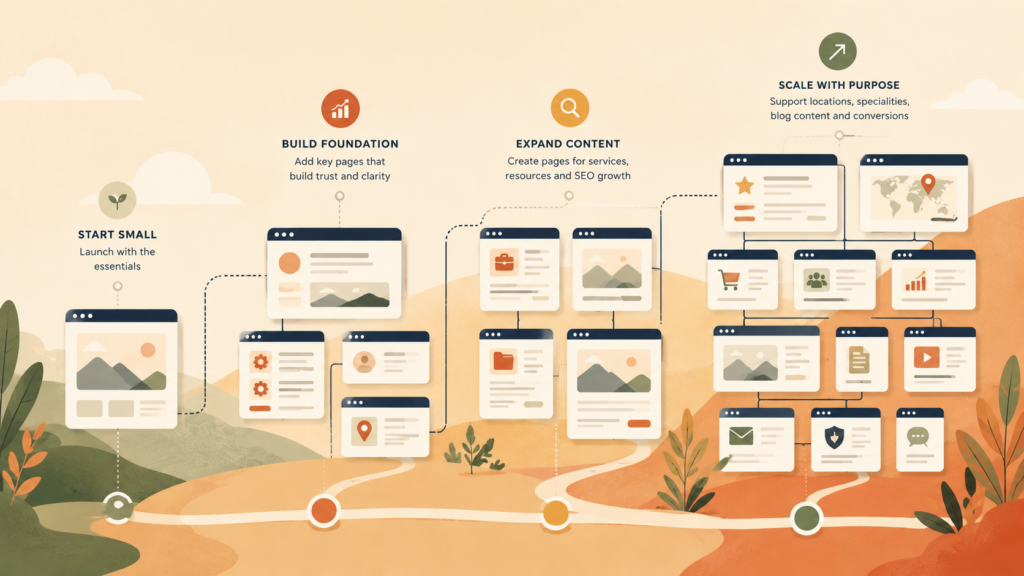
Build the useful foundation first.
Expand because the business needs it, not because a website-page checklist says you must.
FAQ
How many website pages do I need for a new business?
For a simple new business, the answer to how many website pages do I need may be only a few strong core pages. More complex businesses may need separate service, product, location, or FAQ pages immediately.
Is five pages enough for a small business website?
It can be. A five-page small business website can work well when it clearly explains the company, services, trust factors, and contact path. There is no universal minimum.
Does having more website pages improve SEO?
Not automatically. More useful pages can create more opportunities to address relevant search intent, but thin or duplicated pages offer little value. Quality, structure, relevance, and usefulness matter more than page count alone.
Should every service have a separate page?
No. Create an individual service page when the service has enough unique information and customer intent to justify it. Closely related services may work better together.
Can I add website pages later?
Yes. In many cases, starting with a clear foundation and expanding intentionally is better than publishing many weak pages at launch.
How many website pages do I need if SEO is important?
If SEO is a major acquisition channel, how many website pages do I need depends on the number of meaningful services, topics, customer problems, and locations you need to cover. A planned SEO structure can help identify which subjects deserve dedicated pages.
How VVRapid Can Help
If you are still asking how many website pages do I need, VVRapid can help turn the answer into a practical website structure. The goal is not to push unnecessary pages. It is to work out what customers need, what each service needs to communicate, and how the website can expand without becoming confusing.
VVRapid can support the build through Website Design & Development, then layer in SEO, content, hosting, and ongoing website care where those services make sense.
If you are planning a new site or restructuring an existing one, view the Website Design & Development service to compare the available starting points and request a structure suited to your business.
External sources used in this article (helpful resources)
- Source: Google SEO Starter Guide ↗
- Source: Google Search Essentials ↗
- Source: W3C Web Accessibility Initiative ↗