

A website growth plan helps you work out what to fix before you pour more money into SEO, ads, content, or social media. For many small businesses, the problem is not a lack of activity. It is a lack of order. If the offer is unclear, the website is hard to use, or your tracking is weak, more marketing often just sends more people into the same leaks.
Table of Contents
A good website growth plan gives you a clear order of work. It helps you prioritise the highest-impact fixes first, improve conversion rate improvement opportunities, and make better decisions with your budget.
If you are a busy owner, this matters. You do not need ten disconnected tactics. You need a simple small business marketing strategy that shows what is blocking growth, what needs attention now, and what can wait.
Why a website growth plan matters before you spend more
It is tempting to assume growth comes from doing more marketing. More ads. More posts. More email campaigns. More SEO tasks.
Sometimes that is true. Often it is not.
A website growth plan forces you to pause and ask a better question: what is stopping the website from turning attention into action?

Here is what that usually looks like in real life:
- Your website gets visits, but few enquiries
- People land on key pages, but do not click through
- Your offer sounds broad or vague
- Mobile users bounce quickly
- Leads come in, but tracking does not show where they came from
- You are publishing content, but it is not supporting a wider digital strategy roadmap
Without a website growth plan, marketing spend can hide deeper issues. You may be paying for traffic when the real problem is your message, your structure, your pages, or your follow-up process.
Think: traffic only helps when the destination is ready.
What a website growth plan should include
A strong website growth plan is not just a design checklist. It is a practical view of how your lead generation website supports visibility, trust, action, and measurement.
1. Traffic quality and search visibility
The first part of a website growth plan is traffic quality. Not all visits are equal. You need the right people arriving on the right pages with the right intent.
Ask:
- Are your key service pages targeting useful search terms?
- Is your SEO for small business focused on commercial and informational intent?
- Are users landing on pages that match what they searched for?
- Are your page titles, headings, and internal links helping search engines understand your site?
If search visibility is a weak point, start with Search Engine Optimisation. For foundational guidance, the Google SEO Starter Guide ↗ is also a helpful reference.
A good growth plan should identify whether your issue is low traffic, low-quality traffic, or traffic that lands on the wrong pages.
2. Offer clarity and messaging
Many websites do not have a traffic problem. They have a clarity problem.
If a visitor cannot understand what you do, who it is for, and what the next step should be within a few seconds, the page is underperforming. That matters whether you are a consultant, retailer, trades business, or service provider.
Your website growth plan should test:
- Is the headline specific?
- Is the core problem clear?
- Is the value easy to understand?
- Is there proof or reassurance?
- Does each page have one obvious next action?
This is where a website audit checklist becomes useful. You are not judging the website by taste. You are judging it by clarity.
3. User experience and conversion path
A website growth plan should also examine website conversion optimization. This means reducing friction between interest and action.
Common friction points include:
- Slow-loading pages
- Weak mobile experience
- Too many calls to action
- Important buttons placed too low on the page
- Contact forms that ask for too much
- Thin service pages with little trust-building detail
If usability and page structure need attention, Website Design & Development should be part of the solution. For general usability principles, Nielsen Norman Group, Homepage Design Guidelines ↗ is a useful benchmark.
A website growth plan should map the full path from landing page to enquiry, booking, or sale. That is where many hidden losses sit.
4. Measurement and decision-making
A smart website growth plan includes a marketing measurement plan. If you cannot see what is working, you will keep guessing.
Check whether you can answer these questions:
- Which channels bring the best leads?
- Which pages assist conversion?
- What happens after someone fills in a form?
- Where are people dropping off?
- Are you tracking key actions properly?
If analytics setup is patchy, the Google Analytics Help, Set up Analytics for a website ↗ and Google Search Console Help, Performance report ↗ are useful starting points.
A website growth plan should not only tell you what to change. It should also tell you what to measure after the change.
Website growth plan checklist: what to fix first
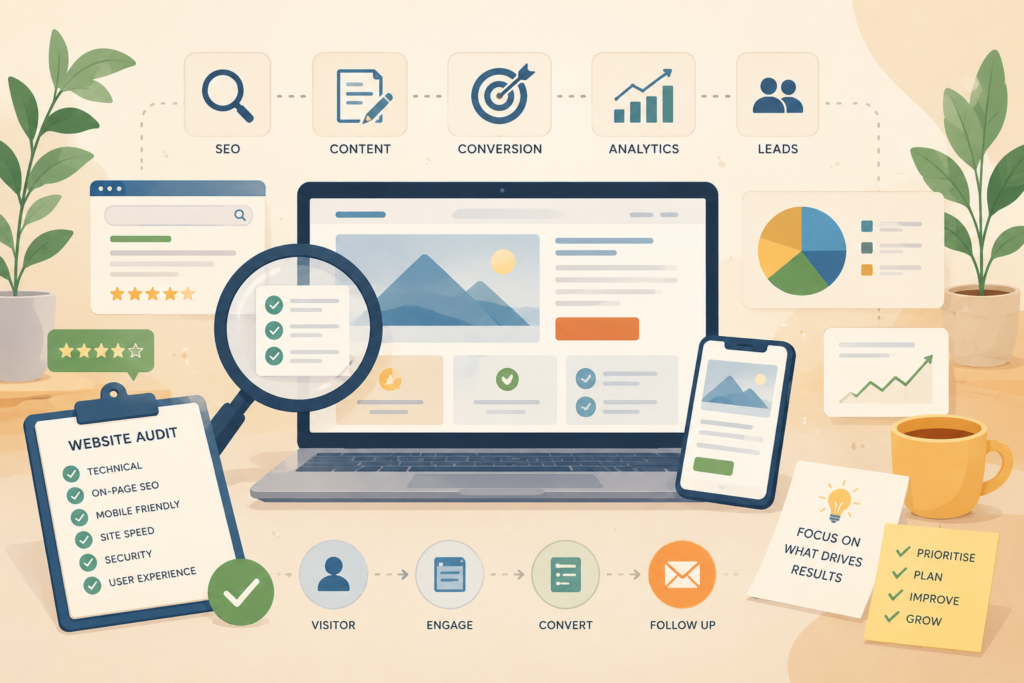
Use this website growth plan checklist to prioritise before spending more on marketing.
- □ Clarify your main offer in one sentence
- □ Make sure your homepage explains what you do and who it is for
- □ Check that each core service has its own useful page
- □ Review whether your top pages match real search intent
- □ Improve page speed, especially on mobile
- □ Simplify your main call to action
- □ Reduce unnecessary form fields
- □ Add trust signals such as FAQs, process steps, guarantees if true, or proof of experience
- □ Check internal links between related pages and blog posts
- □ Identify content gaps that weaken your small business marketing strategy
- □ Confirm that forms, calls, bookings, or purchases are being tracked
- □ Review whether your lead generation site has clear next steps on every important page
If content gaps are part of the problem, Socials, Blog & Article Writing Services can support the content side of your growth plan.
How to prioritise your website growth plan
A useful growth plan separates work into three buckets: now, next, and later.
Fix now
These are issues directly hurting leads or sales:
- Broken calls to action
- Poor mobile usability
- Missing service pages
- Confusing homepage messaging
- No analytics or broken conversion tracking
Fix next
These are improvements that build momentum:
- Better service page copy
- SEO for small business improvements
- Internal linking between blogs and services
- Stronger proof and trust content
- Better landing page structure
Fix later
These are valuable, but not urgent:
- Design refinements that do not affect conversion
- New channel experiments before core issues are fixed
- Extra tools and automations that add complexity too early
A website growth plan works best when it is realistic. You do not need to do everything this month. You need to do the right things in the right order.
That is also where a Digital Strategy Roadmaps service can help. It turns scattered observations into a clearer digital strategy roadmap with priorities you can actually execute.
Common mistakes when building a website growth plan
Even a sensible website growth plan can go off track if you make these mistakes.
Mistake 1: Chasing traffic before fixing conversion
More traffic is exciting, but it does not solve a weak conversion path. If your pages are unclear or hard to use, more visibility simply scales the problem.
Mistake 2: Treating design as the whole answer
A redesign can help, but design alone is not a website growth plan. Growth usually depends on the combination of message, structure, SEO, trust, and measurement.
Mistake 3: Skipping measurement
Without a marketing measurement plan, you are relying on opinion. You need enough tracking to understand where leads come from and which changes improve performance.
Mistake 4: Trying to fix everything at once
A website growth plan should simplify, not overwhelm. Focus on the few fixes most likely to improve enquiries, sales, or qualified leads first.
Mistake 5: Publishing content without a plan
Blogging can support growth, but only if it serves a purpose. Every article should support visibility, authority, or conversion. Random content rarely strengthens a digital strategy roadmap.
Do you need help with your website growth plan?
You can create a basic website growth plan yourself if you have time, data, and a clear view of your business goals. But many owners are too close to the business to spot the biggest friction points quickly.
Outside help is useful when:
- You know growth is possible, but do not know what is blocking it
- Your traffic and leads do not line up
- You have several channels running, but no clear priority order
- You need a practical website audit checklist and action plan
- You want support implementing the work after the strategy is set
If you need both planning and hands-on execution, Fractional Digital Team can also be a natural next step after a growth plan is defined.
FAQ
What is a website growth plan?
A website growth plan is a structured plan for improving the parts of your website that affect visibility, trust, conversion, and measurement. It helps you decide what to fix first so you do not waste budget on low-impact work.
How is a website growth plan different from a redesign?
A redesign focuses on visual and structural changes. A website growth plan looks wider. It considers SEO for small business, messaging, website conversion optimisation, analytics, and the full customer journey.
When should a small business create a website growth plan?
Usually before increasing marketing spend. If you are about to invest more in ads, content, or SEO, a growth plan helps make sure the website is ready to convert that extra attention.
Can a website growth plan improve lead generation?
Yes. A website growth plan often improves lead generation by fixing unclear messaging, weak calls to action, poor service pages, and missing tracking.
How long does a website growth plan take?
A simple review can happen quickly. A deeper website growth plan that includes website analysis, funnel review, and a clearer digital strategy roadmap may take longer depending on scope.
How VVRapid can help
If you need a clearer growth plan, VVRapid can help you identify what is blocking results and what to prioritise next. A roadmap can bring together your website, SEO, content, conversion, and measurement into one practical plan. If needed, VVRapid can also support implementation across the website, content, and wider digital work. The goal is simple: clearer priorities, less guesswork, and better use of your budget.
If you want a practical next step, view Digital Strategy Roadmaps or contact VVRapid for a focused strategy discussion.