

A digital marketing decision framework helps small business owners choose what to do next when everything feels urgent. Your website needs work, SEO could be better, social media feels inconsistent, ads look tempting, email sounds useful, and analytics may not be telling the full story. Without a clear way to decide, it is easy to spend time and money on whichever task is loudest instead of what will move the business forward.
Table of Contents
A practical digital marketing decision framework gives you a simple structure for comparing options. It helps you decide whether your next move should be website improvement, SEO for small business, content marketing, paid advertising, email marketing, analytics setup, or a more complete digital strategy roadmap.
This matters because most small businesses do not fail because they have no ideas. They struggle because they have too many ideas and no clear order of work.
Why small businesses need a digital marketing decision framework
Small business marketing often becomes reactive. One week you are fixing the homepage. The next week you are posting on social media. Then someone suggests Google Ads. Then you realise your enquiry form is not tracking properly. Soon, the marketing plan becomes a pile of half-finished tasks.

A digital marketing decision framework helps you slow down and ask better questions:
- What is the actual business goal?
- What is blocking that goal right now?
- Which task has the highest chance of improving enquiries, bookings, sales, or retention?
- What can we measure after we make the change?
- What should wait until the foundation is stronger?
For many small businesses, the answer is not “do more marketing.” It is “do the right marketing in the right order.”
That is why a framework is useful. It creates a repeatable way to decide what deserves attention now, what should come next, and what is a distraction.
The five-part digital marketing decision framework
This digital marketing decision framework uses five simple filters: goal, gap, impact, effort, and measurement.
You can use these filters when deciding between website changes, search engine optimisation, content creation, social media, paid ads, email campaigns, automation, or analytics work.
1. Goal: what are you trying to improve?
Before choosing a channel, define the outcome.
Are you trying to:
- Get more qualified leads
- Improve online sales
- Increase bookings
- Build local visibility
- Improve website conversion
- Reduce wasted ad spend
- Support repeat customers
- Understand where leads are coming from
A common mistake is starting with a tactic before setting the goal. For example, “we need more Instagram posts” is not a goal. “We need more local enquiries from people looking for our service” is closer to a business outcome.
Your digital marketing decision framework should always begin with the outcome. Once the outcome is clear, the channel becomes easier to choose.
For example, if your main issue is low visibility in search, Search Engine Optimisation may be more important than launching another social campaign. If your issue is traffic that does not convert, the next step may be website conversion optimisation instead.
2. Gap: what is currently missing or broken?
The second part of the digital marketing decision framework is identifying the gap.
There are usually five types of gaps:
- Visibility gap: not enough of the right people are finding you
- Trust gap: people arrive, but do not feel confident enough to act
- Conversion gap: people are interested, but the website does not guide them clearly
- Retention gap: you win customers, but do not stay in touch well
- Measurement gap: you cannot see what is working
This is where many small businesses make expensive mistakes. They invest in paid ads when the real problem is unclear messaging. They publish blog content when the key service pages are weak. They redesign the site when the bigger issue is offer positioning or follow-up.
A digital marketing decision framework keeps the focus on the gap, not the trend.
If the gap is website clarity, Website Design & Development may be the right place to focus. If the gap is inconsistent content and weak authority, Socials, Blog & Article Writing Services may support the next stage.
3. Impact: which option is most likely to move the number?
Once you know the gap, estimate impact.
Ask which option is most likely to improve the result you care about. This does not need to be complicated. You can score each option from low to high impact.
For example:
- Fixing a broken contact form is high impact
- Improving a key service page may be high impact
- Writing a blog post on a low-intent topic may be low impact
- Adding an email follow-up sequence may be high impact if leads go cold
- Launching ads before tracking is fixed may be risky
A digital marketing decision framework should help you compare work based on likely business value, not personal preference.
For many small businesses, high-impact work often sits close to the customer journey. That means service pages, enquiry forms, calls to action, trust signals, tracking, local SEO, and lead follow-up are often more urgent than cosmetic design tweaks.
This is not always exciting work, but it can make a major difference.
How to compare website, SEO, content, ads, email, and analytics
A useful digital marketing decision framework should help you compare the main digital marketing options clearly.
Website improvements
Choose website improvements when people are already visiting your site but not taking action.
Signs this should be your priority:
- High traffic but low enquiry volume
- Unclear service pages
- Weak calls to action
- Poor mobile experience
- Slow pages
- No clear next step
- Low trust or thin proof
Website work is often the foundation for other channels. SEO, ads, social media, and email all work better when the website is clear and conversion-focused.
SEO for small business
Choose SEO for small business when your audience is actively searching for what you offer, but you are not visible enough.
Signs this should be your priority:
- Competitors appear above you in search
- Your key service pages are thin or missing
- Your website has weak internal linking
- Your content does not match search intent
- You rely too heavily on referrals or paid traffic
A good SEO strategy supports long-term visibility. It is especially useful when customers research services before making contact.
For general search guidance, the Google SEO Starter Guide ↗ is a helpful reference.
Content marketing
Choose content marketing when your audience needs education, trust, and reassurance before contacting you.
Signs this should be your priority:
- Customers ask the same questions repeatedly
- Your service needs explanation
- You need to build authority
- Your website lacks useful supporting content
- You want to strengthen internal links to key service pages
Content should not be random. Within a digital marketing decision framework, every article, guide, or resource should support a business goal. It should improve search visibility, build trust, answer objections, or help move users toward an enquiry.
Paid advertising
Choose paid ads when your website can already convert visitors and you have a clear offer, audience, budget, and tracking setup.
Signs this may be a good priority:
- You know your best-converting pages
- You have a clear call to action
- You can track enquiries or sales
- Your margins can support paid acquisition
- You need faster visibility while SEO builds
Paid ads can be powerful, but they expose weak foundations quickly. If your messaging, landing page, or analytics setup is poor, ad spend can disappear without giving you useful learning.
Email marketing and follow-up
Choose email marketing when you already have leads, customers, or enquiries but do not have a consistent follow-up process.
Signs this should be your priority:
- Leads go cold after first contact
- Customers only buy once
- You have a list but rarely email it
- You need to educate prospects over time
- You want to support repeat business
For some small businesses, better follow-up can be more valuable than chasing new traffic. A digital marketing decision framework should include retention and customer communication, not just acquisition.
Analytics and measurement
Choose analytics work when decisions are being made without reliable data.
Signs this should be your priority:
- You do not know which channels bring leads
- Website forms are not tracked
- Search performance is unclear
- You cannot measure campaign results
- Reports exist, but no one uses them to make decisions
A marketing measurement plan helps you connect activity to outcomes. Google Analytics and Google Search Console are common starting points for understanding user behaviour and search performance. The Google Analytics Help, Set up Analytics for a website ↗ and Google Search Console Help, Performance report ↗ are useful references.
A simple scoring method for your next marketing move
You can use this digital marketing decision framework as a simple scoring table.
Score each possible task from 1 to 5 across four areas:
- Business impact: will this improve leads, sales, bookings, or retention?
- Urgency: is this blocking growth right now?
- Confidence: do we have enough evidence that this is the right move?
- Effort: how hard or expensive will this be?
Then compare the options.
For example, you might compare:
- Rewrite the main service page
- Improve local SEO pages
- Launch Google Ads
- Create a blog content cluster
- Fix contact form tracking
- Build an email follow-up sequence
The best next move is usually a task with high impact, high urgency, good confidence, and manageable effort.
This method will not replace expert strategy, but it gives you a useful starting point. It also helps stop one person’s opinion from dominating the marketing plan.
Example: using the framework in a real small business
Imagine a service-based small business that wants more enquiries.
The owner is considering four options:
- Run paid ads
- Post more on social media
- Rewrite the service pages
- Improve analytics tracking
Using the digital marketing decision framework, they start with the goal: more qualified enquiries.
Then they identify the gap. The website gets some traffic, but enquiry volume is low. The main service page is vague, the call to action is buried, and the contact form is not tracked properly.
Now the decision becomes clearer.
Running ads might bring more visitors, but the website is not ready. Posting more on social media may build awareness, but it does not fix the conversion issue. Rewriting the service page and fixing tracking are more likely to improve results and produce better data.
So the first priorities become:
- Clarify the service page
- Improve the call to action
- Fix form and enquiry tracking
- Review performance before adding paid traffic
That is the value of a digital marketing decision framework. It turns scattered marketing ideas into a practical order of work.
When a digital strategy roadmap is the better next step
A digital marketing decision framework is useful for making better day-to-day choices. But sometimes the business needs a more complete plan.
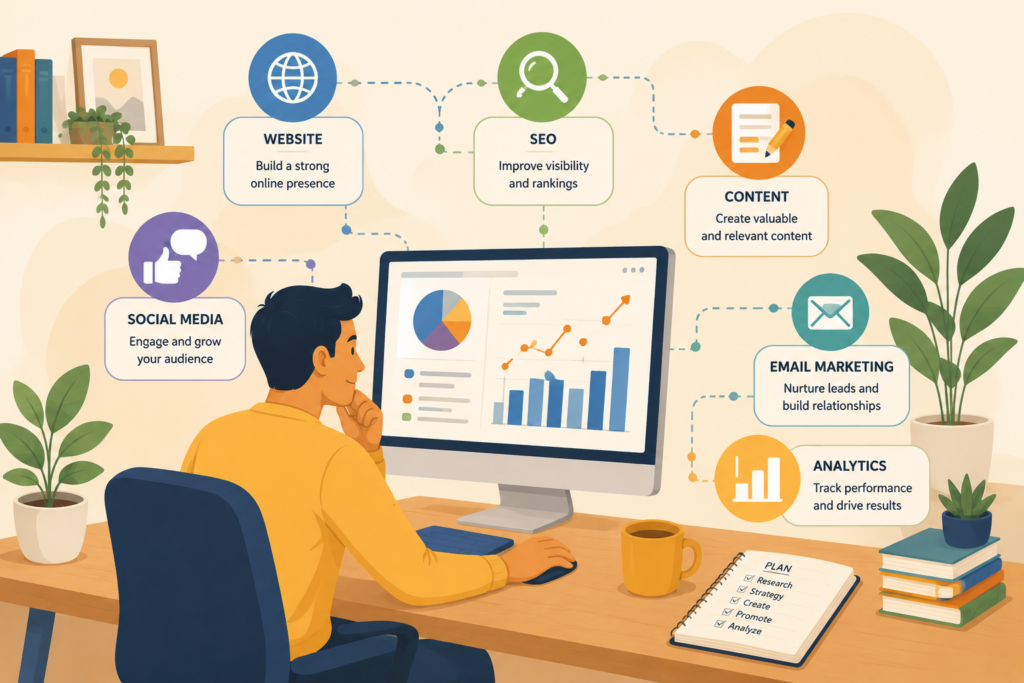
You may need a digital strategy roadmap if:
- Your website, SEO, content, ads, and tracking all feel disconnected
- You have several marketing ideas but no clear order
- Your team or suppliers are working from different assumptions
- You need a 30-day, 90-day, or longer-term action plan
- You want to stop spending on low-impact tasks
- You need clearer ownership, priorities, and measurement
This is where Digital Strategy Roadmaps can help. A roadmap turns the decision process into a structured plan, with priorities, measurable goals, and practical next steps.
If implementation support is also needed, Fractional Digital Team can help turn the strategy into consistent action across your website, SEO, content, and digital marketing tasks.
Common mistakes when choosing digital marketing priorities
A digital marketing decision framework helps avoid these common traps.
Mistake 1: Choosing the channel before the problem
Do not start with “we need TikTok,” “we need ads,” or “we need a blog.” Start with the business goal and the gap.
Mistake 2: Confusing activity with progress
More posts, more campaigns, and more tools do not always mean better results. Progress should connect to leads, sales, bookings, retention, or learning.
Mistake 3: Ignoring the website
Most digital channels eventually point people back to your website. If the website is unclear, slow, or hard to use, other marketing activity becomes less effective.
Mistake 4: Skipping measurement
A good marketing measurement plan helps you learn what is working. Without it, you may repeat work that feels productive but does not produce results.
Mistake 5: Trying to fix everything at once
A practical digital marketing decision framework should reduce overwhelm. Choose the next best move, complete it properly, measure the result, then move to the next priority.
FAQ: digital marketing decision framework
What is a digital marketing decision framework?
A digital marketing decision framework is a simple structure for choosing what digital marketing work to do next. It helps compare options like website fixes, SEO, content, ads, email, and analytics based on business goals, gaps, impact, effort, and measurement.
Why do small businesses need a digital marketing decision framework?
Small businesses often have limited time and budget. A digital marketing decision framework helps them avoid wasting effort on low-impact tasks and focus on work that supports leads, sales, bookings, or retention.
What should I fix first in digital marketing?
Start with the issue closest to the business result. If people cannot find you, visibility may be the priority. If people visit but do not enquire, website conversion may come first. If you cannot see what is working, measurement may need attention first.
Should I focus on SEO or paid ads first?
It depends on the goal, budget, website quality, and tracking setup. SEO for small business is useful for long-term visibility, while paid ads can create faster traffic. Paid ads are usually stronger when the website and measurement setup are already clear.
How does a digital strategy roadmap help?
A digital strategy roadmap turns decisions into a practical action plan. It can show what to do now, what to do next, what to measure, and how website, SEO, content, ads, and analytics should work together.
How VVRapid can help
If your digital marketing feels scattered, a digital marketing decision framework can help you choose the next best move. VVRapid can help turn those decisions into a practical digital strategy roadmap that connects your website, SEO, content, conversion, and measurement.
For a clearer plan, view Digital Strategy Roadmaps or contact VVRapid to discuss what your business should prioritise next.