
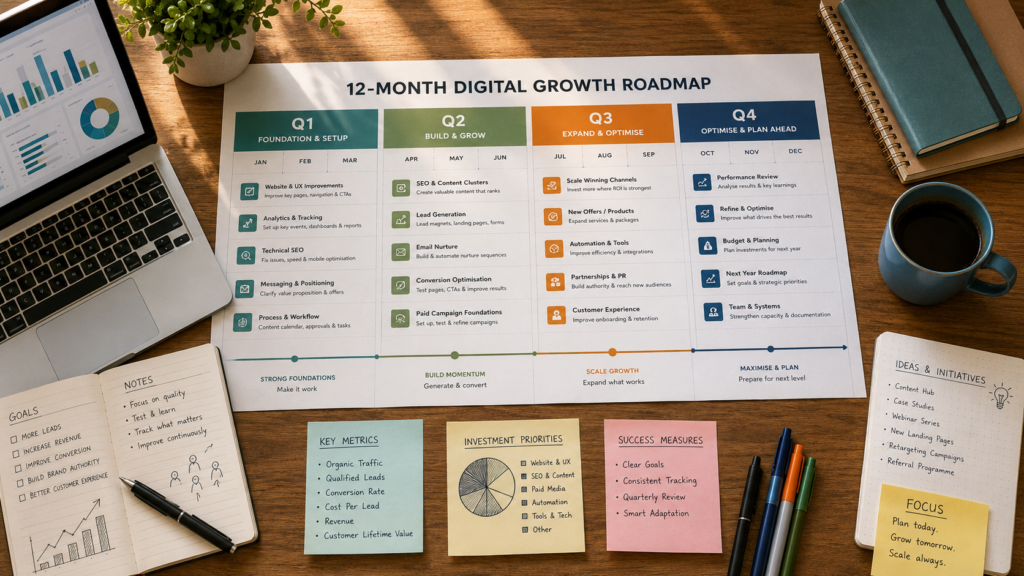
A 12-month digital growth roadmap helps you look beyond the next urgent marketing task and decide how today’s improvements should support the rest of the year. A good 90-day plan gets work moving. A full-year roadmap helps you decide what should come after those first priorities, what depends on them, and where larger investments fit.
Table of Contents
The goal is not to predict every campaign, algorithm change, or business need for the next twelve months. That would create false precision.
Instead, think of an annual roadmap as a direction of travel. You define the outcomes you want, establish the foundations first, sequence larger initiatives, and leave enough flexibility to change course when the evidence changes.
What is a 12-month digital growth roadmap?
A 12-month digital growth roadmap is a structured plan that connects your business goals to digital priorities across a full year.
It can include:
- website improvements
- SEO
- content
- lead generation
- paid acquisition
- customer journeys
- analytics and measurement
- marketing technology
- larger development projects
- quarterly review points
The important word is “roadmap.”
This is not a twelve-month task list where everything is committed in January and followed regardless of what happens.
A useful annual digital strategy separates firm near-term actions from longer-term priorities that may change as results become clearer.
Your first quarter might be detailed down to individual tasks. Quarter four might contain broader objectives such as expanding a successful content cluster or improving customer retention.
That is completely reasonable.
The further away the work is, the more flexibility you should allow.
If you have not yet created the first execution cycle, start with VVRapid’s existing article on building a 90-day Digital Strategy Roadmap before extending it across the year.
Why a 90-day plan and a 12-month digital growth roadmap solve different problems
A 90-day plan asks:
What should we execute next?
A 12-month digital growth roadmap asks:
Where should those next 90 days take us?
That distinction matters.
Short planning cycles are useful because they create focus. You can fix measurement, improve important website pages, publish priority content, or address technical SEO without trying to solve everything simultaneously.
But some digital initiatives need longer horizons.
SEO often develops through repeated technical, content, authority, and optimisation work rather than one isolated task.
A website rebuild might require strategy, content, design, development, testing, and post-launch improvement.
Email automation may depend on first fixing lead capture and CRM processes.
Paid campaigns become easier to evaluate when measurement and landing pages are already working properly.
Your digital growth plan needs to recognise those dependencies.
A 12-month digital growth roadmap gives the short-term work context so that Quarter 1 is not simply a collection of quick wins with no connection to what comes next.
Start with annual business outcomes, not twelve months of marketing tasks
Before dividing the year into quarters, decide what the business is actually trying to improve.
Examples could include:
- increasing qualified enquiries
- growing online sales
- improving lead quality
- expanding into a new market
- generating more revenue from an important service
- reducing dependence on one acquisition channel
- improving customer retention
- creating more predictable lead generation
These are more useful starting points than “post more on social media” or “do SEO.”
Your digital marketing goals should connect digital activity to outcomes the business cares about.
For example:
Business outcome: Increase qualified enquiries for a high-value service.
Possible digital priorities:
- strengthen the service page
- improve relevant search visibility
- publish decision-support content
- improve lead capture
- track qualified enquiries
- test follow-up processes
Now there is a reason for each activity.
That becomes the foundation of the 12-month digital growth roadmap.
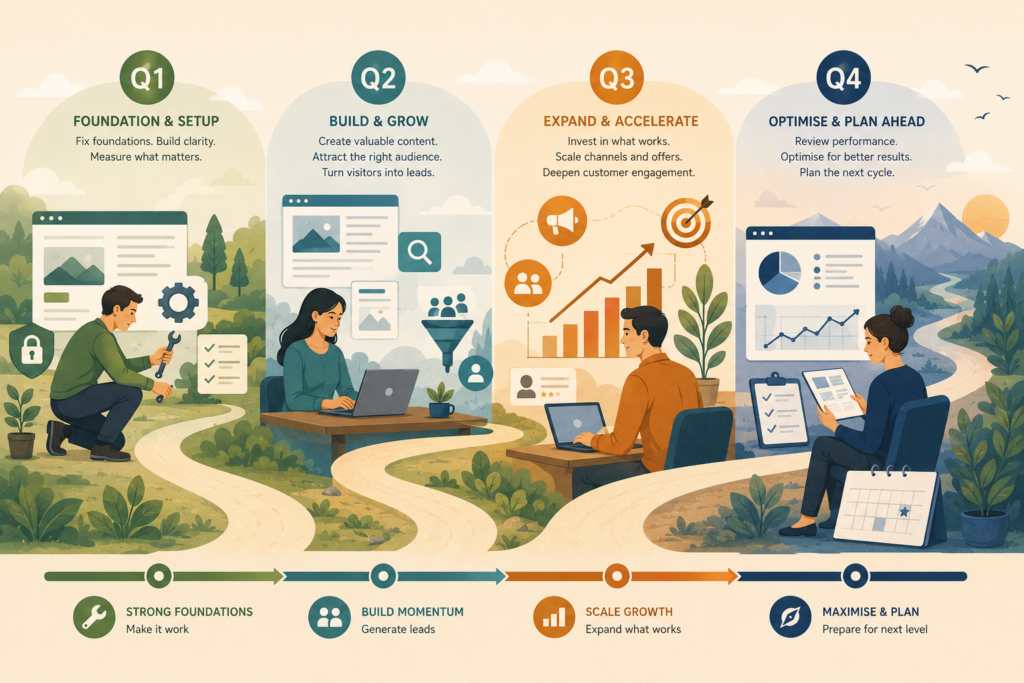
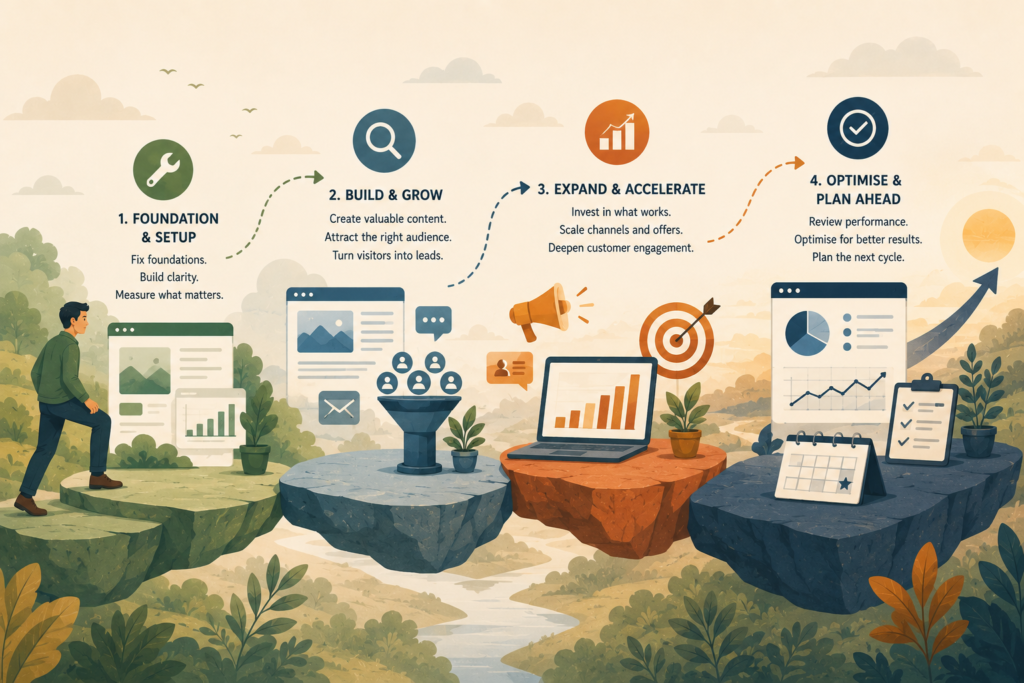
Build the year around four strategic quarters
Quarterly planning provides enough structure to keep work coordinated without pretending you can predict every detail twelve months in advance.
The exact priorities will vary, but this framework works well for many small businesses.
Quarter 1: Fix foundations and establish reliable measurement
The first part of a 12-month digital growth roadmap should usually deal with problems that make everything else less effective.
That might include:
- unclear website messaging
- poor mobile usability
- broken forms
- weak calls to action
- unreliable analytics
- technical SEO problems
- missing service or product pages
- unclear ownership of marketing tasks
- fragmented customer data
Think: before adding more water, fix the leaks.
Establish your baseline
Record where you are starting.
Useful baseline measures might include:
- organic search traffic
- qualified enquiries
- online sales
- conversion rate
- cost per lead
- lead quality
- email subscribers
- repeat customers
- important keyword visibility
Do not measure something simply because a dashboard makes it available.
Google Analytics allows businesses to identify actions that are important to business success as key events. That makes actions such as enquiries, registrations, or other meaningful behaviours more useful than relying on page views alone.: Google Analytics: About key events ↗
Fix strategic blockers first
If your website cannot clearly communicate what you offer, adding more traffic may simply expose more people to the same problem.
If analytics are unreliable, you may struggle to judge later investments.
If important pages cannot be found or indexed properly, content production may underperform.
Quarter 1 should make the next three quarters easier.
Quarter 2: Strengthen acquisition and conversion
Once the foundations are healthier, the 12-month digital growth roadmap can shift towards generating and converting demand more consistently.
This might include:
- improving priority landing pages
- developing SEO content
- building topic clusters
- strengthening internal linking
- improving lead magnets
- creating email nurture
- testing calls to action
- improving enquiry forms
- refining offers and proof
Build around real customer questions
Content planning works better when articles support the decisions prospective customers are already trying to make.
Useful topics often include:
- costs
- comparisons
- alternatives
- mistakes
- processes
- timelines
- suitability
- buying criteria
This supports both discovery and commercial investigation.
Google’s SEO Starter Guide emphasises creating useful content for people while making it understandable and discoverable by search engines.: Google Search Central SEO Starter Guide ↗
If organic search is an important growth channel, this phase can feed into dedicated Search Engine Optimisation work.
Improve conversion alongside traffic
Traffic and conversion should not live on separate roadmaps.
If Quarter 2 brings more people to the website, your marketing roadmap should also consider what happens when those visitors arrive.
Review:
- landing page relevance
- page clarity
- trust signals
- forms
- calls to action
- mobile experience
- customer questions
- follow-up
A stronger acquisition engine is much more valuable when the conversion journey improves at the same time.
Quarter 3: Expand what has earned more investment
By the middle of the year, your 12-month digital growth roadmap should start using evidence from the first two quarters.
This is where annual planning becomes especially useful.
You are not automatically executing everything that appeared on the original January plan.
You are asking what has earned the next round of time and budget.
Scale promising channels
Perhaps organic search is producing better enquiries.
Maybe one service page converts significantly better than the others.
Perhaps a particular email sequence drives repeat purchases.
Or maybe a campaign you expected to perform well has produced very little.
Quarter 3 is a sensible time to concentrate resources around stronger signals.
That can mean:
- expanding successful content themes
- improving high-performing landing pages
- increasing investment in proven campaigns
- adding marketing automation
- developing supporting tools or calculators
- strengthening email sequences
- entering adjacent markets
- building supporting website functionality
This is also where digital investment planning becomes useful.
Larger projects often require more preparation than a quick campaign. If a custom integration, redesigned website section, customer portal, or new application is needed, the work should be placed in the roadmap early enough to account for dependencies.: Website Design & Development
Quarter 4: Optimise, consolidate, and prepare the next year
The final quarter of a 12-month digital growth roadmap is not simply a sprint to finish every unfinished idea.
Use it to consolidate what has worked.
Review:
- which channels generated meaningful outcomes
- which content performed
- which website changes improved behaviour
- whether conversion rates changed
- which projects were delayed and why
- which tools are being used
- which subscriptions or activities can be removed
- where implementation capacity became a bottleneck
Then decide what carries into the next year.
Some initiatives may need another cycle.
Others may have reached the point of diminishing returns.
Some may no longer matter at all.
That is not failure. It is the purpose of a roadmap that adapts to evidence.
How detailed should a 12-month digital growth roadmap be?
A 12-month digital growth roadmap should become less detailed as you move further into the future.
A practical structure might look like this:
Next 30 days
Detailed tasks, owners, deadlines, dependencies, and metrics.
Days 31 to 90
Clear initiatives with approximate delivery windows and ownership.
Quarter 2
Defined objectives and major workstreams.
Quarters 3 and 4
Strategic themes, larger projects, expected dependencies, and decision points.
This keeps the long-term digital strategy useful without locking the business into assumptions that may be outdated six months later.
It also makes the plan easier to review.
Plan dependencies before you plan dates
One of the biggest advantages of a 12-month digital growth roadmap is seeing which activities depend on others.
Imagine the plan includes paid advertising.
Before increasing spend, you might first need:
- reliable conversion tracking
- a stronger landing page
- clearer positioning
- functioning lead follow-up
- an agreed definition of a qualified lead
Or perhaps you want to expand SEO.
You may first need:
- technical issues resolved
- better service page structure
- keyword and intent research
- a publishing workflow
- internal resources for subject-matter input
A calendar tells you when.
Dependencies tell you why that order makes sense.
This is what turns a list of marketing ideas into an actual business growth roadmap.
Budget by strategic theme, not only by channel
A useful 12-month digital growth roadmap should help you anticipate where investment may be needed.
Instead of only thinking:
- SEO budget
- advertising budget
- website budget
- content budget
consider strategic themes such as:
Foundation: analytics, technical fixes, website clarity
Acquisition: SEO, paid media, content, partnerships
Conversion: landing pages, forms, messaging, user experience
Retention: email, customer journeys, automation
Capability: technology, internal skills, external specialists
This helps connect spending to business outcomes rather than treating every channel as an isolated expense.
Pricing varies by scope and region, so annual budget ranges should be treated as planning assumptions and reviewed as the roadmap develops.
Review the roadmap every quarter
A 12-month digital growth roadmap should not sit untouched until the following year.
At the end of each quarter, ask:
- What did we complete?
- What changed?
- What performed better than expected?
- What underperformed?
- Which assumptions were wrong?
- What have we learned about customers?
- Has our capacity changed?
- Are the next priorities still correct?
- Should anything move forward, move back, or disappear?
Then update the next quarter.
Do not rewrite the entire strategy every month.
But do not follow a stale plan simply because it was approved earlier either.
Checklist: what your annual digital growth plan should contain
Before finalising your roadmap, check that it includes:
- One to three meaningful business outcomes
- Baseline performance data
- A detailed first 90 days
- Quarterly strategic priorities
- Website and conversion improvements
- SEO and content priorities where relevant
- Customer journey considerations
- Measurement and key events
- Clear ownership
- Major dependencies
- Larger investment decisions
- Capacity assumptions
- Budget planning by workstream
- Quarterly review dates
- A list of activities you are deliberately not prioritising
That last item matters.
A 12-month digital growth roadmap should make it easier to say no to distracting ideas that do not support current priorities.
Common mistakes with a 12-month digital growth roadmap
Mistake 1: Turning it into a giant task list
More tasks do not automatically make the plan more strategic.
Keep the roadmap focused on outcomes, sequencing, and major initiatives.
Mistake 2: Planning all four quarters at the same level of detail
Quarter 4 cannot be known as accurately as next month.
Keep future work directional until better information becomes available.
Mistake 3: Treating every channel as equally important
Your annual digital strategy should reflect where your customers are, what you can execute well, and what the evidence supports.
Mistake 4: Ignoring dependencies
Do not plan campaigns that depend on pages, tracking, content, systems, or people that do not yet exist.
Mistake 5: Setting goals without measurement
Your 12-month marketing plan needs enough tracking to tell whether activity is creating meaningful progress.
Mistake 6: Refusing to change the roadmap
A roadmap should guide decisions, not prevent better ones.
Mistake 7: Planning beyond your capacity
Five major projects running simultaneously may look ambitious on paper and produce very little in practice.
Match the digital growth plan to the people who actually have to deliver it.
FAQ
Is a 12-month digital growth roadmap better than a 90-day plan?
They serve different purposes. A 90-day plan creates immediate focus and execution. A 12-month digital growth roadmap shows how short-term priorities connect to larger goals, dependencies, investment decisions, and future quarters. Many businesses benefit from using both.
How often should a 12-month roadmap be updated?
Review it formally at least once per quarter. Major business changes may justify an earlier review, but avoid continuously rewriting the plan before initiatives have enough time to produce useful evidence.
Should every marketing channel appear on the roadmap?
No. Include channels that support your audience, goals, and available capacity. Leaving low-priority activities off the roadmap can be as valuable as adding new ones.
How far ahead should digital marketing campaigns be planned?
Near-term campaigns can be planned in detail. Campaigns later in the year are better treated as provisional until performance, budget, market conditions, and capacity are clearer.
Does a small business need a full 12-month digital strategy?
Not always. A business with a narrow immediate challenge may only need a focused 30-day or 90-day plan. A 12-month digital growth roadmap becomes more valuable when multiple projects, channels, suppliers, investments, or dependencies need to be coordinated.
Should website development be included in the digital roadmap?
Yes, when website changes support the wider growth strategy. Larger development work should appear early enough to account for strategy, content, design, technical requirements, testing, and implementation.
How VVRapid can help
VVRapid’s Digital Growth Roadmap is designed for businesses that need to connect immediate digital priorities with longer-term planning.
It can cover website and funnel improvements, SEO, content, channels, measurement, a 90-day execution plan, and a 12-month roadmap.
The aim is to establish the right order of work rather than fill the year with disconnected marketing tasks.
Implementation support can then be handled across relevant website, SEO, content, and digital workstreams.
If your next 90 days are reasonably clear but the rest of the year is still a collection of ideas, reviewing VVRapid’s Digital Strategy Roadmaps service can help you decide whether a deeper annual planning exercise makes sense.