

Website content writing for small business is often treated like a nice-to-have, but for most small businesses it is one of the first things that shapes whether a visitor trusts you, understands your offer, and decides to contact you. Before you worry about publishing weekly articles or posting on every platform, it helps to get the core pages of your website doing their job.
Table of Contents
A small business website does not need dozens of pages to work well. It needs the right pages, written clearly, arranged in the right order, and built around what a real buyer wants to know first. Google’s own SEO guidance says websites should be created with users in mind, with search engines as one of those users, not the other way around.
Why website content writing for small business matters early
A lot of small businesses launch with a homepage, a logo, a contact form, and not much else. Then the owner wonders why traffic does not convert, why enquiries are vague, or why people keep asking questions that should already be answered on the site.
That is where website content writing for small business makes a real difference.
Good website content helps people answer basic questions quickly:
- What do you do?
- Who is it for?
- Why should they trust you?
- What should they do next?
This is not just an SEO issue. It is a clarity issue. Nielsen Norman Group has long found that web users prefer content that is concise, easy to scan, and objective rather than overly promotional.
Think: if a visitor lands on your site and still cannot explain your offer in one sentence, the problem is usually not traffic. It is messaging.
The 5 pages most small businesses should prioritise first
When people talk about website content writing for small business, they often jump straight to blogs. Blogs can help, but they work better once the core website pages are already in place.
The five pages below give most small businesses a practical foundation.
1. Homepage
Your homepage is not supposed to say everything. It is supposed to do three things well:
- tell visitors what you do
- show who you help
- guide them to the next page or action
A useful homepage usually includes:
- a clear headline
- a short supporting intro
- key services or categories
- trust signals
- a primary call to action
- links to deeper pages
The U.S. Small Business Administration also highlights the homepage as one of the essential pages a small business site should include.
A weak homepage often sounds like this:
“Welcome to our website. We are passionate about excellence and customer satisfaction.”
That sounds pleasant, but it does not tell a buyer enough.
A stronger version sounds more like this:
“We help small businesses improve their websites, SEO, and content so more of the right visitors become enquiries.”
Clear beats clever.
2. Services page or service pages
This is where many businesses lose leads.
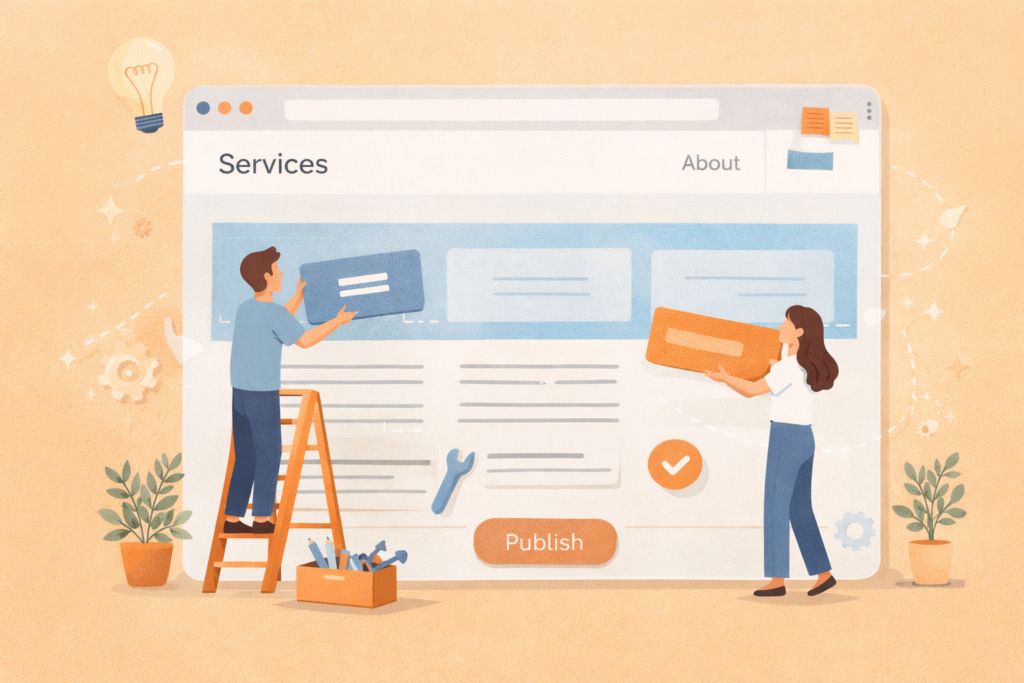
A services page should explain:
- what the service is
- who it is for
- the problem it solves
- what the process looks like
- what happens next
If you offer multiple services, you may need a main services overview page plus individual pages for each offer. This gives you more room for clarity and better SEO targeting.
For example, if your business also needs help with structure and design, a related page like Website Design & Development should sit naturally alongside content-focused pages.
3. About page
People do business with businesses, but they trust people.
Your About page does not need to tell your life story. It should answer a simpler question: why should someone feel confident buying from you?
A good About page often includes:
- who you are
- who you help
- your approach
- relevant experience
- what makes your process practical or different
- a next step
For small service businesses, the About page is often one of the most visited pages after the homepage.
4. Contact page
Your Contact page should reduce friction, not create it.
That means:
- clear contact options
- a simple form
- expected response times if appropriate
- location or service area where relevant
- key pre-sales information
For a South African business, this can also help local buyers feel reassured that they are dealing with a real, reachable company.
5. Key trust-building page
This page may differ by business. It could be:
- a testimonials page
- a case studies page
- an FAQ page
- a pricing guide
- a process page
Not every business needs all of these immediately. Most do need at least one page that reduces uncertainty.
If your prospects tend to ask the same questions before buying, an FAQ or process page can do a lot of heavy lifting.
What to write before you start blogging
This is where website content writing for small business often gets more strategic.
Before you invest in ongoing blog publishing, make sure these basics exist:
Your message hierarchy
Your website should make sense in this order:
- What you do
- Who it is for
- Why it matters
- Why trust you
- What to do next
If that order is missing, blogging may bring visitors to a website that still does not convert well.
Your core service language
Use the words your customers actually use, not only your internal terms.
Google’s people-first content guidance emphasises helpful, reliable content built to benefit people. Their guidance on AI-assisted content also says metadata like titles, descriptions, and alt text should focus on accuracy, quality, and relevance.
That matters for service pages too. If people search “website copy for small business” but your page only talks about “digital messaging ecosystems,” you are making the buyer work too hard.
Your next-step calls to action
Not every visitor is ready to buy today. Good calls to action match different stages:
- Contact us
- Request a quote
- View our services
- See how we work
- Read related articles
A service-led site can connect naturally to supporting content. For example, Search Engine Optimisation and Socials, Blog & Article Writing Services can support a visitor who wants either visibility help or content help.
A simple checklist for your first website pages
Use this checklist before publishing or rewriting your website.
Website content writing for small business checklist
- □ Does the homepage clearly say what you do in plain language?
- □ Does each main service have its own space to be explained properly?
- □ Does the About page build trust without rambling?
- □ Is the Contact page easy to use on mobile?
- □ Does every important page have one clear next step?
- □ Are headings specific rather than generic?
- □ Are pages written for scanning, not dense reading?
- □ Have you removed filler phrases and vague claims?
- □ Have you answered the top 5 buyer questions somewhere on the site?
- □ Are internal links helping people move to the next useful page?
How long should each page be?
There is no perfect word count.
Some pages need 300 useful words. Others need 900. What matters more is whether the page answers the searcher’s intent and supports a decision.
Google’s SEO starter guidance frames SEO as helping search engines understand content and helping users decide whether they should visit your site.
That means the right question is not “How many words should this page have?”
It is “Did this page answer the real question clearly enough?”
As a rough guide:
- Homepage: concise, high-clarity
- Service pages: enough detail to explain outcomes, process, and fit
- About page: focused trust-building
- Contact page: minimal friction
- FAQ or process page: practical and specific
Common mistakes
A lot of weak sites have the same content problems. Here are the most common ones.
Writing for yourself, not the buyer
Business owners know too much about their own offer. That can make pages too technical, too broad, or too assumption-heavy.
Trying to sound impressive instead of clear
Big claims and vague adjectives usually weaken trust.
Examples:
- innovative solutions
- world-class service
- unmatched quality
- cutting-edge excellence
These phrases rarely help a buyer choose.
Hiding service details
If someone has to email you just to understand what you actually offer, the page is underwritten.
Making every page say the same thing
Your homepage, About page, and services page should work together, not repeat each other word for word.
Forgetting internal links
Internal links help both people and search engines move through your site. They also support next-step intent. For example, after reading this post, a reader might naturally want Digital Strategy Roadmaps if they need help prioritising what to fix first.
Publishing blog posts before fixing core pages
A blog can attract attention. It cannot compensate for confusing service pages forever.
When to rewrite and when to start fresh
Not every website needs a total rewrite.
You may only need a rewrite if:
- your offer has changed
- your audience has changed
- pages no longer reflect how you sell
- your traffic is decent but conversions are weak
- the content feels generic or dated
You may only need editing if:
- the structure is mostly fine
- messaging is clear but too wordy
- headings need tightening
- calls to action are weak
- service detail is present but buried
For some businesses, the best step is not “more content.” It is a content clean-up.
If the website itself also needs structural improvement, pairing content with Website Maintenance & Care or a broader build review can make more sense than rewriting in isolation.
What this looks like in practice
Here is a practical order for website content writing for small business if you are starting from scratch.
Phase 1: Clarify the basics
- define your top services
- identify your ideal customers
- list the questions buyers ask most often
- choose your primary conversion goal
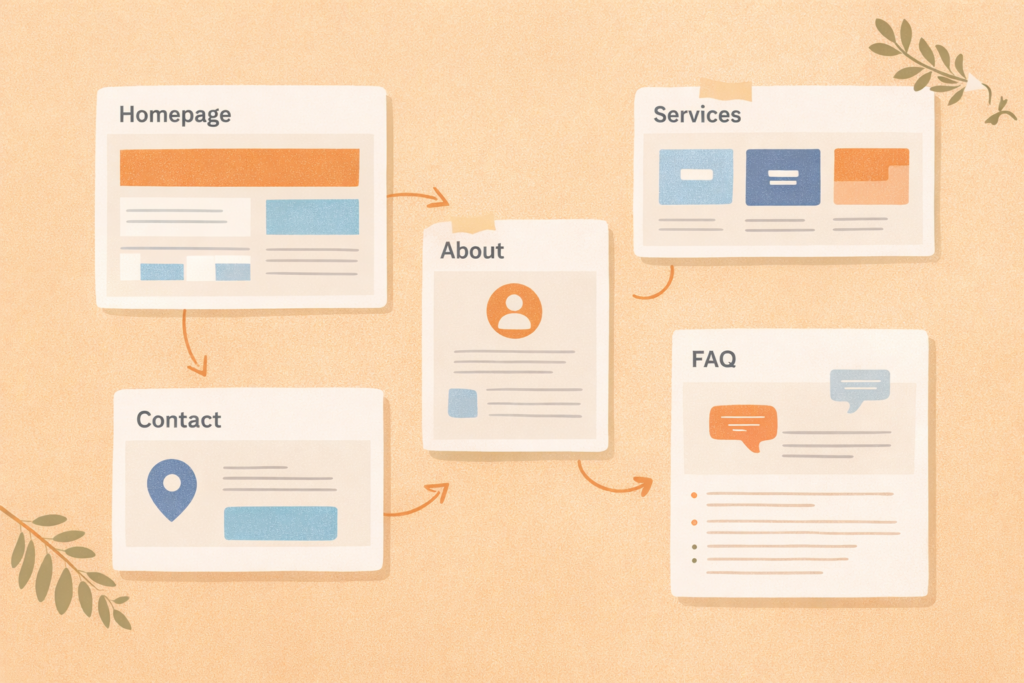
Phase 2: Build the core pages
- homepage
- main services page
- individual service pages if needed
- About page
- Contact page
- one trust-building page
Phase 3: Improve search and support content
- on-page SEO basics
- internal linking
- FAQs
- blog content based on real buyer questions
That is also where a coordinated approach can help. A business may need content, SEO, and design to work together rather than as separate tasks. That is where services like Fractional Digital Team can make sense for growing businesses that need joined-up execution.
How VVRapid can help
VVRapid can help small businesses plan, write, and improve the pages that matter first, without turning the site into a wall of text. That may include homepage messaging, service page content, SEO alignment, supporting blog articles, and content structure that fits the wider website.
The goal is not to add more words for the sake of it.
It is to make the website clearer, more useful, and easier to act on.
You can explore the Socials, Blog & Article Writing Services page if you want help with website content, blog support, or ongoing written content that fits your business goals.
FAQ
What is website content writing for small business?
It is the planning and writing of core website pages so a small business can explain its offer clearly, build trust, and guide visitors towards an enquiry or sale.
Which pages should a small business website have first?
Most small businesses should start with a homepage, services page or service pages, About page, Contact page, and one trust-building page such as FAQs, testimonials, or process information.
Should I blog before fixing my main pages?
Usually not. Core pages should be clear first. Blog posts work better when the rest of the site already supports trust and conversion.
How often should website content be updated?
Review it whenever services, offers, pricing structure, positioning, or customer questions change. A light review every few months is sensible for many businesses.
Does website content writing help SEO?
Yes, when the content is useful, clear, well-structured, and aligned with what users are actually searching for. Google’s guidance consistently stresses people-first, helpful content.
A good next step is to review your current homepage and services page and ask a simple question: would a first-time visitor understand what you do within 10 seconds? If not, start there. Then visit VVRapid’s website content writing for small business service page or get in touch for support with the pages that matter most.: Contact VVRapid