

A lead generation audit for small business helps you find the points where potential customers lose interest, get confused, or fail to take action. If your website gets visitors but enquiries are slow, the problem may not be your marketing volume. It may be the path from first visit to contact.
Table of Contents
A practical lead generation audit for small business looks at the full journey. That includes traffic sources, landing pages, messaging, trust signals, calls to action, enquiry forms, follow-up, and tracking. It is more focused than a general marketing audit for small business because the goal is simple: find what is blocking leads.
For many small business owners, this is the missing step before spending more on SEO, ads, content, or social media. More traffic will not help much if the lead journey is unclear, slow, or hard to measure.
Why a lead generation audit for small business matters
A lead generation audit for small business matters because most websites do not lose leads in one obvious place. They lose them through small points of friction.
A visitor might arrive from Google, read half a page, feel unsure, fail to find proof, skip the contact button, open the form, decide it asks for too much, and leave. From the outside, it looks like “the website is not working.” In reality, several small blockers are working together.
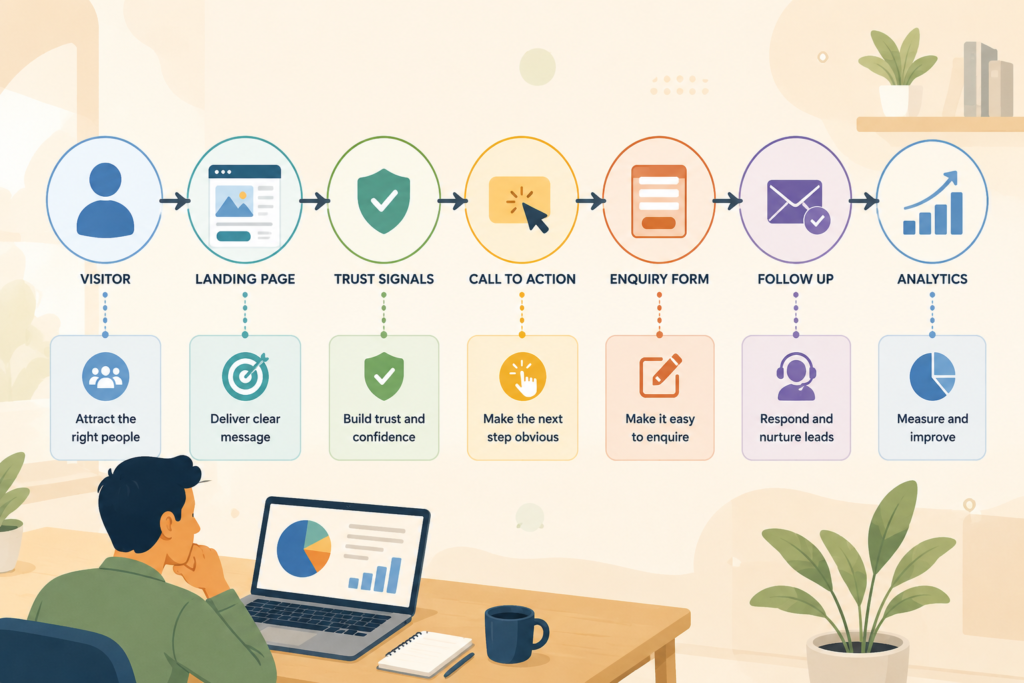
A lead generation audit helps answer questions like:
- Are the right people reaching the website?
- Do key pages explain the offer clearly?
- Is the call to action obvious?
- Does the website build enough trust?
- Is the enquiry form easy to complete?
- Are leads followed up quickly?
- Is tracking showing where enquiries come from?
This is where a lead generation audit for small business becomes more useful than guessing. It gives you a structured way to find the weak points before investing more budget.
How a lead generation audit is different from a marketing audit
A marketing audit for small business usually looks across a wide set of activities. It may review SEO, content, paid ads, social media, website performance, email, analytics, and competitor activity.
A lead generation audit for small business is narrower. It asks one main question: what is stopping people from becoming enquiries?
That means the audit is more focused on:
- Lead quality
- Landing page clarity
- Website conversion optimisation
- Contact forms
- Calls to action
- Trust signals
- Follow-up process
- Lead tracking
- Conversion rate improvement
Both audits are useful, but they solve different problems. A broad audit helps you understand your overall digital marketing. A lead generation audit helps you find the blockers between visitor interest and enquiry.
If your business needs a wider plan that connects website, SEO, content, conversion, and measurement, Digital Strategy Roadmaps is the better fit.
Step 1: Check whether you have the right traffic
The first step in a lead generation audit for small business is checking whether the right visitors are reaching your website.
Not all traffic is useful. A website can have decent visitor numbers and still generate poor leads if those visitors are not the right fit.
Ask:
- Which channels bring visitors to the website?
- Which channels bring enquiries?
- Are visitors landing on relevant service pages?
- Are people searching with buying intent or just browsing?
- Are your pages targeting the right keywords?
If search visibility is weak, SEO for small business may need attention. A strong SEO strategy should connect search intent with useful landing pages and clear next steps.
For this stage, Search Engine Optimisation is a natural internal link. For general search guidance, Google SEO Starter Guide ↗ is useful.
Traffic is the top of the funnel, but it is not the whole answer. A lead generation audit for small business should look beyond visitor numbers and ask whether those visitors have a clear path to action.
Step 2: Review your landing pages
The next part of a lead generation audit for small business is landing page clarity.
A landing page does not need to be fancy, but it does need to answer the right questions quickly.
A strong lead generation website should explain:
- What you do
- Who you help
- What problem you solve
- Why someone should trust you
- What the next step is
- What happens after they enquire
Weak landing pages often sound too general. They may use broad claims like “quality solutions” or “professional service” without showing the specific value.
During your audit, review your key pages and ask:
- Is the headline specific?
- Is the offer clear above the fold?
- Does the page match the visitor’s intent?
- Is the page easy to scan?
- Are benefits explained clearly?
- Is there proof or reassurance?
- Is the next step visible without effort?
If the website structure or page design is part of the problem, Website Design & Development can support this stage.
Step 3: Identify trust gaps
Trust is one of the most common blockers in a lead generation audit for small business.
People rarely enquire just because a website exists. They need enough confidence to take the next step.
Trust signals may include:
- Clear service descriptions
- Case studies or project examples
- Reviews or testimonials
- Team or company information
- Clear process steps
- FAQs
- Guarantees, where accurate
- Security and privacy reassurance
- Professional design and working links
- Consistent branding
A lead generation website must reduce uncertainty. If a visitor has unanswered questions, they may leave rather than contact you.
In service businesses, trust gaps often appear when the website assumes people already understand the service. In reality, many visitors need reassurance before they enquire.
A lead generation audit for small business should list the missing trust signals on each important page. Then you can prioritise the ones closest to conversion.
Step 4: Check calls to action
A call to action tells the visitor what to do next. In a lead generation audit for small business, this is one of the most important areas to review.
Common call-to-action problems include:
- Buttons are too hard to find
- The wording is vague
- There are too many competing actions
- The same page asks for too many decisions
- Contact details are buried
- Mobile users have to scroll too far
- The next step feels too big or unclear
A good call to action should be obvious, relevant, and low-friction.
Examples include:
- Request a quote
- Book a consultation
- Send an enquiry
- Ask a question
- Get a strategy quote
- Schedule a call
The best call to action depends on the business and the level of buyer intent. A visitor who is ready to buy may want a quote. A visitor comparing options may prefer a consultation or question form.
A lead generation audit for small business should check whether every key page has a clear next step.
Step 5: Test enquiry forms and contact paths
Many businesses lose leads at the form stage.
A form may look fine, but small issues can reduce submissions. It might ask for too much information, feel too formal, break on mobile, or fail to send notifications properly.
During a lead generation audit for small business, test every contact path:
- Contact form
- Quote form
- Booking link
- Click-to-call button
- Email link
- Chat widget
- Checkout enquiry path
- Newsletter or lead magnet form
Check:
- Does the form work?
- Is it easy to complete on mobile?
- Are required fields reasonable?
- Does the confirmation message make sense?
- Does the business receive the enquiry?
- Is there an automated reply?
- Is the lead stored somewhere useful?
- Is the source tracked?
This stage is where conversion rate improvement can happen quickly. Sometimes one small form change can improve enquiry volume without increasing traffic.
Step 6: Review lead follow-up
A lead generation audit for small business should not stop at the form submission. Lead generation is only useful if the enquiry is handled well.
Many small businesses lose opportunities because follow-up is slow, inconsistent, or unclear.
Review:
- How quickly are enquiries answered?
- Who is responsible for responding?
- Is there a standard reply process?
- Are leads tracked in a CRM or spreadsheet?
- Are follow-up reminders used?
- Are unready leads nurtured with email?
- Are missed calls returned quickly?
A strong follow-up process turns more enquiries into sales conversations. A weak process makes marketing look worse than it really is.
This is why a lead generation audit for small business should connect marketing and operations. The website can generate the lead, but the business still needs a reliable way to handle it.
Step 7: Check tracking and measurement
A lead generation audit for small business should include a marketing measurement plan.
If tracking is weak, you may not know which pages, channels, or campaigns are creating enquiries. That makes it harder to improve.
At minimum, review whether you can see:
- Website traffic sources
- Top landing pages
- Form submissions
- Click-to-call actions
- Email link clicks
- Booking clicks
- Search queries
- Conversion paths
- Campaign performance
Google Analytics and Google Search Console can help with this when set up correctly. For setup and reporting guidance, use Google Analytics Help, Set up Analytics for a website ↗ and Google Search Console Help, Performance report ↗.
Tracking does not need to be complicated at the start. It just needs to be clear enough to support better decisions.
A good lead generation audit for small business should end with a list of what to measure after changes are made.
Lead generation audit checklist
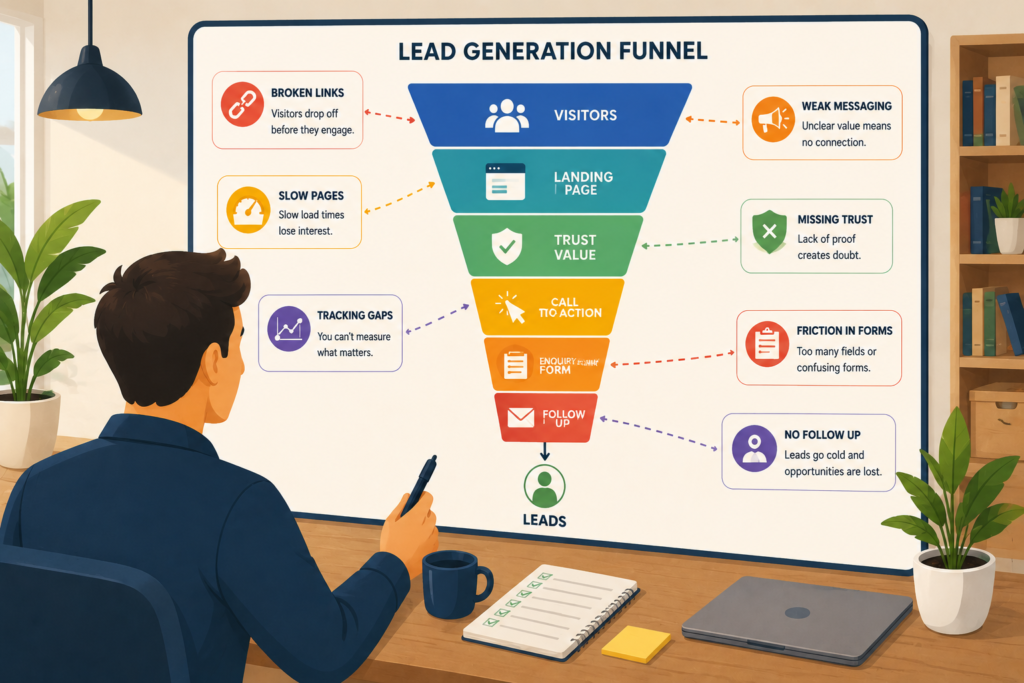
Use this quick checklist to review your own website.
- □ Are the right people finding the website?
- □ Are key service pages easy to find?
- □ Does each page explain the offer clearly?
- □ Is the call to action visible?
- □ Is the website easy to use on mobile?
- □ Are trust signals strong enough?
- □ Are forms short and functional?
- □ Are leads followed up quickly?
- □ Is enquiry tracking working?
- □ Do you know which channels create leads?
- □ Are content pages supporting service pages?
- □ Are old pages creating confusion?
- □ Is the website conversion path simple?
This lead generation audit for small business checklist gives you a starting point. The next step is turning the findings into priorities.
How to prioritise audit findings
A lead generation audit for small business should not end with a long list of problems and no action plan. The value comes from prioritising what matters most.
Split findings into three groups.
Fix now
These are issues directly blocking enquiries:
- Broken forms
- Missing contact options
- Unclear service pages
- Poor mobile usability
- Weak calls to action
- No tracking on key enquiries
Fix next
These support better conversion:
- Add FAQs
- Improve trust signals
- Strengthen landing page copy
- Improve internal links
- Add case studies or examples
- Improve page speed
Fix later
These are useful, but less urgent:
- Cosmetic design refinements
- New content ideas with low commercial intent
- Extra tools before basics are fixed
- New channels before tracking works
This prioritisation process is where a digital strategy roadmap can help. It turns audit findings into a practical order of work, with owners, timelines, and measurable next steps.
When to get help with a lead generation audit
You can run a simple lead generation audit for small business yourself, especially if you have access to analytics, your website, and your enquiry process.
Outside help is useful when:
- You are too close to the business to see the gaps
- Traffic and enquiries do not line up
- Leads come in, but quality is poor
- You are spending on marketing without clear results
- Website, SEO, content, and tracking all feel disconnected
- You need an implementation plan, not just a list of problems
If the audit reveals work across several areas, Fractional Digital Team can help with ongoing execution. If content is part of the issue, Socials, Blog & Article Writing Services can support stronger pages, articles, and trust-building content.
FAQ: lead generation audit for small business
What is a lead generation audit for small business?
A lead generation audit for small business is a review of the full path from visitor to enquiry. It checks traffic quality, landing pages, calls to action, forms, follow-up, and tracking.
How is it different from a marketing audit for small business?
A marketing audit for small business usually reviews the wider marketing ecosystem. A lead generation audit focuses specifically on what is stopping visitors from becoming enquiries.
When should I run a lead generation audit?
Run a lead generation audit for small business before increasing marketing spend, especially if your website gets traffic but does not produce enough enquiries.
Can a lead generation audit improve conversion rates?
Yes. It can support conversion rate improvement by finding friction in page messaging, trust signals, calls to action, forms, and follow-up.
What should I fix first after a lead generation audit?
Fix anything that directly blocks enquiries first. That includes broken forms, unclear service pages, weak calls to action, poor mobile experience, and missing tracking.
How VVRapid can help
If you are getting website visits but not enough enquiries, a lead generation audit for small business can help you find what is blocking results. VVRapid can review your website, SEO, content, conversion path, tracking, and follow-up process, then turn the findings into a practical digital strategy roadmap.
For a clearer plan, view Digital Strategy Roadmaps or contact VVRapid to discuss what is stopping your website from generating better leads.